




The Real History of the Balisong: How Butterfly Knives Evolved Through Time
November 14th, 2025
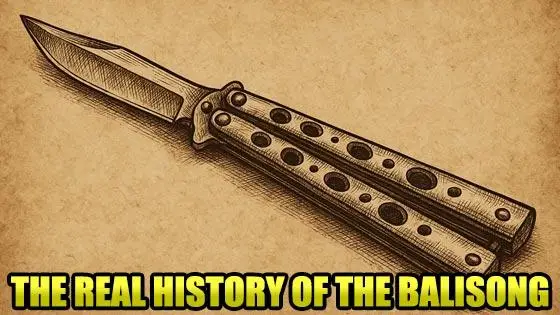
The balisong has one of the most misunderstood histories of any knife. Most people picture movie assassins snapping open a butterfly knife with dramatic flair, but the real story goes far deeper than Hollywood has ever shown. The modern balisong traces its roots to generations of Filipino craftsmen who shaped steel by hand long before the knife became a global icon. Its evolution spans practical farm work, martial arts traditions, wartime influence, and eventually the flipping culture that exploded on YouTube. Understanding where the balisong truly came from gives you a completely different appreciation for the knife you hold in your hand today, and it shows how a simple folding blade grew into one of the most recognizable tools in the world.
The Roots of the Balisong in Filipino Craftsmanship
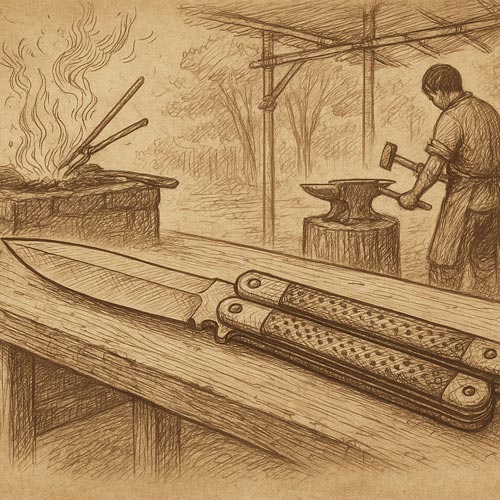
The real history of the balisong begins in the Philippines, not as a weapon, but as a product of a tight-knit blacksmithing culture that shaped everyday life in Batangas. In the small barangays of Balisong and Pandayan, the panday, or village blacksmith, held a respected role that went far beyond making tools. Generations of families built their entire identity around metalwork, passing down techniques that were never written in books. A young apprentice often learned to recognize proper forging heat by the color of the steel instead of relying on thermometers, and he developed skill through muscle memory rather than precise diagrams. Every detail was done by hand, from shaping the blade to drilling the bolsters, which meant no two early balisongs were exactly the same. Some collectors can still identify which family forged a knife simply by the way the spine was ground or the subtle taper of the brass bolsters.
In these rural communities, steel was valuable and nothing went to waste. Early balisongs were forged from recycled car leaf springs, scrap machete blades, and old American files, all of which took a keen eye to repurpose properly. A well-made balisong needed to survive humid weather, farm work, and daily chores, so durability mattered far more than aesthetics. Farmers carried them to cut rope, process food, open sacks, harvest small plants, or perform quick fixes around the field. The quick-folding design made it safer to carry than an open blade, and the solid hand-pinned construction meant it could take years of use without ever needing modern adjustments.
What made the Batangas balisong unique was not just its practicality, but the pride behind it. Families guarded their forging secrets, from heat-treating methods to the exact pivot geometry that made their knives open smoothly. What started as a functional utility tool slowly became a regional symbol, and by the early 1900s, the Batangas balisong had already taken on a reputation for being the strongest, most reliable folding blade in the islands. The knife's evolution from a rural work tool into a cultural icon was already underway long before the outside world knew it existed.
The Debate Over the Balisong's True Origins
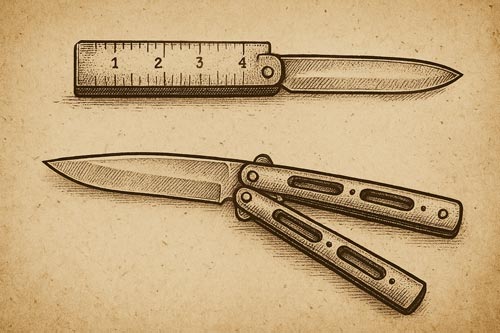
As much as the balisong is tied to Filipino identity, its origin story has sparked debate among historians and knife collectors for decades. The most common argument centers around a French tool from the late 1600s known as the Pied du Roi, a folding ruler that concealed a blade inside a two-part handle. Some people point to this tool as the earliest version of a butterfly knife, mainly because it also featured a split handle that folded around a central blade. At first glance, the resemblance is close enough to create confusion, but once you look deeper, it becomes clear that the Pied du Roi served a completely different purpose. It was a measuring instrument that happened to include a small blade, not a practical cutting tool designed for daily work or fast deployment. Its mechanism was more delicate, its construction was more complex, and it lacked the simple, rugged efficiency that defines the Filipino balisong.
The stronger argument is that the balisong we know today evolved independently in Batangas, shaped by the needs and traditions of local craftsmen rather than borrowed European designs. The earliest Filipino balisongs were built for utility in a tropical environment, which required a dependable folding blade that could be opened quickly with one hand. The design was simple, durable, and easy to maintain, which is why it caught on so quickly across rural communities. Even if folding blades existed elsewhere in the world, the Batangas model had a unique construction that set it apart from any known European version. Many Filipino families have traced their balisong craftsmanship back more than a century through oral history, techniques passed hand to hand, and regional styles that developed without any outside influence.
What makes the origin debate interesting is that it highlights how different cultures often create similar tools for different needs. But when you compare purpose, practicality, and cultural significance, the Filipino balisong stands in a category of its own. The Pied du Roi may have been an early mechanical curiosity, but the Batangas balisong became a working tool, a local craft tradition, and eventually a worldwide icon. Its simplicity, speed, and reliability cemented its identity far beyond anything a European folding ruler ever inspired.
The Balisong in Filipino Martial Arts and Everyday Life
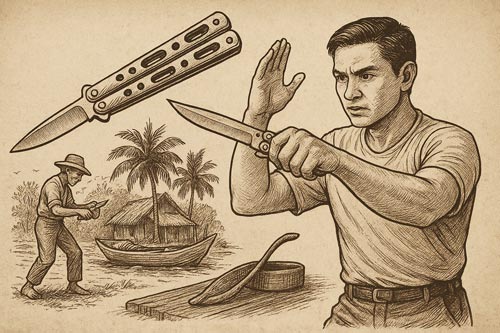
As the balisong spread throughout Batangas and neighboring provinces, it naturally became tied to Filipino martial arts, but not in the exaggerated way movies like to portray. In reality, the knife grew into a familiar part of daily life long before it appeared in any fighting system. Farmers carried one to cut twine, fishermen used it to clean their catch, and laborers kept it handy for quick repairs. Its folding design made it safer to keep in a pocket than an open blade, and the ability to deploy it with one hand turned it into a practical tool rather than a dramatic weapon. Over time, however, its speed and simplicity caught the attention of practitioners of eskrima, arnis, and kali, who recognized the balisong as a natural extension of the short-blade techniques already present in Filipino combat traditions.
In training halls across the islands, the balisong was not treated as a flashy accessory but as a working blade that fit neatly into the principles of timing, positioning, and awareness. It was used to demonstrate how a folding knife changes the dynamics of footwork and distance, and how the deployment sequence affects both offense and defense. Unlike the choreographed openings that became popular decades later, traditional use focused on minimal movement and practical intent. The goal was not to show off, but to use the tool efficiently if the situation demanded it. This practical mindset helped shape the knife's identity in Filipino culture. It was not defined by acrobatics or cinematic flair but by reliability and the everyday experience of people who depended on a durable knife that could be opened quickly when work needed to be done.
Despite this practical foundation, the balisong still carried symbolic weight. In rural communities, a well-made Batangas balisong was often given as a gift or passed down between generations. Many families still keep old handmade pieces as heirlooms, recognizing the blade not just as a tool, but as a part of local history. This blend of utility, craftsmanship, and cultural significance helped the balisong become more than a folding knife. It became a regional emblem of skill, resourcefulness, and identity, setting the stage for its transformation into an international icon once the outside world finally discovered it.
How the Balisong Reached the United States and Gained Worldwide Attention
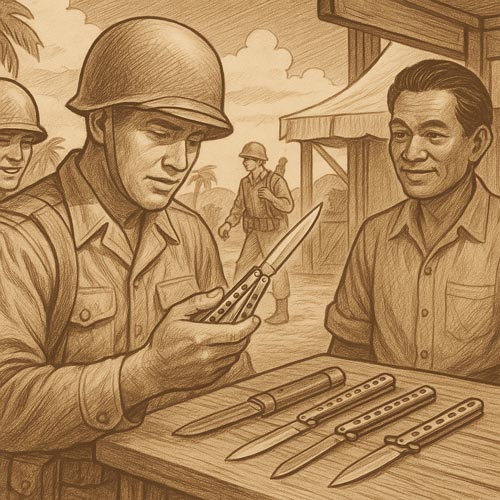
The balisong might have stayed a regional Filipino tool if not for a major turning point in the mid twentieth century. During World War II, American servicemen stationed in the Pacific Islands encountered local craftsmanship they had never seen before. Many soldiers bought handmade Batangas balisongs as souvenirs, drawn to the knife's unusual two handle design and the smooth, satisfying way it opened. These knives made their way into duffel bags and footlockers, eventually landing in the United States when soldiers returned home. What had started as a practical farm knife in rural Batangas suddenly found itself in American garages, toolboxes, and display cases, often without its new owners fully understanding its cultural origins.
The growing interest continued into the 1960s and 1970s as martial arts films became more popular. The balisong appeared on screen in the hands of heroes and villains alike, usually shown with dramatic spinning motions that looked nothing like its traditional use. Hollywood exaggerated the knife for style, but the exposure had a real effect. Knife enthusiasts became curious about the unusual folding mechanism and began searching for ways to buy one. Importers brought more Filipino made balisongs into the country, and American knife makers soon took notice. By the late 1970s, companies started experimenting with their own designs, trying to blend the charm of the handmade Batangas balisong with modern materials and machining.
The real explosion of interest happened in the 1980s when American companies began producing higher precision balisongs with tighter tolerances and more consistent performance. Benchmade, one of the most influential brands in the knife industry, built its early reputation on butterfly knives during this period. Their use of stainless steel handles, improved pivot hardware, and reliable latch systems introduced the balisong to a much wider audience. Unlike the handmade Filipino versions, which each had their own personality, these American made models were consistent and predictable, making them perfect for both collectors and new users who wanted to practice opening techniques.
By the time the 1990s arrived, the balisong had become a recognizable knife in the United States, supported by collectors, martial artists, and Hollywood influence. Laws in some states tightened because the knife was often misunderstood, but the interest never faded. Instead, it evolved. The balisong community grew, manufacturers experimented with new materials, and the knife transitioned from a simple utility blade to a modern flipping tool appreciated for its engineering and motion. The combination of wartime spread, American manufacturing, and pop culture attention turned the balisong from a regional craft into a worldwide phenomenon.
The Rise of Modern Flipping Culture and the YouTube Explosion
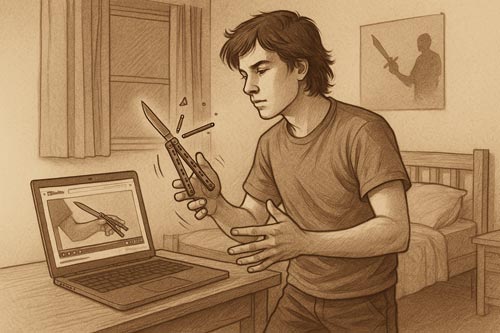
By the early 2000s, the balisong had already secured a place among knife enthusiasts, but its popularity was about to shift in a completely new direction. As the internet grew and YouTube became a platform for sharing skills, a small group of early flippers began uploading videos that showcased smooth openings, aerials, rollovers, and combinations that had never been widely seen before. These videos changed the identity of the balisong almost overnight. What had once been a practical cutting tool and a collectible suddenly became the centerpiece of a skill based hobby that felt more like a mix between martial arts and freestyle flow arts. Viewers were amazed by the speed and fluidity of the movements, and the idea of learning to flip a butterfly knife became exciting instead of intimidating.
Creators such as early flipping pioneers gained loyal followings, often filming in bedrooms, garages, or backyards with nothing more than a basic trainer and a cheap camera. What drew people in was not just the tricks, but the sense of community. Flippers traded advice, broke down techniques frame by frame, and shared their progress with others learning alongside them. Tutorials made it possible for complete beginners to master moves that previously required hands-on teaching. As more people started flipping, companies responded by making purpose built trainers that matched the weight and balance of live blades but allowed new flippers to practice safely. This shift was crucial because it removed most of the risk that had kept people away from trying the hobby in earlier decades.
The flipping scene grew even larger when modern CNC machining allowed makers to produce balisongs with better tolerances, smoother pivots, and consistent balance. For the first time, knives were being designed not just for cutting, but specifically for flipping. Channel construction, bushing systems, precision bearings, and improved handle geometry created a new generation of balisongs that felt dramatically different from the earlier Filipino or American made versions. Flippers could now perform faster combinations, more aerials, and longer sessions with fewer drops or mechanical issues. The balisong had officially entered a new era, fueled by social media, engineering advancements, and thousands of enthusiasts practicing daily.
By the late 2010s, the flipping community had gone global. Instagram clips, slow motion breakdowns, competition style routines, and maker showcases turned the hobby into a constantly evolving art form. Even people who never intended to carry a balisong became invested in the flipping culture, appreciating the knife as a skill based tool rather than a weapon. What started as handmade farm equipment in Batangas and later became a collectible in the United States had fully transformed into one of the most unique flow hobbies in the world. The energy of the flipping community continues to influence modern balisong design, inspiring makers to push boundaries and create knives that move smoothly enough to match the creativity of the people flipping them.
The Evolution of Modern Balisong Engineering
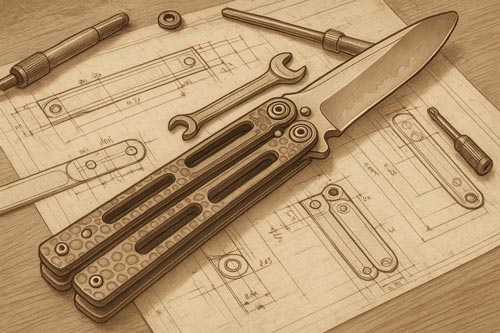
As flipping culture took off, the balisong went through one of the most dramatic transformations in its history. The early Batangas models were handmade tools shaped by tradition and necessity, but modern balisongs are engineered with a level of precision that would have been impossible for village smiths working with hand tools and recycled steel. Makers began experimenting with new materials, new pivot systems, and entirely new design philosophies that redefined what a balisong could feel like in motion. CNC machining allowed for exact tolerances that made knives flip the same way every time, and the consistency attracted both new flippers and longtime collectors who appreciated the blend of craft and engineering.
One of the biggest breakthroughs came from improvements to the pivot system. Traditional balisongs used simple washers, which worked well for daily cutting tasks but limited the smoothness and balance needed for advanced flipping. Modern makers introduced bushing systems that kept the handles centered perfectly around the blade, allowing for smooth rotation without side to side play. Bearings came next, giving balisongs an even lighter, faster movement that appealed to flippers who liked high speed combinations. These innovations created entirely new categories of feel. Some flippers prefer the controlled glide of bushings, while others enjoy the quick rotation of bearings. The key point is that the knife you choose today can be tailored to your style in a way early makers could never have imagined.
Handle construction evolved just as quickly. Handmade balisongs were usually built in a sandwich style, with bolsters and liners pinned together around the blade. Modern designs introduced channel construction, where each handle is milled from a single piece of metal to eliminate flex and improve durability. Titanium became a favorite for its balance of lightness and strength, while aluminum and stainless steel offered more budget friendly options with predictable weight. Makers also experimented with different textures, spine shapes, and cuts that improved grip during rollovers and aerials. Every detail started to matter, from the width of the latch gate to the angle of the handle chamfers.
Even the blade changed. Traditional balisong blades were designed for utility, but modern flippers often prefer trainer blades or specific profiles that improve balance during tricks. Speed, weight distribution, and momentum replaced cutting performance as the top priorities for many buyers. This created a divide that still exists today. Some people want a balisong that performs best as a knife, while others want the smoothest flipping tool possible. The variety that resulted from that split shaped the current marketplace, giving today's users the freedom to choose knives that match their exact preferences.
Modern balisong engineering shows how far the knife has come from its humble beginnings. What started as a handmade farm tool evolved into a precision instrument built to withstand thousands of flips, drops, and training sessions. The combination of new materials, better machining, and community feedback pushed balisong design into a new era, one that honors its roots while embracing the possibilities of modern manufacturing.
The Balisong as a Global Icon Today
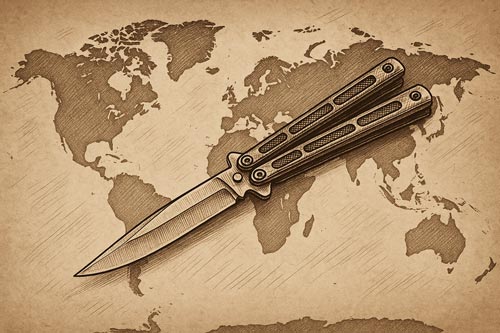
Today, the balisong stands in a category of its own. What began as a practical folding tool in Batangas has grown into a worldwide phenomenon shaped by collectors, martial artists, flippers, engineers, and everyday enthusiasts. The modern balisong community spans dozens of countries, with online groups devoted to comparing pivots, debating blade profiles, and reviewing the newest designs from makers who have turned precision machining into a craft of its own. Knife manufacturers now release dedicated flippers, premium builds, mid range options, and trainers that match the balance of their live blade counterparts. This level of variety would have been unimaginable to the early panday who forged balisongs from car springs, yet the spirit of craftsmanship that defined the original versions still influences modern designs.
One of the most interesting things about the balisong's rise is how universal its appeal has become. Some people are drawn to the engineering, others love the flow of flipping, and some simply appreciate the history and cultural background behind the knife. Collectors often keep both handmade Filipino balisongs and modern CNC models in the same display case, recognizing that each represents a different chapter of the knife's story. The old Batangas pieces show the artistry and tradition of hand forging, while the new flippers show what is possible with advanced machining and modern materials. Despite the contrast, both share the same core idea that made the balisong special in the first place. It is a simple, reliable folding blade built around clever mechanics and a satisfying motion.
The knife's global presence has also inspired a new appreciation for its cultural roots. Many enthusiasts now seek out traditional Batangas balisongs to better understand how the knife evolved. Some even travel to the Philippines to meet makers who still craft them by hand, keeping alive a tradition that stretches back more than a century. Others focus entirely on the modern side of the hobby, learning complex aerials and combinations that push the limits of what the knife can do in motion. The beauty of the balisong is that there is room for both. Its legacy is shared by the craftsmen who built the originals, the engineers who refined the modern versions, and the community that continues to reimagine what the knife can be.
What makes the balisong so interesting today is how many different communities have adopted it for completely different reasons. Some people collect traditional Batangas pieces because they appreciate the handmade workmanship. Others prefer modern flippers built with perfect tolerances and smooth pivots. Many users never flip at all and simply enjoy the mechanics of the knife. The variety of reasons people connect with the balisong is part of what keeps it relevant. It continues to evolve because every group that uses it adds something new to its story, whether that comes from tradition, engineering, or pure creativity.
Choosing a Modern Balisong After Learning Its History
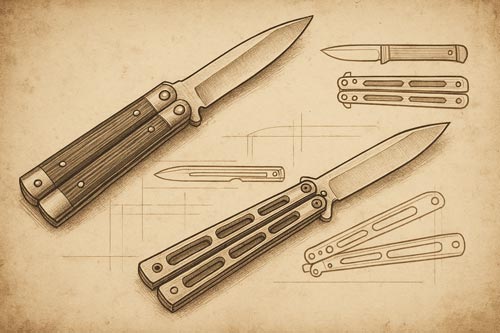
Understanding where the balisong came from makes choosing a modern one a lot more interesting. Once you know how early Batangas makers shaped their knives by hand, it becomes easier to appreciate the differences between traditional builds and the precision machined models made today. Some people prefer old school designs with brass bolsters, pinned construction, and that slightly imperfect handmade character. Others are drawn to modern flippers with smooth bushings, channel handles, and a balance that makes tricks feel effortless. Neither is the "right" choice. They simply represent different parts of the balisong's evolution, the same way the handmade Filipino versions and the CNC engineered models each played a role in shaping the knife's identity.
For new buyers, the best way to choose a balisong is to think about how you plan to use it. If you want to practice flipping, a trainer or a balanced flipper is usually the easiest place to start. If you prefer something closer to the original Batangas style, a classic design with metal bolsters and a simple latch might feel more authentic. Some users even keep both types so they can enjoy the smooth feel of a modern flipper while still appreciating the history behind the traditional versions. The key is finding a knife that matches your goals and feels good in your hand, whether that means clean rollovers, controlled deployment, or simply enjoying the mechanics of the design.
If you want to explore the modern side of the hobby and see how far the balisong has come, you can look through our full selection of butterfly knives and balisongs for examples of the current designs that grew out of this long history. Today's makers continue to refine balance, pivots, materials, and weight in ways that pay tribute to the original Batangas craftsmen while pushing the knife forward in new directions. The result is a wide range of balisongs that honor the past while offering the performance and consistency that modern users expect.
You May Also Be Interested In:
- Can Butterfly Knives be used for Combat?
- The Most Popular Military Knives of All Time
- The Real History of Nunchaku: From Farm Tool to Hollywood Icon
- The Real History of Brass Knuckles: From Battlefield to Back Pocket
- The Real History of Escrima Sticks: From Battlefield Weapon to Modern Martial Art
- 10 Real Ninja Weapons and How They Were Actually Used
- How to Tell a Real Katana from a Decorative Sword
- History and Evolution of Self-Defense Keychains
- The History and Evolution of the Karambit Knife
- What Is a Bo Staff? Beginner Guide to History, Sizes, and Training
Leave a Reply