




10 Things You Didn't Know About the Karambit Knife
October 29th, 2025

At first glance, the karambit looks like something pulled straight out of a movie. It's sleek, curved, and a little intimidating. Behind that distinctive design is one of the most fascinating blade evolutions in history. The karambit wasn't born in a weapons lab or designed for special forces. It started in the rice fields of Southeast Asia as a humble farming tool before becoming a favorite among martial artists, collectors, and tactical users around the world. Whether you see it as a self-defense weapon, a utility blade, or just an incredible piece of craftsmanship, there is a lot more to the karambit than meets the eye.
Up next, we'll uncover ten things most people don't know about the karambit knife, including how it was inspired by nature, how it became a staple in martial arts, and why it continues to dominate the world of tactical blades today.
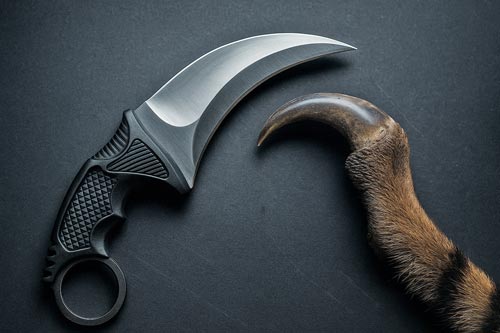
The curved blade of a karambit wasn't just made to look fierce. Its shape was modeled after the claw of a tiger, mimicking the way a predator hooks and pulls its prey. That natural arc allows the blade to slice with maximum efficiency using a controlled pulling motion rather than brute strength. In martial arts or utility work, the motion feels instinctive, following the same mechanics your hand already uses when grabbing or pulling.
The tiger's claw design also gives the karambit a unique mechanical advantage. Instead of relying on straight, linear pressure, the curve focuses cutting force into a single point of contact, letting you achieve deeper cuts with less effort. This makes the karambit incredibly effective in close quarters or precision cutting, where space and control matter more than raw reach.
Whether you're using it for tactical training, field work, or collecting, that claw-inspired design is what gives the karambit its unmistakable identity. It's both functional and symbolic, serving as a tribute to nature's perfect cutting tool.
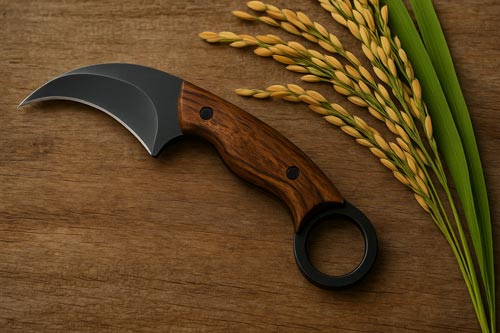
Long before the karambit became known as a tactical or self-defense weapon, it served a very different purpose. In the islands of Indonesia and across parts of Malaysia and the Philippines, early versions of the karambit were used as everyday farming tools. Villagers used the curved blade to cut rice stalks, harvest crops, and clear vegetation. Its shape wasn't just for aesthetics; it helped the blade slice efficiently through dense plant material with a pulling motion, reducing strain during repetitive work.
Over time, that practical design began to evolve. Farmers and travelers discovered the same features that made the karambit useful in the field also made it effective for protection. The finger ring kept the knife from slipping during wet or fast movements, and the compact curved blade made it ideal for close control when defending against wild animals or human threats. As word spread, the karambit transitioned from a simple agricultural tool to a respected blade in Southeast Asian martial arts and regional combat systems.
Today's tactical karambits still carry that same DNA. Whether you're holding a modern folding version or a full-tang fixed blade, you're handling a design rooted in centuries of practicality and survival. What began as a farmer's utility knife evolved into one of the most iconic combat and self-defense blades in the world.
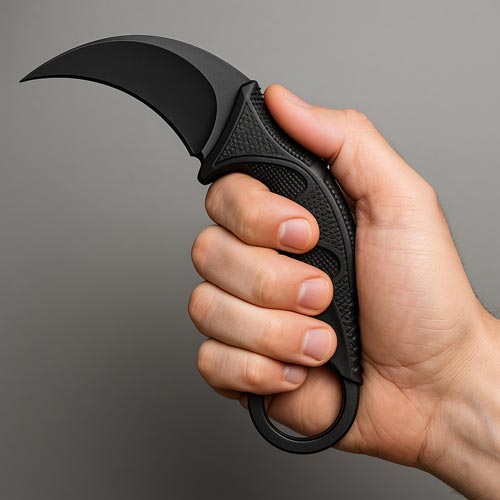
One of the most recognizable features of the karambit is the circular ring at the end of the handle. This simple addition completely changed how the knife could be used. Originally, farmers used the ring to keep the knife from slipping out of their hands while working in wet fields. Later, martial artists discovered that the same feature provided incredible retention and control during combat or self-defense movements.
The ring allows users to maintain a secure grip while performing fast transitions between forward and reverse grips. It also helps stabilize the blade during spinning techniques, quick draws, and precision cuts. In self-defense applications, the ring ensures the knife stays in your hand even under pressure or sudden movement, reducing the risk of disarmament.
Modern karambits often feature textured rings, finger grooves, or extended guards for added comfort and control. Some tactical models even include reinforced rings made from steel or titanium to handle the stress of striking or impact techniques. Whether you're using a karambit for training, everyday carry, or martial arts, that ring is one of the reasons the design remains so unique and functional.
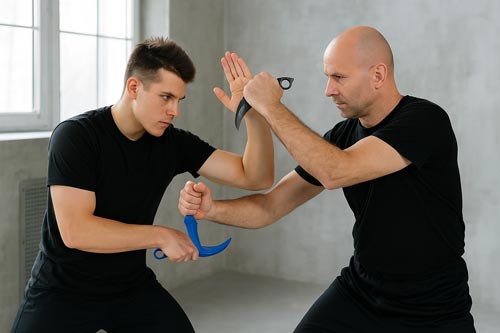
Even though the karambit has evolved into a modern tactical knife, it still plays a big role in traditional martial arts. Systems like Silat, Kali, and Pencak Silat all feature karambit techniques that have been passed down for generations. Practitioners use the knife to develop precision, control, and fluidity in motion. In these disciplines, the karambit is seen not just as a weapon, but as an extension of the body-its curve flowing naturally with each movement.
Training with a karambit focuses on timing, distance, and retention. Students learn to switch between forward and reverse grips, use the ring for spinning or trapping, and control the blade safely during close contact drills. For beginners, instructors recommend starting with training karambits made from rubber or polypropylene. These allow martial artists to learn safely while still practicing realistic techniques.
Many modern martial arts schools continue to incorporate karambit drills into their curriculums, even for students who focus on self-defense rather than traditional combat arts. The combination of heritage, function, and adaptability has helped the karambit remain one of the most respected blade designs in the martial arts world.
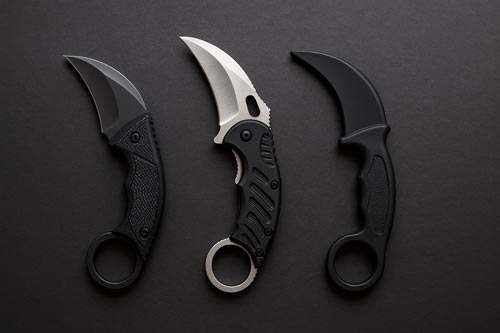
While the karambit's curved shape stays consistent, the way it's built can change dramatically. The three most common styles are fixed-blade karambits, folding karambits, and training karambits, each designed for specific purposes. Fixed-blade karambits are the strongest and most reliable, favored by martial artists, survivalists, and tactical users who value durability and simplicity. Folding karambits, on the other hand, are more discreet and easier to carry, often equipped with spring-assisted mechanisms or thumb rings for rapid deployment.
Training karambits are made from blunt materials like rubber, aluminum, or polymer and are essential for learning safe handling. They let you practice draws, spins, and retention techniques without the risk of injury. Many instructors require students to master movements with a trainer before ever touching a live blade.
Choosing between these styles depends on your purpose. If you want a reliable field or self-defense tool, go for a fixed-blade karambit. If you prefer everyday carry, a folding karambit might be more practical. And if you're training or performing demonstrations, a blunt trainer is the smartest place to start.
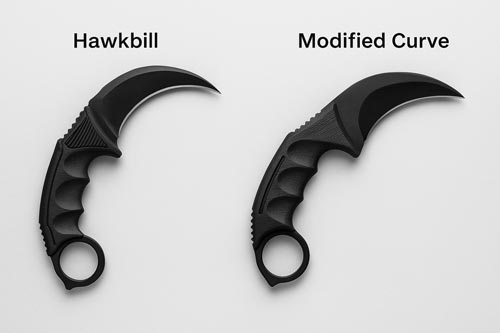
Most karambit knives have a blade shaped like a hawkbill, curving inward like a claw, but not all follow that exact form. Over the years, designers have created modified curves that balance the aggressive cutting power of a traditional karambit with the practicality of everyday use. Some feature a shallower curve for easier slicing and utility work, while others exaggerate the curve for precise hooking and control in close quarters applications.
A true hawkbill karambit excels at pulling cuts, letting you dig into tough materials with minimal effort. However, modified karambits can make general cutting tasks, like opening boxes or slicing rope, feel more natural. This makes them a great option for users who want the control of a karambit without sacrificing versatility.
No matter which curve style you prefer, the key design principle remains the same: the blade's arc amplifies cutting efficiency. Whether you choose a deep hawkbill or a subtle modified curve, both embody the spirit of the karambit's tiger claw heritage, sharp, fast, and efficient.
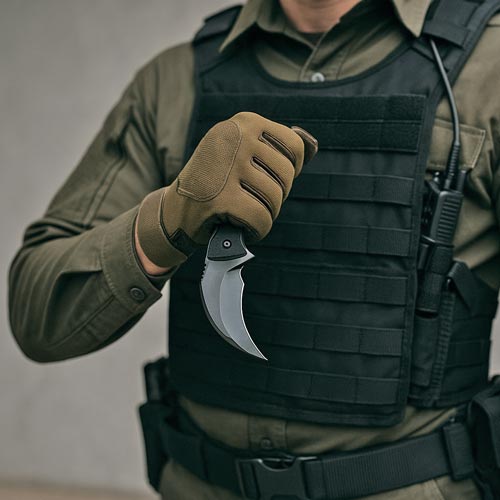
In recent decades, the karambit has earned a strong following among military, law enforcement, and security professionals. Its compact size, control-oriented design, and reliable retention make it ideal for close quarters work where every movement counts. Many tactical operators favor the karambit because the ring grip allows them to maintain a secure hold even when wearing gloves or switching between tools and firearms.
Unlike larger fixed blades, the karambit's shape and handle design make it easy to draw quickly in confined spaces. The curved blade gives users precise control, allowing for efficient, focused cutting rather than wide slashing motions. Folding karambits, especially those with assisted-opening mechanisms, have become popular for everyday duty carry since they combine speed and portability.
In the tactical community, the karambit is valued for more than its cutting performance. It is also seen as a multi-purpose retention tool that can double as a striking or trapping instrument when needed. Combined with proper training, a karambit becomes an extension of the user's hand, agile, efficient, and dependable under pressure.
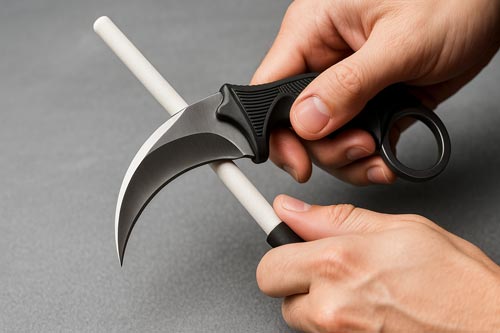
Sharpening a karambit is not as simple as running the blade across a flat stone. The curved shape means you need tools that match its arc, like tapered diamond rods, small ceramic sticks, or flexible sharpening systems. These tools let you follow the blade's natural curve without flattening it or damaging the edge geometry. Many karambit owners also use a leather strop with polishing compound to refine the edge and maintain sharpness over time.
When sharpening, always move the tool along the same curve as the blade instead of forcing a straight motion. This keeps the edge consistent and prevents uneven wear. For serrated or partially serrated karambits, use narrow conical rods to get between the serrations without dulling the peaks. A steady hand, light pressure, and patience go a long way toward maintaining that signature razor-like curve.
If you are new to sharpening curved blades, start with a cheaper or training karambit until you get comfortable. Once you understand the motion, you can restore a live blade safely and effectively. Keeping your karambit sharp is not just about performance; it is about respecting the craftsmanship that makes this design so unique.
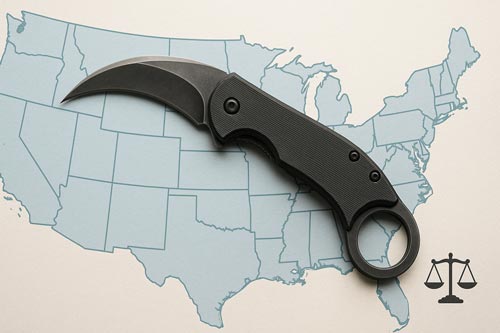
Knife laws vary widely by state and locality, so a karambit that is legal to carry in one place may be restricted or illegal in another. Regulations often focus on blade length, locking mechanisms, whether the knife is carried openly or concealed, and specific blade shapes. That means a folding karambit with a safe lock might be allowed in some areas while a fixed karambit could be illegal there.
Beyond state law there are also location based restrictions. Federal buildings, courthouses, schools, and airports commonly prohibit knives entirely. Parks, municipal codes, and private property rules may add additional limits. It is your responsibility to check the laws that apply where you live and where you travel.
If you plan to carry a karambit, consider safer options to reduce legal risk. Choose a reputable folding model with a strong lock, carry it in a way that complies with local concealed carry rules, and avoid carrying in restricted locations. When in doubt consult local statutes or a qualified attorney to get definitive guidance. Keeping a copy of receipts and documentation that show the knife is intended as a tool can help in ambiguous situations.
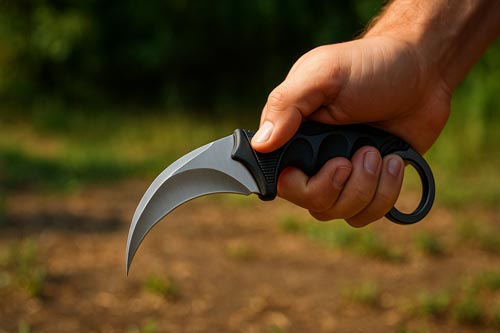
Yes. The karambit's curved belly and controlled pulling action make it surprisingly good for everyday cutting tasks when used properly. The blade excels at slicing rope, cord, and fibrous materials because the material conforms to the arc and the pull cut keeps the edge engaged across more surface area.
In outdoor or survival settings a karambit is helpful for field dressing small game, trimming paracord, and cutting webbing or straps. A trailing point or longer-bellied karambit increases the usable cutting length, which is useful when you need a smoother draw cut. For camp chores and light utility work a karambit can be faster and more precise than some straight-bladed knives.
There are limits to keep in mind. The curved shape is not ideal for batoning, heavy chopping, or prying, and the tip may be more delicate than a robust drop point. If you need to perform heavy-duty bushcraft tasks, pair the karambit with a small fixed-blade or hatchet for more demanding work. For everyday carry consider a folding karambit with a secure lock and a practical sheath so you can access it safely and legally.
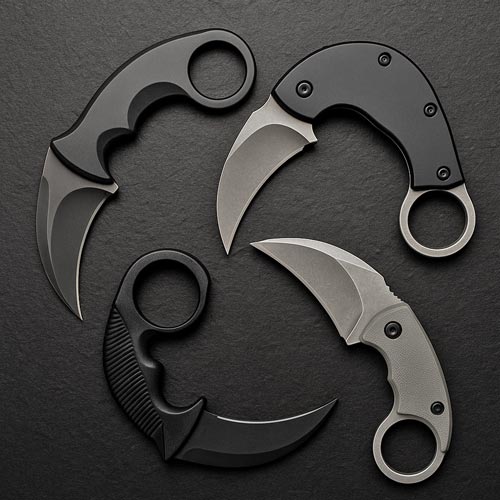
The karambit has come a long way from its agricultural roots, but its purpose has never changed. It is a tool built for precision, control, and efficiency. Every curve, ring, and contour serves a purpose, whether you are using it for martial arts, self-defense, or everyday cutting tasks. Its design proves that a well-crafted blade can be both elegant and highly functional.
If you are ready to experience what makes the karambit so unique, explore our full selection of karambit knives. You will find fixed blades, folding versions, and safe trainers designed for every skill level and purpose.
1. The Karambit's Design Was Inspired by a Tiger's Claw
The curved blade of a karambit wasn't just made to look fierce. Its shape was modeled after the claw of a tiger, mimicking the way a predator hooks and pulls its prey. That natural arc allows the blade to slice with maximum efficiency using a controlled pulling motion rather than brute strength. In martial arts or utility work, the motion feels instinctive, following the same mechanics your hand already uses when grabbing or pulling.
The tiger's claw design also gives the karambit a unique mechanical advantage. Instead of relying on straight, linear pressure, the curve focuses cutting force into a single point of contact, letting you achieve deeper cuts with less effort. This makes the karambit incredibly effective in close quarters or precision cutting, where space and control matter more than raw reach.
Whether you're using it for tactical training, field work, or collecting, that claw-inspired design is what gives the karambit its unmistakable identity. It's both functional and symbolic, serving as a tribute to nature's perfect cutting tool.
2. It Started as a Farming Tool in Southeast Asia
Long before the karambit became known as a tactical or self-defense weapon, it served a very different purpose. In the islands of Indonesia and across parts of Malaysia and the Philippines, early versions of the karambit were used as everyday farming tools. Villagers used the curved blade to cut rice stalks, harvest crops, and clear vegetation. Its shape wasn't just for aesthetics; it helped the blade slice efficiently through dense plant material with a pulling motion, reducing strain during repetitive work.
Over time, that practical design began to evolve. Farmers and travelers discovered the same features that made the karambit useful in the field also made it effective for protection. The finger ring kept the knife from slipping during wet or fast movements, and the compact curved blade made it ideal for close control when defending against wild animals or human threats. As word spread, the karambit transitioned from a simple agricultural tool to a respected blade in Southeast Asian martial arts and regional combat systems.
Today's tactical karambits still carry that same DNA. Whether you're holding a modern folding version or a full-tang fixed blade, you're handling a design rooted in centuries of practicality and survival. What began as a farmer's utility knife evolved into one of the most iconic combat and self-defense blades in the world.
3. The Finger Ring Was Added for Retention and Safety
One of the most recognizable features of the karambit is the circular ring at the end of the handle. This simple addition completely changed how the knife could be used. Originally, farmers used the ring to keep the knife from slipping out of their hands while working in wet fields. Later, martial artists discovered that the same feature provided incredible retention and control during combat or self-defense movements.
The ring allows users to maintain a secure grip while performing fast transitions between forward and reverse grips. It also helps stabilize the blade during spinning techniques, quick draws, and precision cuts. In self-defense applications, the ring ensures the knife stays in your hand even under pressure or sudden movement, reducing the risk of disarmament.
Modern karambits often feature textured rings, finger grooves, or extended guards for added comfort and control. Some tactical models even include reinforced rings made from steel or titanium to handle the stress of striking or impact techniques. Whether you're using a karambit for training, everyday carry, or martial arts, that ring is one of the reasons the design remains so unique and functional.
4. Martial Artists Still Train with Karambits Today
Even though the karambit has evolved into a modern tactical knife, it still plays a big role in traditional martial arts. Systems like Silat, Kali, and Pencak Silat all feature karambit techniques that have been passed down for generations. Practitioners use the knife to develop precision, control, and fluidity in motion. In these disciplines, the karambit is seen not just as a weapon, but as an extension of the body-its curve flowing naturally with each movement.
Training with a karambit focuses on timing, distance, and retention. Students learn to switch between forward and reverse grips, use the ring for spinning or trapping, and control the blade safely during close contact drills. For beginners, instructors recommend starting with training karambits made from rubber or polypropylene. These allow martial artists to learn safely while still practicing realistic techniques.
Many modern martial arts schools continue to incorporate karambit drills into their curriculums, even for students who focus on self-defense rather than traditional combat arts. The combination of heritage, function, and adaptability has helped the karambit remain one of the most respected blade designs in the martial arts world.
5. There Are Fixed, Folding, and Training Versions
While the karambit's curved shape stays consistent, the way it's built can change dramatically. The three most common styles are fixed-blade karambits, folding karambits, and training karambits, each designed for specific purposes. Fixed-blade karambits are the strongest and most reliable, favored by martial artists, survivalists, and tactical users who value durability and simplicity. Folding karambits, on the other hand, are more discreet and easier to carry, often equipped with spring-assisted mechanisms or thumb rings for rapid deployment.
Training karambits are made from blunt materials like rubber, aluminum, or polymer and are essential for learning safe handling. They let you practice draws, spins, and retention techniques without the risk of injury. Many instructors require students to master movements with a trainer before ever touching a live blade.
Choosing between these styles depends on your purpose. If you want a reliable field or self-defense tool, go for a fixed-blade karambit. If you prefer everyday carry, a folding karambit might be more practical. And if you're training or performing demonstrations, a blunt trainer is the smartest place to start.
6. A Real Karambit Can Have a Hawkbill or Modified Curve
Most karambit knives have a blade shaped like a hawkbill, curving inward like a claw, but not all follow that exact form. Over the years, designers have created modified curves that balance the aggressive cutting power of a traditional karambit with the practicality of everyday use. Some feature a shallower curve for easier slicing and utility work, while others exaggerate the curve for precise hooking and control in close quarters applications.
A true hawkbill karambit excels at pulling cuts, letting you dig into tough materials with minimal effort. However, modified karambits can make general cutting tasks, like opening boxes or slicing rope, feel more natural. This makes them a great option for users who want the control of a karambit without sacrificing versatility.
No matter which curve style you prefer, the key design principle remains the same: the blade's arc amplifies cutting efficiency. Whether you choose a deep hawkbill or a subtle modified curve, both embody the spirit of the karambit's tiger claw heritage, sharp, fast, and efficient.
7. Karambits Are Popular Among Tactical Professionals
In recent decades, the karambit has earned a strong following among military, law enforcement, and security professionals. Its compact size, control-oriented design, and reliable retention make it ideal for close quarters work where every movement counts. Many tactical operators favor the karambit because the ring grip allows them to maintain a secure hold even when wearing gloves or switching between tools and firearms.
Unlike larger fixed blades, the karambit's shape and handle design make it easy to draw quickly in confined spaces. The curved blade gives users precise control, allowing for efficient, focused cutting rather than wide slashing motions. Folding karambits, especially those with assisted-opening mechanisms, have become popular for everyday duty carry since they combine speed and portability.
In the tactical community, the karambit is valued for more than its cutting performance. It is also seen as a multi-purpose retention tool that can double as a striking or trapping instrument when needed. Combined with proper training, a karambit becomes an extension of the user's hand, agile, efficient, and dependable under pressure.
8. They Require Specialized Sharpening Techniques
Sharpening a karambit is not as simple as running the blade across a flat stone. The curved shape means you need tools that match its arc, like tapered diamond rods, small ceramic sticks, or flexible sharpening systems. These tools let you follow the blade's natural curve without flattening it or damaging the edge geometry. Many karambit owners also use a leather strop with polishing compound to refine the edge and maintain sharpness over time.
When sharpening, always move the tool along the same curve as the blade instead of forcing a straight motion. This keeps the edge consistent and prevents uneven wear. For serrated or partially serrated karambits, use narrow conical rods to get between the serrations without dulling the peaks. A steady hand, light pressure, and patience go a long way toward maintaining that signature razor-like curve.
If you are new to sharpening curved blades, start with a cheaper or training karambit until you get comfortable. Once you understand the motion, you can restore a live blade safely and effectively. Keeping your karambit sharp is not just about performance; it is about respecting the craftsmanship that makes this design so unique.
9. Karambit Knives Aren't Legal Everywhere
Knife laws vary widely by state and locality, so a karambit that is legal to carry in one place may be restricted or illegal in another. Regulations often focus on blade length, locking mechanisms, whether the knife is carried openly or concealed, and specific blade shapes. That means a folding karambit with a safe lock might be allowed in some areas while a fixed karambit could be illegal there.
Beyond state law there are also location based restrictions. Federal buildings, courthouses, schools, and airports commonly prohibit knives entirely. Parks, municipal codes, and private property rules may add additional limits. It is your responsibility to check the laws that apply where you live and where you travel.
If you plan to carry a karambit, consider safer options to reduce legal risk. Choose a reputable folding model with a strong lock, carry it in a way that complies with local concealed carry rules, and avoid carrying in restricted locations. When in doubt consult local statutes or a qualified attorney to get definitive guidance. Keeping a copy of receipts and documentation that show the knife is intended as a tool can help in ambiguous situations.
10. You Can Still Use a Karambit as a Utility Knife
Yes. The karambit's curved belly and controlled pulling action make it surprisingly good for everyday cutting tasks when used properly. The blade excels at slicing rope, cord, and fibrous materials because the material conforms to the arc and the pull cut keeps the edge engaged across more surface area.
In outdoor or survival settings a karambit is helpful for field dressing small game, trimming paracord, and cutting webbing or straps. A trailing point or longer-bellied karambit increases the usable cutting length, which is useful when you need a smoother draw cut. For camp chores and light utility work a karambit can be faster and more precise than some straight-bladed knives.
There are limits to keep in mind. The curved shape is not ideal for batoning, heavy chopping, or prying, and the tip may be more delicate than a robust drop point. If you need to perform heavy-duty bushcraft tasks, pair the karambit with a small fixed-blade or hatchet for more demanding work. For everyday carry consider a folding karambit with a secure lock and a practical sheath so you can access it safely and legally.
Conclusion
The karambit has come a long way from its agricultural roots, but its purpose has never changed. It is a tool built for precision, control, and efficiency. Every curve, ring, and contour serves a purpose, whether you are using it for martial arts, self-defense, or everyday cutting tasks. Its design proves that a well-crafted blade can be both elegant and highly functional.
If you are ready to experience what makes the karambit so unique, explore our full selection of karambit knives. You will find fixed blades, folding versions, and safe trainers designed for every skill level and purpose.
You May Also Be Interested In:
- The History and Evolution of the Karambit Knife
- What Is a Karambit Knife? Beginner Guide to Karambits
- Deadly Weapons You Didn't Know Existed
- What Are Brass Knuckles? Everything You Didn't Know You Needed to Know
- Why Every Day Should Be an EDC Knife Day: How a Simple Knife Can Make Your Life Easier and Safer
- Best EDC Knife: How to Choose the Right Everyday Carry Knife
- Why Karambit Knives Are So Effective
- Karambit vs Push Dagger: Which Blade Would You Bet Your Life On?
- Why Karambit Knives Became So Popular in Video Games
- Switchblade vs Automatic Knife: What's the Difference?
Leave a Reply