




How Do Automatic Knives Work? Inside the Mechanism
March 23rd, 2026
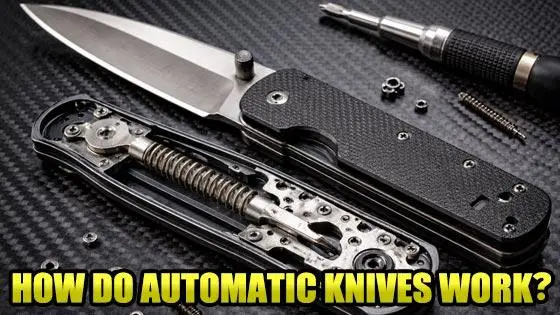
If you've ever pressed a button and watched a blade snap open instantly, you've probably wondered what's actually happening inside the handle. Automatic knives feel simple from the outside, but there's a surprisingly clever mechanism behind that smooth, fast action. Whether it's a classic switchblade or a modern OTF design, the basic idea is the same: stored spring tension is released to deploy the blade in a controlled way. Once you understand how that system works, it becomes much easier to see what separates different types of automatic knives and why they feel so different in use.
How Automatic Knives Use Spring Tension
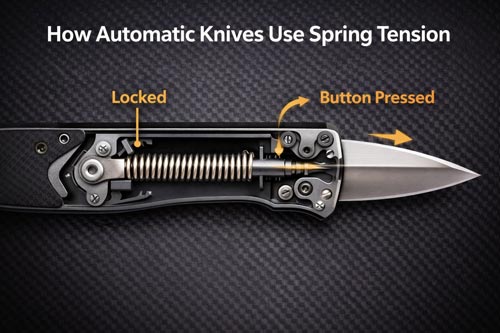
At the core of every automatic knife is a spring that stores energy until it is released. When you press the button or slide the switch, that stored tension is instantly released, which forces the blade to move into the open position. This is what gives automatic knives their fast and smooth deployment.
Inside the handle, the spring is held under tension while the knife is closed. A locking mechanism keeps everything in place so the blade does not move until you activate it. Once the button is pressed, that lock is disengaged, allowing the spring to do its job and drive the blade outward in a controlled motion.
The type of spring can vary depending on the design. Some automatic knives use a coiled spring, while others rely on a flat spring or torsion bar. Each version accomplishes the same goal, but the feel and strength of the opening action can be slightly different depending on how the spring is built and positioned.
After the blade is fully deployed, another locking mechanism takes over to hold it firmly in place. This ensures that the knife remains stable during use and does not collapse back into the handle unexpectedly. Understanding this balance between spring tension and locking systems is key to understanding how automatic knives function overall.
How Side-Opening Switchblades Work
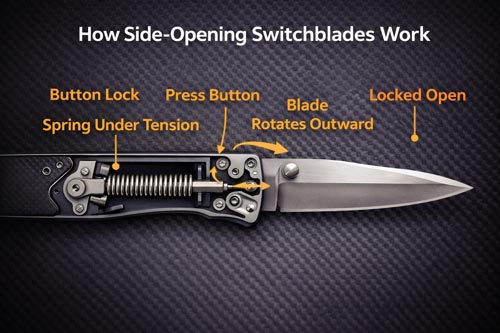
Side-opening switchblades are one of the most recognizable types of automatic knives, and their mechanism is actually pretty straightforward once you understand the basics. Inside the handle, the blade is connected to a pivot point, much like a manual folding knife. The difference is that a spring is preloaded to push the blade open as soon as the lock is released.
When the knife is closed, the spring is held under tension and a button lock keeps the blade securely in place. Pressing the button releases that lock, allowing the spring to rotate the blade outward in a smooth arc until it reaches the fully open position. At that point, another lock engages to keep the blade steady during use.
This style of automatic knife feels very similar to a traditional folding knife, just much faster and easier to deploy. Because the blade swings out from the side, it has a natural, familiar motion that many people prefer, especially if they are already used to standard pocket knives.
One of the advantages of side-opening designs is their simplicity. With fewer internal tracks and components compared to other automatic knives, they are often easier to maintain and can be more forgiving over time. That straightforward design is part of the reason switchblades have remained popular for so long.
How OTF Automatic Knives Work
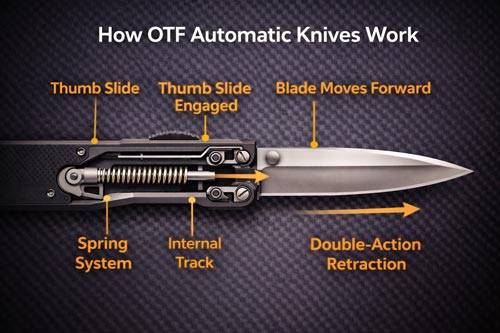
Out-the-front knives, often called OTF knives, work a little differently than side-opening switchblades. Instead of rotating on a pivot, the blade travels straight in and out of the handle along an internal track. This gives OTF knives their distinct forward-deploying action.
Inside the handle, a spring system is connected to a sliding mechanism that moves the blade along that track. When you push the thumb slide forward, it engages the spring and drives the blade straight out of the front of the knife. In double-action designs, pulling the slide back reverses the process and retracts the blade back into the handle.
One key difference with OTF knives is how the spring tension is managed. Unlike side-opening switchblades that rely on a single release of stored tension, many OTF knives use a system that both loads and releases the spring as you move the slide. This allows for both deployment and retraction using the same control.
Because the blade moves along a guided track, OTF knives require more internal components and tighter tolerances. This makes them a bit more complex mechanically, but it also gives them that smooth, linear action that many people find satisfying to use. Once you understand how the internal track and spring system work together, the design starts to make a lot more sense.
Why Automatic Knives Feel Different to Use
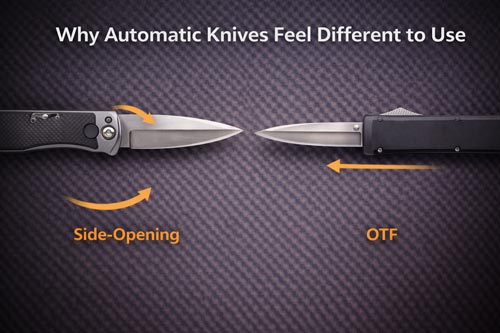
Once you understand the internal mechanics, it becomes much easier to see why automatic knives feel so different compared to manual folders. The combination of spring tension, locking systems, and deployment style creates a completely different experience in the hand. Whether the blade swings open or slides straight out, that instant response is what sets them apart.
Side-opening designs tend to feel more familiar because the blade rotates in an arc, similar to a standard folding knife. The difference is the speed and ease of deployment. With just a quick press of a button, the blade is fully open and locked into place. That makes them feel fast, but still predictable and controlled.
OTF knives have a very different feel. Because the blade travels along a straight track, the motion is more linear and mechanical. Many people describe it as smooth and precise, almost like a controlled forward snap rather than a swinging motion. That unique action is part of what makes OTF knives so popular among enthusiasts.
If you want to get a better sense of how these different styles compare, it helps to explore a range of automatic knife designs and see how each one is built. Once you handle a few different types, the differences in feel and function become much more obvious.
At the end of the day, both styles rely on the same core principle of spring-driven deployment. The difference comes down to how that energy is applied and how the blade moves as a result. That is what gives each type its own distinct character.
Are Automatic Knives Reliable Over Time?
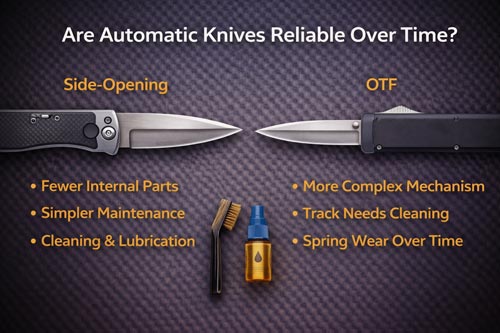
One question that comes up a lot is whether automatic knives hold up over time, especially with all the moving parts inside. The short answer is yes, but like any mechanical tool, their reliability depends on how they are used and maintained. Because automatic knives rely on springs, locks, and internal tracks, those components need to stay clean and properly aligned to function smoothly.
Side-opening switchblades tend to have fewer internal parts, which can make them a bit more forgiving over time. With a simple pivot and spring system, there is less that can go wrong, and routine maintenance like cleaning and occasional lubrication is usually enough to keep them working well.
OTF knives are more complex, so they require a little more attention. Since the blade moves along a track inside the handle, dirt, lint, or debris can affect how smoothly the knife deploys and retracts. Keeping the inside clean and avoiding excessive buildup helps maintain that crisp, reliable action.
Another factor is spring wear. Over time, springs can lose a bit of their tension, especially if the knife is used heavily. That said, most modern automatic knives are built to handle repeated use, and it typically takes a long time before any noticeable change in performance occurs.
If you are looking through different automatic knife options, it is worth paying attention to build quality and materials. A well-made knife with solid internal components will generally last longer and perform more consistently than a lower-quality model.
With basic care and normal use, automatic knives can remain reliable for years. Understanding how they work and what affects their performance makes it much easier to keep them functioning the way they should.
Final Thoughts on How Automatic Knives Work
Once you understand the basic mechanics behind automatic knives, everything about them starts to make more sense. What seems like a simple push-button action is actually a coordinated system of springs, locks, and moving parts working together to control the blade. That balance is what allows them to open quickly while still remaining safe and stable during use.
The main differences between styles come down to how that stored energy is applied. Side-opening switchblades rotate the blade outward using a pivot, while OTF knives move the blade along a straight track. Both approaches rely on the same core principle of spring tension, but they deliver very different experiences in terms of motion and feel.
If you have ever been curious about why automatic knives feel so smooth or why different styles behave the way they do, it all comes back to these internal mechanisms. Understanding how they function not only clears up confusion, but also helps you appreciate the design and engineering that goes into each knife.
If you want to see how these mechanisms come together in real designs, you can explore different automatic knife styles and compare how each one is built. Looking at real examples is often the easiest way to connect what you have learned with how these knives actually perform.
At the end of the day, automatic knives are a great example of simple concepts working together in a precise way. Once you see how the spring, lock, and blade interact, the entire system becomes easy to understand.
Frequently Asked Questions
Are Automatic Knives Spring Loaded?
Yes, automatic knives rely on a spring that stores energy while the blade is closed. When the button or switch is activated, that stored tension is released, which forces the blade to open quickly and smoothly.
How Does a Switchblade Open So Fast?
A switchblade opens quickly because the spring inside the handle is already under tension. Pressing the button releases a locking mechanism, allowing the spring to instantly push the blade into the open position.
What Makes OTF Knives Different Internally?
OTF knives use a sliding mechanism and internal track instead of a pivot. The blade moves straight in and out of the handle, and many designs use a system that both loads and releases the spring as you move the thumb slide.
Do Automatic Knives Wear Out Over Time?
Like any mechanical tool, automatic knives can experience wear over time, especially in the spring and internal components. With normal use and basic maintenance, most high-quality automatic knives remain reliable for many years.
You May Also Be Interested In:
- How Automatic Knives Actually Work
- Why Automatic Knives Belong in Your EDC
- The Evolution of Automatic Knives: From Battlefield Tools to Everyday Carry
- Switchblade vs Automatic Knife: What's the Difference?
- What Is a Telescoping Baton and How Does It Work
- Non Lethal Self Defense Weapons That Actually Work
- How Stun Guns Work and How to Choose One
- Cat Keychain Self Defense: Do They Work and Are They Legal
- Stun Gun Brass Knuckles: How They Work and Are They Effective?
- Can Butterfly Knives be used for Combat?
Leave a Reply