




Top 5 Self-Defense Weapons for Travelers (What Actually Works on the Road)
January 21st, 2026
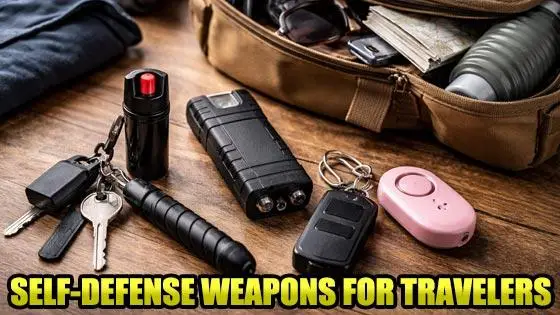
Travel puts you in places you do not control. New cities, unfamiliar neighborhoods, hotel parking garages, late-night rideshares, empty sidewalks. Most trips are uneventful, but the moments that feel off tend to happen when you are tired, distracted, or far from home. That is why travelers think about personal safety differently. The goal is not to fight anyone. It is to create space, break contact, and get out of a bad situation fast. The tools in this guide focus on exactly that. They are practical, non-lethal, and designed for real-world carry.
What Makes a Self-Defense Tool Travel-Friendly?
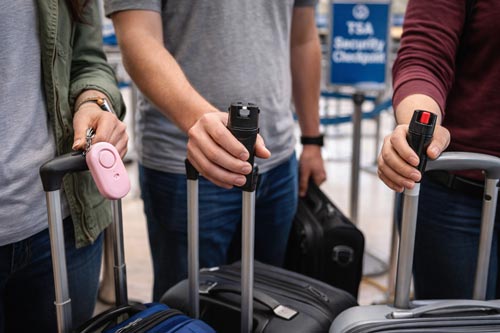
Not every self-defense tool makes sense on the road. Travelers have different needs than someone carrying the same item every day at home. Luggage space is limited. Clothing changes. Laws vary by location. And most importantly, a travel tool has to work when you are tired, distracted, or under stress in an unfamiliar place.
The best travel-friendly self-defense tools share a few traits. They are compact enough to carry comfortably in a pocket, purse, or small bag. They are intuitive, meaning you do not need complex motions or fine motor skills to use them. They are legal in most places, or at least widely accepted with minimal restrictions. And they favor distance and deterrence whenever possible, giving you a chance to create space and escape rather than forcing close contact.
Another factor people overlook is carry compliance. A tool does not help you if it lives in your suitcase. Travelers tend to leave bulky or awkward gear behind when it becomes inconvenient. The right tool is one you will actually keep on you while walking to your hotel, stepping into an elevator, or crossing a parking lot at night. Convenience is not a luxury. It is part of what makes a defensive tool effective in real life.
With those principles in mind, the five tools below are not about bravado or confrontation. They are about practicality. Each one earns its place because it fits naturally into a traveler's routine while offering a real way to break contact and get to safety when something feels wrong.
#1 - Pepper Spray
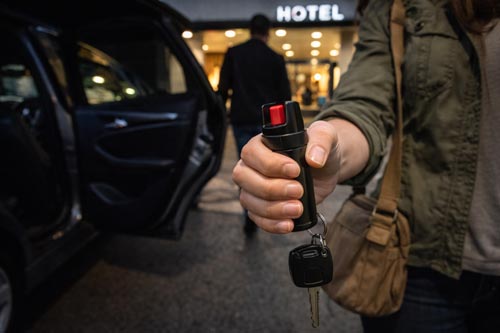
For travelers, distance is everything. The ability to stop a threat without being within arm's reach is what makes pepper spray the most practical non-lethal option on the road. It gives you a way to create space instantly, buying precious seconds to break contact and get away. That advantage matters in places like parking garages, hotel hallways, sidewalks, or anywhere you cannot rely on help being immediately nearby.
Pepper spray works by overwhelming the eyes, nose, and respiratory system. Even a brief burst causes intense burning, involuntary eye closure, coughing, and disorientation. You do not need strength, size, or special training to make it effective. You point, press, and move. That simplicity is what makes it so well suited for travel, where stress and unfamiliar surroundings can make complex actions unreliable.
Another benefit is portability. Modern pepper spray canisters are small enough to fit in a pocket, purse, or clipped to a keychain. They disappear into everyday carry without drawing attention or adding bulk. That means you are far more likely to actually have it on you when you need it, instead of leaving it behind in a bag or hotel room because it feels inconvenient.
Travel often involves transitional spaces where people feel most vulnerable: walking from a rideshare to a hotel entrance, crossing a dimly lit lot, stepping into an elevator with a stranger. In those moments, a tool that works at several feet instead of several inches changes the entire dynamic. You are not trying to overpower anyone. You are creating an opportunity to escape before the situation becomes physical.
Pepper spray is not magic, and it is not a substitute for awareness. Wind, rain, and extreme cold can affect how it performs, and expired canisters lose pressure and range. But when maintained and carried consistently, it remains one of the most reliable defensive tools a traveler can carry. It is fast, intuitive, and effective against most threats without requiring you to close distance or escalate beyond what is necessary to get away.
#2 - Personal Alarms
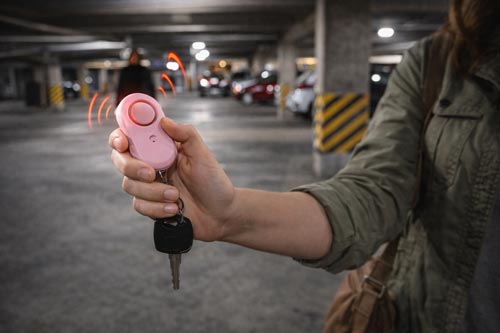
Personal alarms work on a simple principle: attention changes everything. When something feels wrong, drawing immediate focus to the situation can interrupt it before it escalates. A small device that emits a piercing siren can startle an attacker, alert people nearby, and shift the balance in your favor without requiring any physical confrontation at all.
For travelers, this is especially valuable in semi-public spaces like hotel corridors, stairwells, transit platforms, or parking structures. These are places where help may be close, but not close enough to notice a quiet struggle. An alarm bridges that gap instantly. The sound cuts through walls, echoes in enclosed spaces, and signals that something is happening right now. In many situations, that alone is enough to make a bad actor disengage and move on.
Another advantage is simplicity. Most personal alarms activate with a single pull or press. There is no aiming, no fine motor skill, and no strength requirement. Under stress, that matters. You can trigger one while moving, while running, or even while dropping it on the ground. The goal is not to win a fight. It is to break the moment and create an opportunity to escape.
Alarms are also among the easiest tools to carry consistently. They are small, lightweight, and blend naturally into keychains or bags. Many people who hesitate to carry other defensive tools feel comfortable keeping an alarm on them at all times. That reliability makes them an excellent first layer of protection, especially for travelers who want something discreet that still provides a real defensive advantage in unfamiliar places.
#3 - Compact Impact Tools
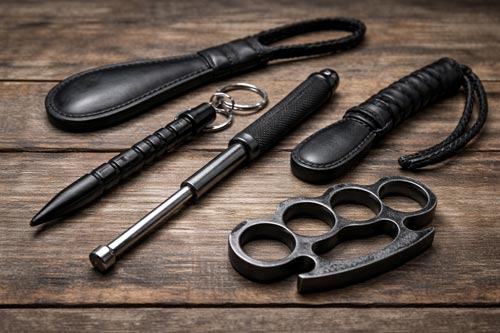
Compact impact tools are small, solid devices designed to give you leverage in close-range situations. This category includes items people often recognize, such as kubaton-style sticks, short batons, compact slapjacks, and other reinforced hand tools built to concentrate force into a small point. They are simple by design. No batteries, no pressure canisters, no electronics. You hold them in your hand and use them to create a brief moment of disruption when distance is already gone.
For travelers, these tools make sense because they are durable and discreet. Many are small enough to fit in a pocket or ride on a keychain without drawing attention. They work in rain, cold, heat, and darkness. There is nothing to malfunction. When stress strips away fine motor control, that simplicity becomes a real advantage.
Impact tools are not about overpowering someone. Their purpose is to create an opening. A quick, focused strike can shock, distract, or unbalance an attacker just long enough for you to break contact and move. In tight spaces like stairwells, elevators, or doorways, that moment can be the difference between being trapped and getting free.
#4 - Electronic Self-Defense Devices
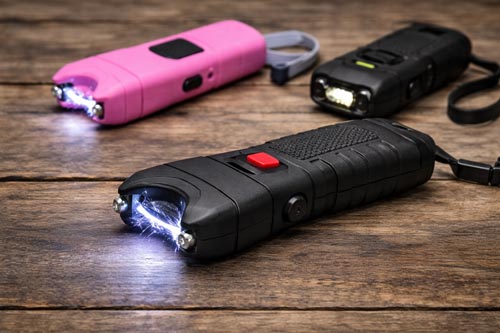
Electronic self-defense devices, such as compact stun guns, appeal to travelers for one simple reason: immediate deterrence. The sound and visual presence alone can change the tone of an encounter before it becomes physical. In unfamiliar places where confidence and body language matter, that instant signal can be enough to make someone reconsider their approach.
These tools are designed for close-range defense and built to be simple under stress. Most activate with a single switch or button, producing a loud crackling sound and visible arc. That sensory impact is powerful. It draws attention, startles, and communicates that you are not an easy target. In many real-world situations, deterrence is the outcome you want. Anything that interrupts momentum and creates hesitation works in your favor.
For travelers, size and portability are key advantages. Modern stun guns are compact enough to fit in a pocket, purse, or small bag without feeling bulky. They integrate easily into everyday carry, which increases the odds that you will actually have them with you when you step into an elevator, exit a rideshare, or cross a dimly lit lot at night.
Like any tool, they are not a solution on their own. They work best as part of a layered approach that includes awareness, distance-based options, and a clear plan to move away from danger. Used in that context, electronic devices offer a fast, unmistakable signal that can disrupt a situation and give you the moment you need to create space and get to safety.
For many travelers, these tools serve as a dependable fallback. Distance-based options are ideal, but situations do not always allow for space. A compact impact tool adds a layer of resilience to your safety plan. It is there for the moments when something goes wrong up close and your only objective is to create space and get out.
#5 - Everyday Carry Defensive Accessories
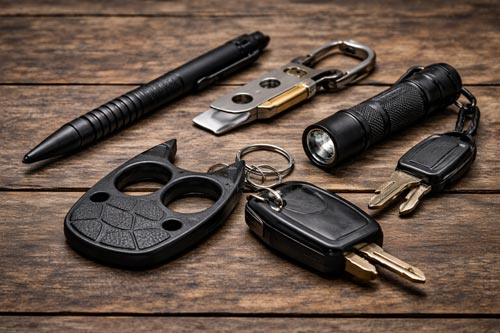
Everyday carry accessories are designed to blend into normal life. These are the tools that live on your keys, clip inside a pocket, or ride unnoticed in a small bag. They do not look tactical. They do not announce themselves. And that is exactly why people actually carry them.
Travel has a way of stripping gear down to essentials. Anything bulky, awkward, or uncomfortable gets left behind in a suitcase or hotel room. Defensive accessories solve that problem by becoming part of what you already carry. A keychain tool that fits in your hand. A reinforced accessory that disappears in a pocket. A compact device that feels no different than carrying a flashlight or charger. These tools work because they remove friction from the decision to stay prepared.
The principle is simple: the best tool is the one you have with you. A powerful option that sits in a bag across the room does nothing when you step into an elevator or cross a parking lot. Small, unobtrusive tools stay on your person. They move with you from airport to hotel, from sidewalk to rideshare, without requiring a conscious choice each time.
For travelers, everyday carry accessories are often the first layer of defense. They provide a constant baseline of readiness without changing how you move through the world. You are not carrying something that feels heavy or intimidating. You are carrying something that feels normal. That consistency is what makes them effective. They ensure that preparation is not a special event, but part of how you travel.
How to Choose the Right Tool for Your Travel Style
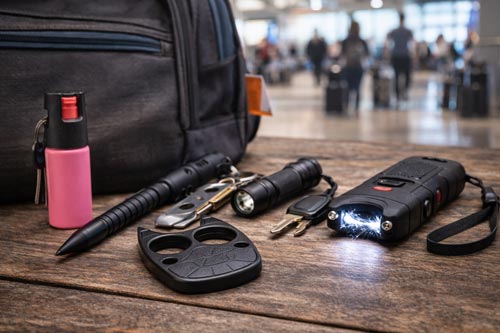
There is no single "best" self-defense tool for everyone. The right choice depends on how you travel, where you go, and how you move through unfamiliar spaces. Someone who spends most of their time in dense urban areas has different needs than someone on road trips through small towns. A solo traveler walking at night faces different risks than a business traveler moving between airports and hotels in daylight. Your gear should reflect those realities.
If your travel involves a lot of walking in public spaces, distance-based tools make the most sense. Options that let you create space before someone gets close are ideal for sidewalks, parking structures, and transit platforms. For travelers who move through tight interiors like stairwells, elevators, and hotel corridors, compact close-range tools become more relevant. These are the moments where space disappears quickly and a simple, mechanical option can make a difference.
Think about how you actually carry things. Do you keep everything in a bag, or do you prefer items in your pockets? Are your hands usually full with luggage, coffee, or a phone? Tools that require two hands or digging through a backpack are less useful than ones that live on your keys or in an outer pocket. The best setup is one that fits seamlessly into your habits instead of fighting them.
Many experienced travelers layer their options. A distance tool for open areas. A simple close-range option for confined spaces. A discreet everyday accessory that is always on them no matter what. You are not choosing a single solution. You are building a small system that adapts as your environment changes. That flexibility is what turns preparation into confidence rather than anxiety.
If you want to explore the full range of travel-friendly options in one place, you can browse them all on Kombativ's self-defense weapons page.
Legal and Travel Considerations
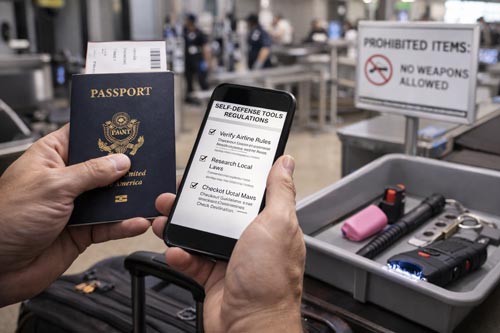
When you travel with any kind of self-defense tool, legality matters just as much as effectiveness. Rules can change not only from country to country, but from state to state and even city to city. Something that is perfectly legal at home may be restricted once you cross a border. Being prepared means understanding that your rights and responsibilities shift with your location.
Air travel adds another layer. Most self-defense tools are not allowed in carry-on bags, and some are restricted even in checked luggage. Security agencies focus on what can be brought through the checkpoint, while airlines may have their own baggage policies. On top of that, the laws at your destination still apply once you land. A tool that is permitted by airport security may still be regulated where you are headed.
The safest approach is simple: verify before you go. Check security guidelines, review your airline's rules, and look up the local laws for your destination. This is especially important if you travel across state lines or internationally. A few minutes of research can prevent confiscation, delays, or legal trouble that turns a smooth trip into a stressful one.
Being responsible with defensive tools is part of being prepared. These items exist to help you escape danger, not to create it. Treat them with the same care you would any other piece of travel gear. Know where you can carry them, know where you cannot, and make informed choices based on where you are headed. That awareness keeps your focus where it belongs: enjoying the journey with confidence rather than worry.
Training and Mindset
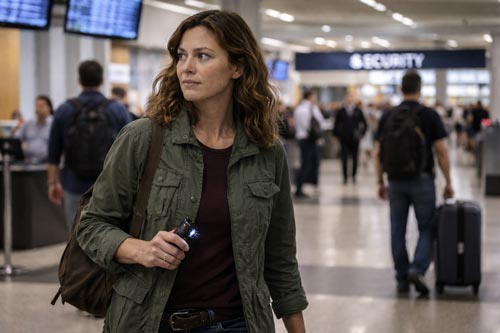
A self-defense tool is only as effective as the person using it. Gear does not replace awareness, and it does not make bad decisions safer. What it does is amplify good habits. The most important layer of personal safety is still your ability to notice when something feels off, adjust your path, and create distance before a situation turns physical.
Stress changes how the body works. Heart rate spikes. Hands shake. Fine motor control drops. That is why tools that are simple and intuitive perform better in the real world. It is also why even a small amount of training can have an outsized impact. A short class or workshop teaches you how to move under pressure, how to keep space, and how to deploy a tool while your body is in fight-or-flight mode. That experience alone builds confidence and clarity.
The right mindset is not about expecting danger. It is about staying present. Travelers who move with awareness notice exits, lighting, and proximity without becoming anxious. They avoid distractions in vulnerable moments. They trust their instincts when something feels wrong. Tools support that mindset by giving you options. You are not relying on luck. You are carrying a plan.
Personal safety on the road is not about winning encounters. It is about ending them quickly and on your terms. Every tool in this guide serves that goal. They exist to help you break contact, create space, and move toward safety. When paired with awareness and a calm, prepared mindset, they turn uncertainty into something manageable instead of something frightening.
Prepared, Not Paranoid
Travel should be something you look forward to, not something you fear. The purpose of carrying a self-defense tool is not to live in a constant state of alert. It is to remove uncertainty. Preparation replaces anxiety with options. When you know you have a way to create space and get out of a bad situation, your mind is free to focus on the experience instead of the risk.
The tools in this guide are not about confrontation. They are about escape. Each one exists to give you a moment, a pause, or an opening when something feels wrong. That moment is often all you need. It lets you change direction, reach safety, or draw attention before a situation becomes physical. That is real-world self-defense.
Being prepared does not mean expecting the worst. It means respecting reality. Unfamiliar places remove the comfort of routine. Good lighting, known paths, and trusted faces disappear. A small amount of planning restores balance. You are not carrying fear. You are carrying capability.
If you want to explore practical, travel-friendly options designed for real-world carry, you can browse the full selection on Kombativ's self-defense weapons page. The right tool does not change who you are. It simply ensures that wherever you go, you bring confidence with you.
You May Also Be Interested In:
- Kubaton Weapon: What It Is and How It Works for Self Defense
- Pepper Spray 101: What It Is, How It Works, and Why It's So Effective
- Self-Defense Umbrella and Other New Weapons
- Should Self-Defense Weapons Be Legal?
- Self-Defense Weapons That Could Save Your Life
- Non Lethal Self Defense Weapons That Actually Work
- The Bizarre Weapons People Once Carried for Self Defense
- A Practical Guide to Modern Self-Defense Weapons
- Best Self Defense Weapons for Everyday Carry (EDC Guide)
- Improvised Self-Defense Weapons: Everyday Objects That Could Save Your Life
Leave a Reply