




Best EDC Flashlight: How to Choose the Right One for Daily Use
May 5th, 2026
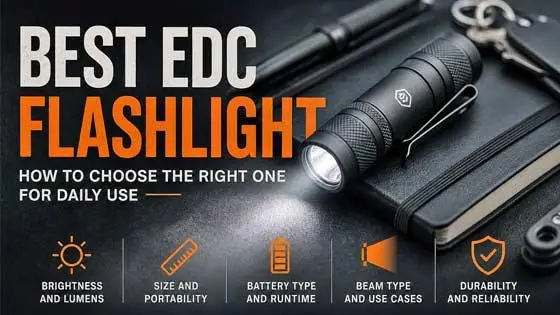
Choosing the best EDC flashlight is not just about picking the brightest option you can find. It is about finding something that fits your daily routine, is easy to carry, and works reliably when you need it. With so many sizes, brightness levels, and features available, it can be difficult to know what actually matters for everyday use.
If you are already building an everyday carry setup, a flashlight is one of the most useful tools you can add. In this guide, we will break down what to look for in an everyday carry flashlight and help you choose one that fits your needs and lifestyle.
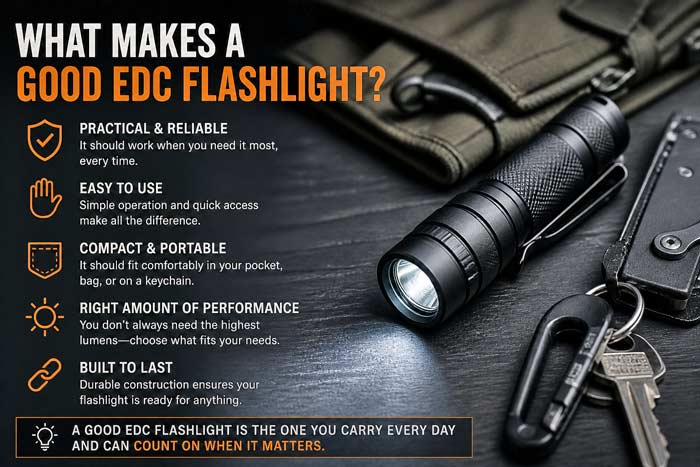
A good everyday carry flashlight should be practical, reliable, and easy to use in real-world situations. The goal is not to find the biggest or brightest option available, but to choose something that fits naturally into your daily routine and works when you actually need it. If a flashlight is too bulky, complicated, or inconvenient to carry, it is unlikely to stay with you consistently.
One of the first things to consider is how you plan to use it. Most everyday tasks involve quick, simple needs like finding something in a dark space, lighting your path at night, or handling unexpected situations where extra visibility helps. For those purposes, a compact flashlight that is easy to access and operate is usually the best choice.
Portability is just as important as performance. A good EDC flashlight should fit comfortably in your pocket, bag, or on a keychain without getting in the way. If you are already putting together your daily carry gear, your flashlight should feel like a natural addition rather than something extra you have to think about carrying.
Finally, reliability matters more than anything else. A flashlight that turns on instantly, holds a consistent beam, and works when you need it most is far more valuable than one with extra features you rarely use. Choosing something simple, durable, and dependable will always lead to a better everyday carry experience.
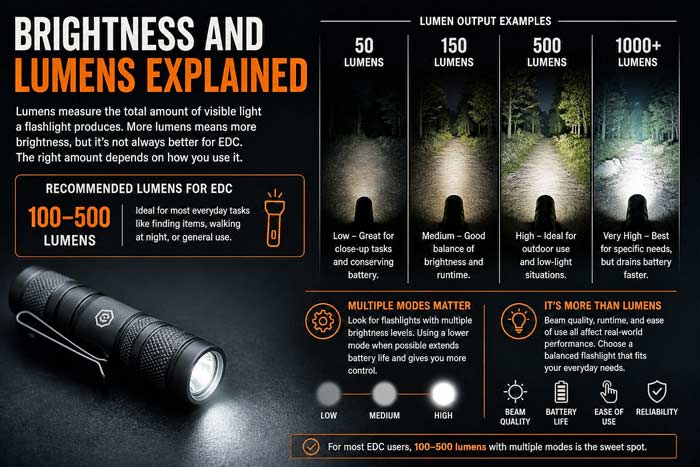
When choosing an EDC flashlight, brightness is one of the first things people look at, and it is usually measured in lumens. Lumens tell you how much total light a flashlight produces, but more is not always better when it comes to everyday carry. The goal is to have enough brightness to handle your daily needs without sacrificing battery life or creating unnecessary bulk.
For most everyday tasks, a flashlight in the range of 100 to 500 lumens is more than enough. This level of brightness works well for things like finding items in the dark, walking at night, or checking your surroundings. Higher lumen outputs can be useful in certain situations, but they are not always practical for daily use and can drain the battery much faster.
Another thing to consider is whether the flashlight offers multiple brightness modes. Being able to switch between low, medium, and high settings gives you more control and helps conserve battery when you do not need full power. Many people end up using lower settings most of the time and only switching to higher brightness when needed.
It is also worth remembering that brightness is just one part of overall performance. Beam quality, battery life, and ease of use all play a role in how effective a flashlight is in real-world situations. Choosing a balanced option with the right level of brightness will give you a much better everyday carry experience than simply picking the highest lumen number available.
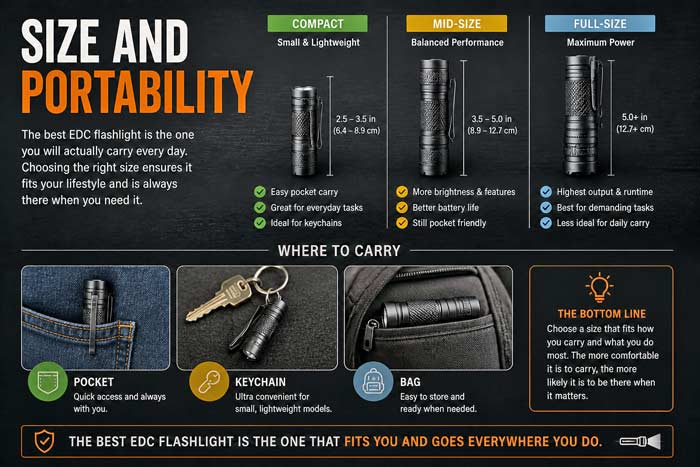
Size is one of the most important factors when choosing an EDC flashlight because it directly affects whether you will actually carry it every day. A flashlight can have great features, but if it is too large or uncomfortable to carry, it will likely end up staying at home. The best option is one that fits naturally into your routine without adding extra bulk.
Smaller flashlights are usually the most practical choice for everyday carry. They can fit easily in your pocket, attach to a keychain, or slide into a small compartment in your bag. This makes them easy to carry consistently, which is what matters most for EDC. Many compact designs still offer plenty of brightness for everyday tasks, so you are not sacrificing performance just to save space.
Larger flashlights can provide more power and longer battery life, but they are not always necessary for daily use. They tend to be better suited for specific situations rather than constant carry. For most people, a compact or mid-sized flashlight offers the best balance between performance and portability.
When choosing a size, think about how you plan to carry it. Whether it is in your pocket, on your keys, or in your bag, the right flashlight should feel easy to bring with you without getting in the way. A simple, comfortable carry option is what makes it something you will actually use every day.
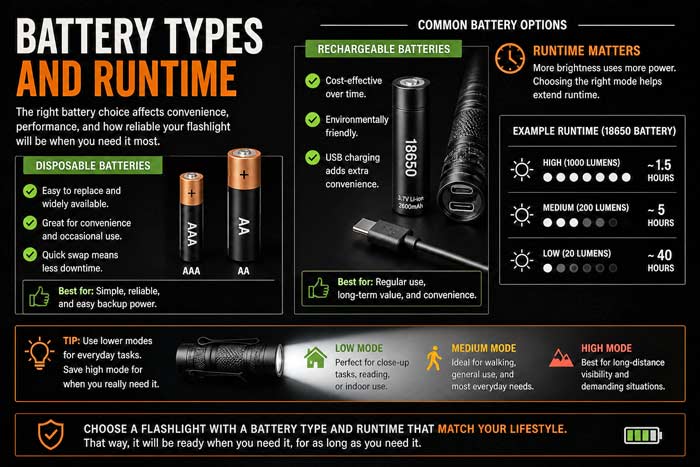
Battery type is an important factor when choosing an EDC flashlight because it affects both convenience and long-term use. The two most common options are disposable batteries and rechargeable batteries, and each one has its own advantages depending on how you plan to use your flashlight.
Disposable batteries, such as AAA or AA, are easy to replace and widely available. This makes them a convenient option if you want something simple and do not want to worry about charging. If the battery runs out, you can quickly swap it and keep going. For some people, that simplicity is a big advantage, especially for occasional use.
Rechargeable batteries, on the other hand, are becoming more popular for everyday carry. Many modern flashlights use built-in rechargeable batteries or removable lithium-ion cells that can be charged with a USB cable. This can be more convenient over time since you do not have to keep buying replacements, and it is often more cost-effective if you use your flashlight regularly.
Runtime is just as important as battery type. A flashlight that is very bright but drains quickly may not be as useful for everyday carry. This is why many people prefer models with multiple brightness levels, allowing them to extend battery life by using lower settings when full power is not needed. Choosing a flashlight with a good balance of brightness and runtime will give you a more reliable and practical everyday tool.
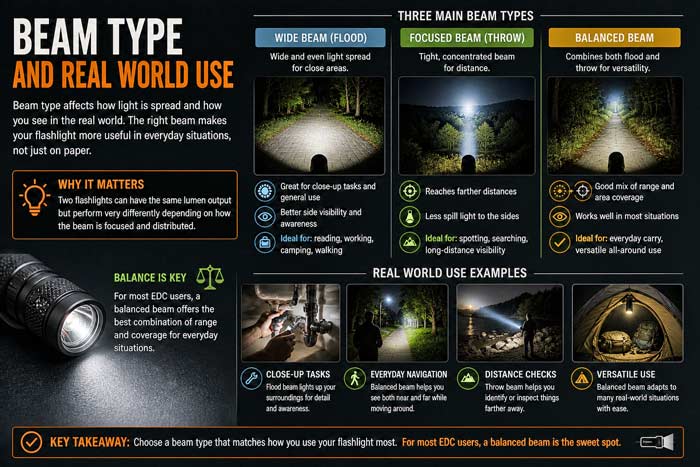
Beam type is something a lot of people overlook when choosing an EDC flashlight, but it has a big impact on how useful the light actually is. Two flashlights can have the same lumen output and still perform very differently depending on how the beam is focused and distributed.
A wide beam, often called a flood beam, spreads light across a larger area. This makes it ideal for close-up tasks like searching through a bag, working in tight spaces, or walking in low-light conditions. It provides better visibility across your surroundings rather than focusing on a single point.
A focused beam, sometimes referred to as a throw beam, concentrates light into a tighter area and projects it farther. This is useful when you need to see at a distance, such as checking a dark path ahead or identifying something farther away. However, it does not provide as much side visibility as a flood beam.
Many EDC flashlights offer a balanced beam that combines both flood and throw. This type of beam is usually the most practical for everyday use because it gives you enough range while still lighting up the area around you. For most people, a balanced beam is the best option since it works well across a variety of real-world situations.
Choosing the best EDC flashlight comes down to finding something that fits your routine, feels comfortable to carry, and works reliably when you need it. It is easy to get caught up in specs like maximum brightness or advanced features, but for everyday use, simplicity and consistency usually matter more.
For most people, a compact flashlight with a balanced beam, multiple brightness modes, and a dependable battery setup will cover nearly every situation they run into. The key is to choose something that you will actually carry every day rather than something that feels too bulky or unnecessary.
If you are building out your everyday setup, it can also help to look at how a flashlight fits alongside other gear. Browsing different types of EDC tools can give you a better idea of how everything works together and help you create a setup that makes sense for your lifestyle.
At the end of the day, the best EDC flashlight is the one you trust, the one you are comfortable using, and the one you have with you when it matters most.
What Makes a Good EDC Flashlight?
A good everyday carry flashlight should be practical, reliable, and easy to use in real-world situations. The goal is not to find the biggest or brightest option available, but to choose something that fits naturally into your daily routine and works when you actually need it. If a flashlight is too bulky, complicated, or inconvenient to carry, it is unlikely to stay with you consistently.
One of the first things to consider is how you plan to use it. Most everyday tasks involve quick, simple needs like finding something in a dark space, lighting your path at night, or handling unexpected situations where extra visibility helps. For those purposes, a compact flashlight that is easy to access and operate is usually the best choice.
Portability is just as important as performance. A good EDC flashlight should fit comfortably in your pocket, bag, or on a keychain without getting in the way. If you are already putting together your daily carry gear, your flashlight should feel like a natural addition rather than something extra you have to think about carrying.
Finally, reliability matters more than anything else. A flashlight that turns on instantly, holds a consistent beam, and works when you need it most is far more valuable than one with extra features you rarely use. Choosing something simple, durable, and dependable will always lead to a better everyday carry experience.
Brightness and Lumens Explained
When choosing an EDC flashlight, brightness is one of the first things people look at, and it is usually measured in lumens. Lumens tell you how much total light a flashlight produces, but more is not always better when it comes to everyday carry. The goal is to have enough brightness to handle your daily needs without sacrificing battery life or creating unnecessary bulk.
For most everyday tasks, a flashlight in the range of 100 to 500 lumens is more than enough. This level of brightness works well for things like finding items in the dark, walking at night, or checking your surroundings. Higher lumen outputs can be useful in certain situations, but they are not always practical for daily use and can drain the battery much faster.
Another thing to consider is whether the flashlight offers multiple brightness modes. Being able to switch between low, medium, and high settings gives you more control and helps conserve battery when you do not need full power. Many people end up using lower settings most of the time and only switching to higher brightness when needed.
It is also worth remembering that brightness is just one part of overall performance. Beam quality, battery life, and ease of use all play a role in how effective a flashlight is in real-world situations. Choosing a balanced option with the right level of brightness will give you a much better everyday carry experience than simply picking the highest lumen number available.
Size and Portability
Size is one of the most important factors when choosing an EDC flashlight because it directly affects whether you will actually carry it every day. A flashlight can have great features, but if it is too large or uncomfortable to carry, it will likely end up staying at home. The best option is one that fits naturally into your routine without adding extra bulk.
Smaller flashlights are usually the most practical choice for everyday carry. They can fit easily in your pocket, attach to a keychain, or slide into a small compartment in your bag. This makes them easy to carry consistently, which is what matters most for EDC. Many compact designs still offer plenty of brightness for everyday tasks, so you are not sacrificing performance just to save space.
Larger flashlights can provide more power and longer battery life, but they are not always necessary for daily use. They tend to be better suited for specific situations rather than constant carry. For most people, a compact or mid-sized flashlight offers the best balance between performance and portability.
When choosing a size, think about how you plan to carry it. Whether it is in your pocket, on your keys, or in your bag, the right flashlight should feel easy to bring with you without getting in the way. A simple, comfortable carry option is what makes it something you will actually use every day.
Battery Types and Runtime
Battery type is an important factor when choosing an EDC flashlight because it affects both convenience and long-term use. The two most common options are disposable batteries and rechargeable batteries, and each one has its own advantages depending on how you plan to use your flashlight.
Disposable batteries, such as AAA or AA, are easy to replace and widely available. This makes them a convenient option if you want something simple and do not want to worry about charging. If the battery runs out, you can quickly swap it and keep going. For some people, that simplicity is a big advantage, especially for occasional use.
Rechargeable batteries, on the other hand, are becoming more popular for everyday carry. Many modern flashlights use built-in rechargeable batteries or removable lithium-ion cells that can be charged with a USB cable. This can be more convenient over time since you do not have to keep buying replacements, and it is often more cost-effective if you use your flashlight regularly.
Runtime is just as important as battery type. A flashlight that is very bright but drains quickly may not be as useful for everyday carry. This is why many people prefer models with multiple brightness levels, allowing them to extend battery life by using lower settings when full power is not needed. Choosing a flashlight with a good balance of brightness and runtime will give you a more reliable and practical everyday tool.
Beam Type and Real World Use
Beam type is something a lot of people overlook when choosing an EDC flashlight, but it has a big impact on how useful the light actually is. Two flashlights can have the same lumen output and still perform very differently depending on how the beam is focused and distributed.
A wide beam, often called a flood beam, spreads light across a larger area. This makes it ideal for close-up tasks like searching through a bag, working in tight spaces, or walking in low-light conditions. It provides better visibility across your surroundings rather than focusing on a single point.
A focused beam, sometimes referred to as a throw beam, concentrates light into a tighter area and projects it farther. This is useful when you need to see at a distance, such as checking a dark path ahead or identifying something farther away. However, it does not provide as much side visibility as a flood beam.
Many EDC flashlights offer a balanced beam that combines both flood and throw. This type of beam is usually the most practical for everyday use because it gives you enough range while still lighting up the area around you. For most people, a balanced beam is the best option since it works well across a variety of real-world situations.
Final Thoughts on Choosing the Best EDC Flashlight
Choosing the best EDC flashlight comes down to finding something that fits your routine, feels comfortable to carry, and works reliably when you need it. It is easy to get caught up in specs like maximum brightness or advanced features, but for everyday use, simplicity and consistency usually matter more.
For most people, a compact flashlight with a balanced beam, multiple brightness modes, and a dependable battery setup will cover nearly every situation they run into. The key is to choose something that you will actually carry every day rather than something that feels too bulky or unnecessary.
If you are building out your everyday setup, it can also help to look at how a flashlight fits alongside other gear. Browsing different types of EDC tools can give you a better idea of how everything works together and help you create a setup that makes sense for your lifestyle.
At the end of the day, the best EDC flashlight is the one you trust, the one you are comfortable using, and the one you have with you when it matters most.
You May Also Be Interested In:
- How to Choose the Best Self Defense Keychain for EDC
- How to Choose the Right Nunchaku for Your Skill Level
- How Stun Guns Work and How to Choose One
- Why Choose a Ribbed Grip Aluminum Escrima?
- Throwing Axes for Beginners: How to Choose, Throw & Improve
- Best EDC Knife: How to Choose the Right Everyday Carry Knife
Leave a Reply