




How Automatic Knives Actually Work
May 8th, 2026
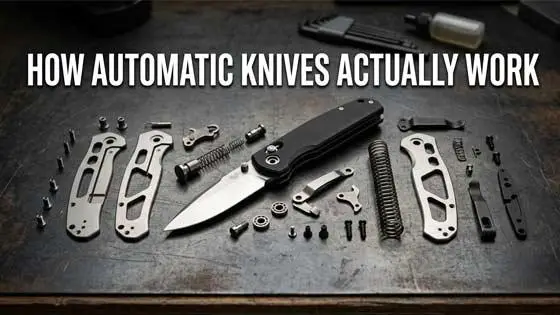
Automatic knives have always had a certain mystique around them. Part of it comes from movies and pop culture, but a lot of it comes from the mechanism itself. There is just something satisfying about pressing a button and watching the blade snap open instantly. Even people who are not serious knife collectors are usually curious about how these knives actually work internally and what makes them different from traditional folders. Whether it is a side-opening automatic knife or an out-the-front design, the engineering behind them is a lot more interesting than most people realize.
In this guide, we are going to break down how automatic knives work, what happens inside the handle when the button is pressed, and the differences between some of the most popular styles on the market today. We will also cover why automatic knives became so popular, how they compare to other types of knives, and what people usually look for when choosing one for everyday carry or collecting.
An automatic knife is a type of folding knife that uses an internal spring mechanism to deploy the blade when a button, lever, or switch is activated. Unlike a traditional manual folder that has to be opened with your thumb or both hands, an automatic knife uses stored spring tension to snap the blade open quickly and smoothly. That fast deployment is one of the main reasons these knives became so popular with collectors, knife enthusiasts, and everyday carry users.
Most people think of switchblades when they hear the term automatic knife, and technically that is correct. A switchblade is simply another name for an automatic knife. Over the years, the term "switchblade" became heavily associated with movies and pop culture, while many modern knife enthusiasts started using terms like automatic knife, auto knife, or OTF knife depending on the style and mechanism.
There are several different types of automatic knives, but they all operate using the same basic concept. Energy is stored inside the handle using a spring, and pressing the release mechanism allows that stored tension to rapidly deploy the blade. Some automatic knives open from the side like a traditional pocket knife, while others use an out-the-front design where the blade slides directly out of the handle.
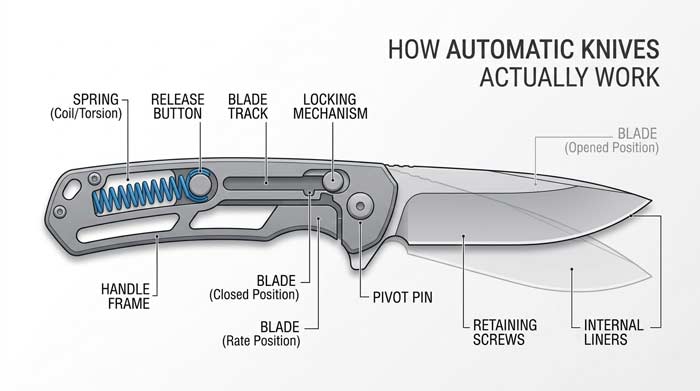
One thing that surprises many people is how much precision engineering goes into these mechanisms. Even a relatively simple automatic knife contains multiple internal components working together at the same time, including springs, locking systems, release buttons, stop pins, and blade tracks. When all of those parts are tuned correctly, the knife opens quickly, locks securely, and feels smooth every time the button is pressed.
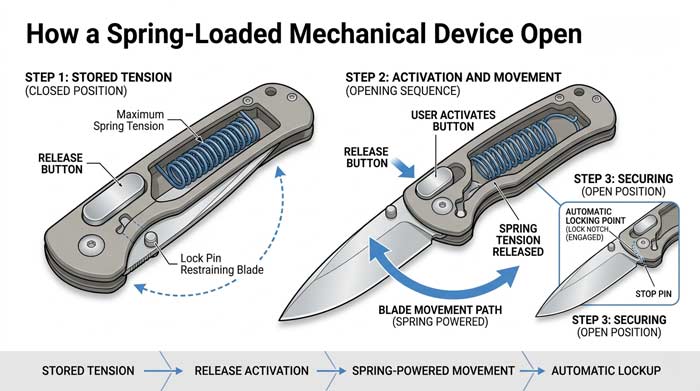
The speed of an automatic knife comes from stored spring tension inside the handle. When the knife is closed, the spring is compressed or tensioned and held in place by a locking mechanism. Pressing the button releases that tension almost instantly, which forces the blade outward with enough speed to fully open and lock into position.
Even though the action looks simple from the outside, several parts are working together at the exact same moment. As the release button disengages the lock, the spring pushes against the blade tang or internal carrier system. The blade then rotates or slides forward depending on the knife design until it reaches a stopping point where another lock engages to keep the blade secure while in use.
Most side-opening automatic knives work somewhat like a traditional folding knife, except the spring handles the opening movement instead of your thumb. Out-the-front knives, often called OTF knives, work differently because the blade travels straight out through the front of the handle on a guided track system. Those designs usually involve more complex internal mechanics and tighter tolerances.
One reason people enjoy automatic knives so much is the consistency of the mechanism. A well-made automatic knife opens with the same smooth snap every time the button is pressed. Knife enthusiasts often pay close attention to how strong the deployment feels, how solid the lockup is, and how smooth the action remains after repeated use.
Some people assume automatic knives are fragile because they contain moving parts, but quality designs are usually built to handle repeated opening and closing cycles. Like any mechanical tool, though, they still benefit from occasional cleaning and maintenance to keep dirt, lint, and debris from affecting the internal action over time.
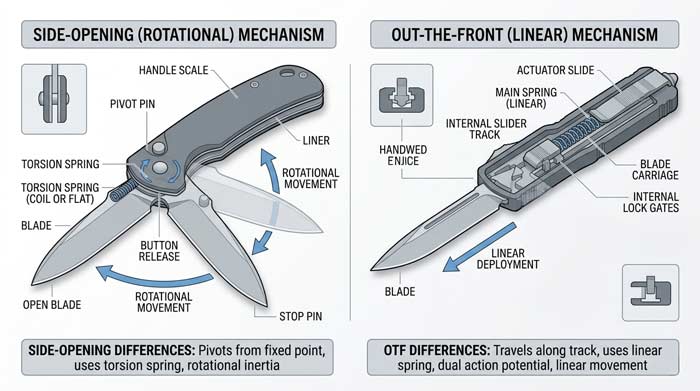
Not all automatic knives work the same way, and one of the biggest differences is how the blade deploys. The two most common styles are side-opening automatic knives and out-the-front knives, usually shortened to OTF knives. Both use spring-powered mechanisms, but the blade movement and internal construction are very different.
Side-opening automatic knives work similarly to traditional folding knives. The blade rotates outward from the side of the handle using a pivot point. When the release button is pressed, the spring rapidly swings the blade into the open position until the locking system engages. This style has been around for decades and is often appreciated for its simple, reliable design.
OTF knives operate differently because the blade slides directly out through the front of the handle instead of rotating from the side. Most modern OTF knives use a sliding switch on the handle that both deploys and retracts the blade. These mechanisms usually rely on internal tracks, springs, and carriers that guide the blade during movement. Because of the additional moving parts involved, OTF knives tend to feel more mechanical and futuristic compared to side-opening models.
Many knife enthusiasts enjoy OTF knives because the action feels fast, smooth, and satisfying to operate. Others prefer side-opening automatic knives because they are often simpler internally and may be easier to maintain over time. Neither style is universally better since it mostly comes down to personal preference, intended use, and what type of opening mechanism someone enjoys carrying.
Some collectors end up owning both styles because the experience feels completely different between them. A side-opening automatic knife often feels closer to a classic pocket knife, while an OTF design feels more specialized and mechanically unique. That variety is part of what keeps automatic knives so popular among knife enthusiasts and collectors today.
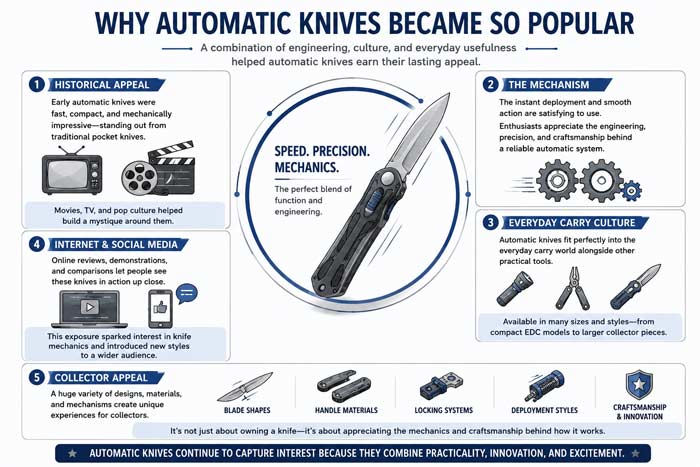
Automatic knives have been popular for decades, but their appeal has changed quite a bit over time. Early automatic knives gained attention because they were fast, compact, and mechanically impressive compared to traditional pocket knives. Over the years, movies, television, and pop culture also helped create a certain mystique around them, especially during the mid to late 1900s when switchblades became heavily associated with action films and crime dramas.
Today, most people interested in automatic knives are drawn to them because of the mechanism itself. There is something satisfying about the instant deployment and smooth mechanical action that makes these knives enjoyable to operate. Many knife enthusiasts appreciate the engineering, precision, and craftsmanship involved in designing a reliable automatic opening system.
Another reason automatic knives became so popular is the growth of everyday carry culture. People became more interested in practical tools they could carry daily, and automatic knives naturally fit into that world alongside flashlights, multitools, and other compact gear. Modern knives are available in a huge range of sizes and styles, from compact everyday carry models to larger collector-focused designs.
The rise of internet videos and social media also played a major role in their popularity. Knife reviews, demonstrations, and mechanism comparisons gave people a chance to see how these knives functioned up close. That exposure helped many people become more interested in knife mechanics and introduced newer generations to styles like OTF knives that they may not have seen before.
Collectors also enjoy the variety available in the automatic knife world. Different blade shapes, opening mechanisms, handle materials, locking systems, and deployment styles all create slightly different experiences. For many enthusiasts, the appeal is not just owning a knife, but appreciating the mechanics and craftsmanship behind how it works.
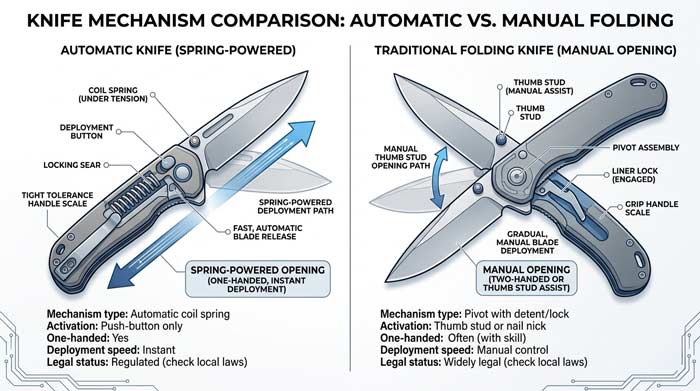
One of the biggest differences between automatic knives and traditional folding knives is how the blade is deployed. A traditional folding knife usually requires manual pressure from the user to open the blade using a thumb stud, nail nick, flipper tab, or opening hole. Automatic knives use an internal spring mechanism to handle most of that movement once the release button is pressed.
For many people, the biggest advantage of an automatic knife is speed and convenience. The blade can be deployed quickly using one hand, which makes the action feel smooth and effortless. Knife enthusiasts also tend to enjoy the mechanical feel and satisfying snap that automatic knives provide during deployment.
Traditional folding knives still remain extremely popular because of their simplicity and wide variety of styles. Since they do not rely on internal spring tension for deployment, they often have fewer moving parts internally. Many people appreciate that simpler construction, especially for heavy everyday use or long-term reliability.
Another major difference comes down to the overall experience of carrying and using the knife. Automatic knives often appeal to collectors and enthusiasts who enjoy mechanical precision, while traditional folding knives are frequently chosen for practicality, utility, and simplicity. Neither style is universally better because both offer advantages depending on personal preference and intended use.
Some knife users eventually carry both styles for different situations. An automatic knife may be preferred for quick one-handed access and mechanical appeal, while a manual folder may feel lighter, simpler, or easier to maintain over time. That variety is part of what makes the broader world of fixed blade knives and pocket carry tools so interesting to collectors and everyday carry enthusiasts alike.
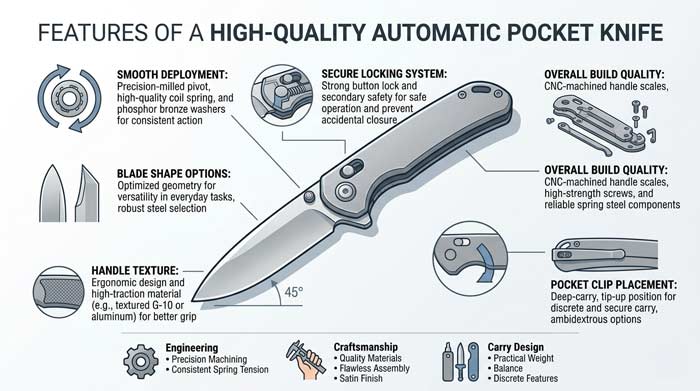
People look for different things when choosing an automatic knife, but a few features tend to matter to almost everyone. One of the biggest is how smooth and reliable the opening action feels. A quality automatic knife should deploy consistently with solid lockup and minimal blade play when opened. Enthusiasts often pay close attention to how crisp the action feels when the button is pressed and how securely the blade locks into position afterward.
Blade shape is another major factor. Some people prefer compact drop point blades for general everyday carry tasks, while others like tanto or spear point designs for a more tactical appearance. The intended use usually determines what style feels most practical. Many buyers also pay attention to blade steel, edge retention, corrosion resistance, and how easy the knife is to sharpen over time.
Handle design can make a huge difference in how comfortable the knife feels during use. Texture, grip shape, weight balance, and pocket clip placement all affect how the knife carries and handles in everyday situations. Some people prefer lightweight aluminum handles for easier pocket carry, while others like heavier designs that feel more solid and substantial in the hand.
Another important factor is overall build quality. Better automatic knives typically have tighter tolerances, smoother deployment, and stronger locking systems. Even small details like button responsiveness, spring tension, and blade centering can dramatically change how refined the knife feels. Many enthusiasts enjoy trying different styles because each mechanism and handle design creates a slightly different experience.
For beginners exploring the world of auto-opening knives, personal preference usually matters more than chasing the most expensive option immediately. Many affordable models still provide smooth deployment, solid construction, and plenty of everyday usability while giving people a chance to learn what styles and mechanisms they enjoy most.
Part of what makes automatic knives so interesting is that they combine mechanical engineering with practical everyday design. Even though the opening action looks simple on the outside, there is a surprising amount of precision happening inside the handle every time the button is pressed. Springs, locks, tracks, and moving components all work together within a very small space to create that fast and satisfying deployment people enjoy so much.
For some people, the appeal comes from convenience and one-handed operation. For others, it is purely about the mechanics and craftsmanship behind the design. That is why automatic knives continue to attract everyone from casual everyday carry users to serious collectors who appreciate the small differences between opening systems, lock styles, and overall construction quality.
Modern automatic knives also come in a huge variety of shapes, sizes, and deployment styles, which gives people a chance to find something that matches their personal preferences. Some users prefer compact side-opening models that feel similar to traditional pocket knives, while others enjoy the futuristic mechanical feel of OTF designs. There is no single "best" option because the experience is largely personal and depends on what someone enjoys carrying and using most often.
Whether someone is new to the hobby or already a longtime enthusiast, learning how these mechanisms work usually makes automatic knives even more interesting. Understanding the engineering behind the action gives people a greater appreciation for the craftsmanship, design, and precision that go into building reliable modern everyday carry blades and pocket tools.
What Is an Automatic Knife?
An automatic knife is a type of folding knife that uses an internal spring mechanism to deploy the blade when a button, lever, or switch is activated. Unlike a traditional manual folder that has to be opened with your thumb or both hands, an automatic knife uses stored spring tension to snap the blade open quickly and smoothly. That fast deployment is one of the main reasons these knives became so popular with collectors, knife enthusiasts, and everyday carry users.
Most people think of switchblades when they hear the term automatic knife, and technically that is correct. A switchblade is simply another name for an automatic knife. Over the years, the term "switchblade" became heavily associated with movies and pop culture, while many modern knife enthusiasts started using terms like automatic knife, auto knife, or OTF knife depending on the style and mechanism.
There are several different types of automatic knives, but they all operate using the same basic concept. Energy is stored inside the handle using a spring, and pressing the release mechanism allows that stored tension to rapidly deploy the blade. Some automatic knives open from the side like a traditional pocket knife, while others use an out-the-front design where the blade slides directly out of the handle.
One thing that surprises many people is how much precision engineering goes into these mechanisms. Even a relatively simple automatic knife contains multiple internal components working together at the same time, including springs, locking systems, release buttons, stop pins, and blade tracks. When all of those parts are tuned correctly, the knife opens quickly, locks securely, and feels smooth every time the button is pressed.
How Automatic Knives Open So Quickly
The speed of an automatic knife comes from stored spring tension inside the handle. When the knife is closed, the spring is compressed or tensioned and held in place by a locking mechanism. Pressing the button releases that tension almost instantly, which forces the blade outward with enough speed to fully open and lock into position.
Even though the action looks simple from the outside, several parts are working together at the exact same moment. As the release button disengages the lock, the spring pushes against the blade tang or internal carrier system. The blade then rotates or slides forward depending on the knife design until it reaches a stopping point where another lock engages to keep the blade secure while in use.
Most side-opening automatic knives work somewhat like a traditional folding knife, except the spring handles the opening movement instead of your thumb. Out-the-front knives, often called OTF knives, work differently because the blade travels straight out through the front of the handle on a guided track system. Those designs usually involve more complex internal mechanics and tighter tolerances.
One reason people enjoy automatic knives so much is the consistency of the mechanism. A well-made automatic knife opens with the same smooth snap every time the button is pressed. Knife enthusiasts often pay close attention to how strong the deployment feels, how solid the lockup is, and how smooth the action remains after repeated use.
Some people assume automatic knives are fragile because they contain moving parts, but quality designs are usually built to handle repeated opening and closing cycles. Like any mechanical tool, though, they still benefit from occasional cleaning and maintenance to keep dirt, lint, and debris from affecting the internal action over time.
Side-Opening vs OTF Automatic Knives
Not all automatic knives work the same way, and one of the biggest differences is how the blade deploys. The two most common styles are side-opening automatic knives and out-the-front knives, usually shortened to OTF knives. Both use spring-powered mechanisms, but the blade movement and internal construction are very different.
Side-opening automatic knives work similarly to traditional folding knives. The blade rotates outward from the side of the handle using a pivot point. When the release button is pressed, the spring rapidly swings the blade into the open position until the locking system engages. This style has been around for decades and is often appreciated for its simple, reliable design.
OTF knives operate differently because the blade slides directly out through the front of the handle instead of rotating from the side. Most modern OTF knives use a sliding switch on the handle that both deploys and retracts the blade. These mechanisms usually rely on internal tracks, springs, and carriers that guide the blade during movement. Because of the additional moving parts involved, OTF knives tend to feel more mechanical and futuristic compared to side-opening models.
Many knife enthusiasts enjoy OTF knives because the action feels fast, smooth, and satisfying to operate. Others prefer side-opening automatic knives because they are often simpler internally and may be easier to maintain over time. Neither style is universally better since it mostly comes down to personal preference, intended use, and what type of opening mechanism someone enjoys carrying.
Some collectors end up owning both styles because the experience feels completely different between them. A side-opening automatic knife often feels closer to a classic pocket knife, while an OTF design feels more specialized and mechanically unique. That variety is part of what keeps automatic knives so popular among knife enthusiasts and collectors today.
Why Automatic Knives Became So Popular
Automatic knives have been popular for decades, but their appeal has changed quite a bit over time. Early automatic knives gained attention because they were fast, compact, and mechanically impressive compared to traditional pocket knives. Over the years, movies, television, and pop culture also helped create a certain mystique around them, especially during the mid to late 1900s when switchblades became heavily associated with action films and crime dramas.
Today, most people interested in automatic knives are drawn to them because of the mechanism itself. There is something satisfying about the instant deployment and smooth mechanical action that makes these knives enjoyable to operate. Many knife enthusiasts appreciate the engineering, precision, and craftsmanship involved in designing a reliable automatic opening system.
Another reason automatic knives became so popular is the growth of everyday carry culture. People became more interested in practical tools they could carry daily, and automatic knives naturally fit into that world alongside flashlights, multitools, and other compact gear. Modern knives are available in a huge range of sizes and styles, from compact everyday carry models to larger collector-focused designs.
The rise of internet videos and social media also played a major role in their popularity. Knife reviews, demonstrations, and mechanism comparisons gave people a chance to see how these knives functioned up close. That exposure helped many people become more interested in knife mechanics and introduced newer generations to styles like OTF knives that they may not have seen before.
Collectors also enjoy the variety available in the automatic knife world. Different blade shapes, opening mechanisms, handle materials, locking systems, and deployment styles all create slightly different experiences. For many enthusiasts, the appeal is not just owning a knife, but appreciating the mechanics and craftsmanship behind how it works.
Automatic Knives vs Traditional Folding Knives
One of the biggest differences between automatic knives and traditional folding knives is how the blade is deployed. A traditional folding knife usually requires manual pressure from the user to open the blade using a thumb stud, nail nick, flipper tab, or opening hole. Automatic knives use an internal spring mechanism to handle most of that movement once the release button is pressed.
For many people, the biggest advantage of an automatic knife is speed and convenience. The blade can be deployed quickly using one hand, which makes the action feel smooth and effortless. Knife enthusiasts also tend to enjoy the mechanical feel and satisfying snap that automatic knives provide during deployment.
Traditional folding knives still remain extremely popular because of their simplicity and wide variety of styles. Since they do not rely on internal spring tension for deployment, they often have fewer moving parts internally. Many people appreciate that simpler construction, especially for heavy everyday use or long-term reliability.
Another major difference comes down to the overall experience of carrying and using the knife. Automatic knives often appeal to collectors and enthusiasts who enjoy mechanical precision, while traditional folding knives are frequently chosen for practicality, utility, and simplicity. Neither style is universally better because both offer advantages depending on personal preference and intended use.
Some knife users eventually carry both styles for different situations. An automatic knife may be preferred for quick one-handed access and mechanical appeal, while a manual folder may feel lighter, simpler, or easier to maintain over time. That variety is part of what makes the broader world of fixed blade knives and pocket carry tools so interesting to collectors and everyday carry enthusiasts alike.
What Makes a Good Automatic Knife?
People look for different things when choosing an automatic knife, but a few features tend to matter to almost everyone. One of the biggest is how smooth and reliable the opening action feels. A quality automatic knife should deploy consistently with solid lockup and minimal blade play when opened. Enthusiasts often pay close attention to how crisp the action feels when the button is pressed and how securely the blade locks into position afterward.
Blade shape is another major factor. Some people prefer compact drop point blades for general everyday carry tasks, while others like tanto or spear point designs for a more tactical appearance. The intended use usually determines what style feels most practical. Many buyers also pay attention to blade steel, edge retention, corrosion resistance, and how easy the knife is to sharpen over time.
Handle design can make a huge difference in how comfortable the knife feels during use. Texture, grip shape, weight balance, and pocket clip placement all affect how the knife carries and handles in everyday situations. Some people prefer lightweight aluminum handles for easier pocket carry, while others like heavier designs that feel more solid and substantial in the hand.
Another important factor is overall build quality. Better automatic knives typically have tighter tolerances, smoother deployment, and stronger locking systems. Even small details like button responsiveness, spring tension, and blade centering can dramatically change how refined the knife feels. Many enthusiasts enjoy trying different styles because each mechanism and handle design creates a slightly different experience.
For beginners exploring the world of auto-opening knives, personal preference usually matters more than chasing the most expensive option immediately. Many affordable models still provide smooth deployment, solid construction, and plenty of everyday usability while giving people a chance to learn what styles and mechanisms they enjoy most.
Final Thoughts on Automatic Knife Mechanisms
Part of what makes automatic knives so interesting is that they combine mechanical engineering with practical everyday design. Even though the opening action looks simple on the outside, there is a surprising amount of precision happening inside the handle every time the button is pressed. Springs, locks, tracks, and moving components all work together within a very small space to create that fast and satisfying deployment people enjoy so much.
For some people, the appeal comes from convenience and one-handed operation. For others, it is purely about the mechanics and craftsmanship behind the design. That is why automatic knives continue to attract everyone from casual everyday carry users to serious collectors who appreciate the small differences between opening systems, lock styles, and overall construction quality.
Modern automatic knives also come in a huge variety of shapes, sizes, and deployment styles, which gives people a chance to find something that matches their personal preferences. Some users prefer compact side-opening models that feel similar to traditional pocket knives, while others enjoy the futuristic mechanical feel of OTF designs. There is no single "best" option because the experience is largely personal and depends on what someone enjoys carrying and using most often.
Whether someone is new to the hobby or already a longtime enthusiast, learning how these mechanisms work usually makes automatic knives even more interesting. Understanding the engineering behind the action gives people a greater appreciation for the craftsmanship, design, and precision that go into building reliable modern everyday carry blades and pocket tools.
You May Also Be Interested In:
- How Do Automatic Knives Work? Inside the Mechanism
- Why Automatic Knives Belong in Your EDC
- The Evolution of Automatic Knives: From Battlefield Tools to Everyday Carry
- Switchblade vs Automatic Knife: What's the Difference?
- What Is a Telescoping Baton and How Does It Work
- Non Lethal Self Defense Weapons That Actually Work
- Cat Keychain Self Defense: Do They Work and Are They Legal
- How Stun Guns Work and How to Choose One
- Stun Gun Brass Knuckles: How They Work and Are They Effective?
- 6 Unusual Folding Knives
Leave a Reply