




Best EDC Knife: How to Choose the Right Everyday Carry Knife
May 5th, 2026
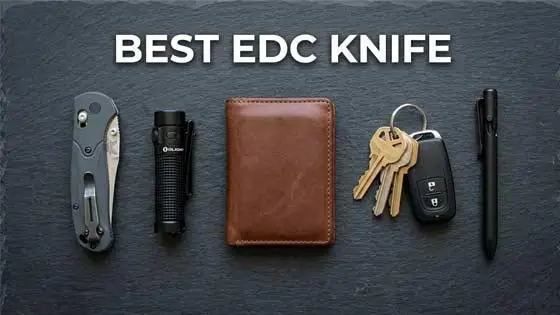
Choosing the best EDC knife is not just about picking something that looks good. It is about finding a tool that fits your daily routine, feels comfortable to carry, and actually gets used when you need it. With so many styles, sizes, and designs available, it is easy to end up with something that does not match how you plan to use it.
If you are already building an everyday carry setup or trying to decide between different knife styles like OTF vs folding knives, your choice becomes even more important. In this guide, we will break down what to look for in an everyday carry knife and help you choose an option that fits your needs and lifestyle.
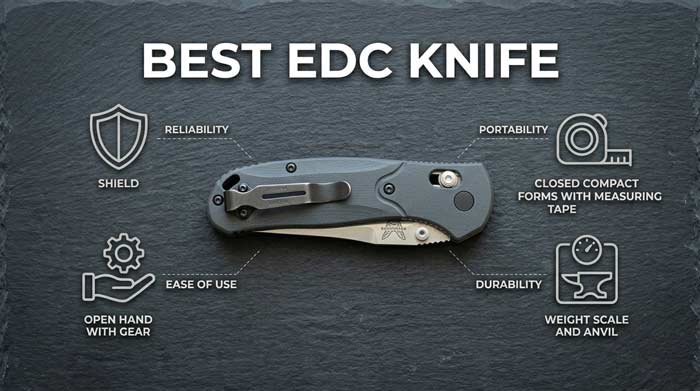
A good everyday carry knife should be practical, reliable, and easy to use in real-world situations. The goal is not to find the most advanced or expensive option, but to choose something that fits naturally into your daily routine and handles the tasks you actually encounter. If a knife feels too bulky, difficult to use, or unnecessary for your day-to-day needs, it is not going to be something you carry consistently.
One of the first things to consider is how the knife will be used. Most everyday tasks involve simple cutting jobs like opening packages, trimming materials, or handling small utility work. For those purposes, a compact and easy-to-carry design is usually the best choice. If you are still narrowing down your options, understanding how different styles compare, such as in this guide on OTF vs folding knives, can help you decide what fits your needs best.
Comfort and carry style are just as important as performance. Weight, size, and how the knife fits in your pocket all play a role in whether you will actually bring it with you every day. A well-chosen EDC knife should feel natural to carry and easy to access without getting in your way.
Finally, reliability matters more than anything else. A knife that works smoothly and consistently is far more valuable than one with extra features that you never use. Choosing something simple, durable, and comfortable will always lead to a better everyday carry experience.
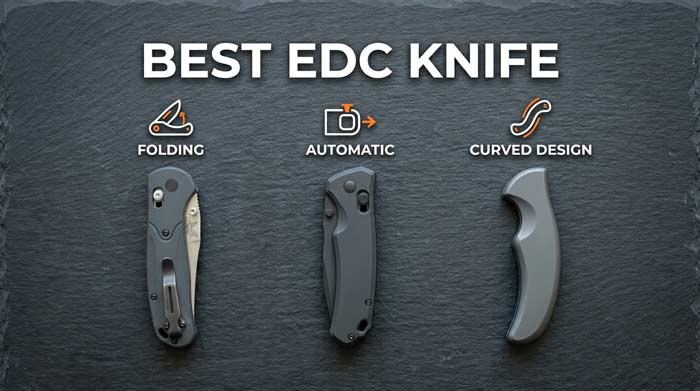
There are several types of knives that can work well for everyday carry, and each one offers different advantages depending on how you plan to use it. Understanding these basic categories can help you narrow down your options and choose something that fits your routine without overcomplicating the decision.
Folding knives are the most common choice for everyday carry. They are compact, easy to use, and come in a wide range of sizes and styles. Because they fold into the handle, they are simple to carry in a pocket and tend to be more widely accepted in different environments. If you are looking for a practical and reliable option, browsing different styles of folding knives is usually the best place to start.
Automatic knives, including out-the-front designs, offer a different experience focused on speed and convenience. With the push of a button or switch, the blade deploys quickly, making them appealing for users who want fast, one-handed operation. While they can be very convenient, they are more specialized and may have restrictions depending on where you live. If you are considering this type, exploring different automatic knives can give you a better sense of what is available.
There are also more specialized designs, such as curved blades that are built for specific grip styles and cutting techniques. These are often chosen by people who already have experience with different knife types and want something that feels more tailored to their preferences. If that interests you, looking into options like karambit knives can help you see how these designs differ from more traditional styles.
For most people, starting with a simple, well-made folding knife is the easiest and most practical choice. As you gain experience, you can explore other types and decide whether they add value to your everyday carry setup.
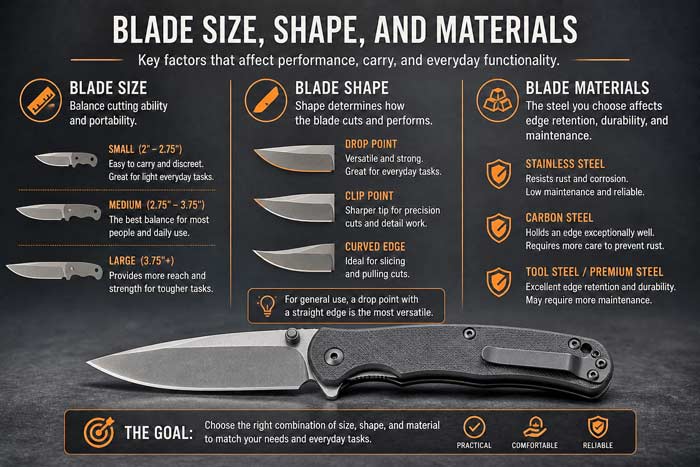
When choosing the best EDC knife, the blade itself is one of the most important factors to consider. Size, shape, and material all affect how the knife performs in everyday situations. The goal is to find a balance that gives you enough cutting ability without making the knife uncomfortable or impractical to carry.
Blade size plays a big role in portability. Smaller blades are easier to carry and less noticeable in your pocket, which makes them ideal for everyday use. Larger blades can handle tougher tasks, but they may feel bulky and are not always necessary for simple daily jobs. For most people, a medium-sized blade offers the best balance between convenience and functionality.
Blade shape also affects how the knife performs. Straight-edged blades are great for clean, controlled cuts, while curved designs can make slicing tasks easier. Some shapes are more specialized, but for general use, a simple and versatile blade design is usually the most practical choice. The more you use your knife, the more you will start to notice which shapes feel natural and effective for your routine.
Material is another key factor. Different blade steels offer different levels of sharpness, durability, and corrosion resistance. While some high-end materials can hold an edge longer, they may require more maintenance. On the other hand, more common steels are easier to sharpen and maintain, which can be a better fit for everyday use. Choosing the right material comes down to how much maintenance you are willing to do and how often you plan to use your knife.
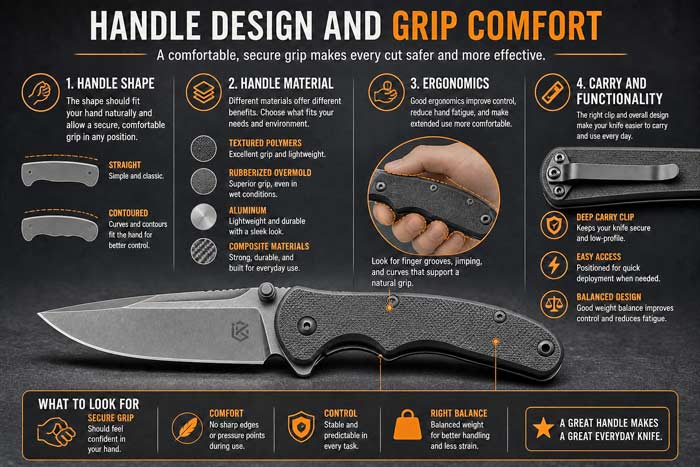
The handle of an EDC knife is just as important as the blade, especially when it comes to comfort and control. Since you will likely be using your knife for a variety of small, everyday tasks, it needs to feel natural in your hand and provide a secure grip. A knife that looks good but feels awkward or slippery is not going to be enjoyable or reliable to use.
One of the first things to consider is the shape of the handle. Some designs are straight and simple, while others include curves or contours that fit more naturally in your hand. The right shape depends on your personal preference, but it should allow you to hold the knife comfortably without having to adjust your grip constantly.
Material also plays a big role in how the knife feels. Common handle materials include textured polymers, rubberized coatings, aluminum, and other composites. Some offer better grip, while others focus on durability or a lightweight feel. The best option is one that gives you a confident grip without adding unnecessary weight or bulk to your everyday carry.
It is also worth paying attention to details like pocket clips and overall ergonomics. A well-designed clip makes it easier to carry the knife securely and access it quickly when needed. When everything works together, from the shape to the material to the carry style, the knife becomes something you barely notice until you need it.
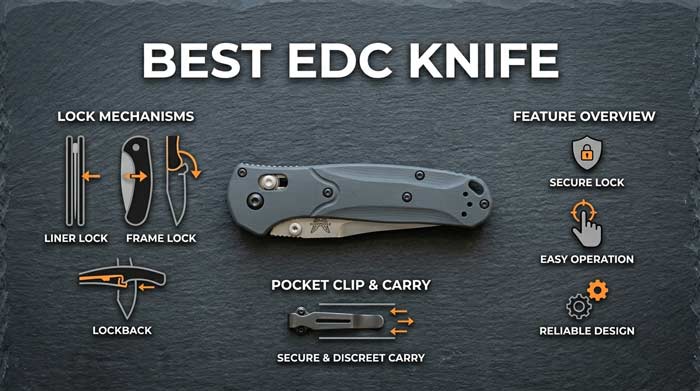
The locking mechanism on an EDC knife plays a major role in both safety and usability. Once the blade is open, the lock keeps it securely in place so it does not accidentally close during use. A good locking system should feel solid and dependable without making the knife difficult to operate.
There are several common types of locks, and each one has its own feel and level of convenience. Liner locks and frame locks are popular because they are simple, reliable, and easy to use with one hand. Lockback designs offer a more traditional feel and are known for their strength, although they can require a bit more effort to close. Axis-style locks and similar designs are often favored for their smooth operation and ambidextrous use.
Ease of use is just as important as the locking mechanism itself. A good EDC knife should open and close smoothly without requiring too much force or complicated steps. Whether you prefer a thumb stud, flipper tab, or another opening method, the knife should feel natural to operate and consistent every time you use it.
For most people, the best option is a simple, well-designed locking system that balances security and convenience. When a knife feels easy to open, secure when in use, and simple to close, it becomes a tool you can rely on without having to think about it.
Choosing the best EDC knife comes down to finding something that fits your routine, feels comfortable to carry, and works well for the tasks you actually encounter. There is no single option that works for everyone, and the right choice is usually the one that balances simplicity, reliability, and ease of use without adding unnecessary bulk.
For most people, starting with a practical and well-built option is the best approach. A simple design that you can carry every day will always be more useful than something more advanced that you leave at home. As you gain experience, you will naturally develop preferences for different features, styles, and materials based on how you use your knife.
If you are still exploring your options, browsing a wide range of everyday carry knives can help you get a better sense of what is available and what might fit your needs. You can also take a look at different types of EDC weapons to see how a knife fits into a broader everyday carry setup.
At the end of the day, the best EDC knife is the one you trust, the one you are comfortable using, and the one you will actually carry with you every day.
What Makes a Good EDC Knife?
A good everyday carry knife should be practical, reliable, and easy to use in real-world situations. The goal is not to find the most advanced or expensive option, but to choose something that fits naturally into your daily routine and handles the tasks you actually encounter. If a knife feels too bulky, difficult to use, or unnecessary for your day-to-day needs, it is not going to be something you carry consistently.
One of the first things to consider is how the knife will be used. Most everyday tasks involve simple cutting jobs like opening packages, trimming materials, or handling small utility work. For those purposes, a compact and easy-to-carry design is usually the best choice. If you are still narrowing down your options, understanding how different styles compare, such as in this guide on OTF vs folding knives, can help you decide what fits your needs best.
Comfort and carry style are just as important as performance. Weight, size, and how the knife fits in your pocket all play a role in whether you will actually bring it with you every day. A well-chosen EDC knife should feel natural to carry and easy to access without getting in your way.
Finally, reliability matters more than anything else. A knife that works smoothly and consistently is far more valuable than one with extra features that you never use. Choosing something simple, durable, and comfortable will always lead to a better everyday carry experience.
Types of EDC Knives
There are several types of knives that can work well for everyday carry, and each one offers different advantages depending on how you plan to use it. Understanding these basic categories can help you narrow down your options and choose something that fits your routine without overcomplicating the decision.
Folding knives are the most common choice for everyday carry. They are compact, easy to use, and come in a wide range of sizes and styles. Because they fold into the handle, they are simple to carry in a pocket and tend to be more widely accepted in different environments. If you are looking for a practical and reliable option, browsing different styles of folding knives is usually the best place to start.
Automatic knives, including out-the-front designs, offer a different experience focused on speed and convenience. With the push of a button or switch, the blade deploys quickly, making them appealing for users who want fast, one-handed operation. While they can be very convenient, they are more specialized and may have restrictions depending on where you live. If you are considering this type, exploring different automatic knives can give you a better sense of what is available.
There are also more specialized designs, such as curved blades that are built for specific grip styles and cutting techniques. These are often chosen by people who already have experience with different knife types and want something that feels more tailored to their preferences. If that interests you, looking into options like karambit knives can help you see how these designs differ from more traditional styles.
For most people, starting with a simple, well-made folding knife is the easiest and most practical choice. As you gain experience, you can explore other types and decide whether they add value to your everyday carry setup.
Blade Size, Shape, and Materials
When choosing the best EDC knife, the blade itself is one of the most important factors to consider. Size, shape, and material all affect how the knife performs in everyday situations. The goal is to find a balance that gives you enough cutting ability without making the knife uncomfortable or impractical to carry.
Blade size plays a big role in portability. Smaller blades are easier to carry and less noticeable in your pocket, which makes them ideal for everyday use. Larger blades can handle tougher tasks, but they may feel bulky and are not always necessary for simple daily jobs. For most people, a medium-sized blade offers the best balance between convenience and functionality.
Blade shape also affects how the knife performs. Straight-edged blades are great for clean, controlled cuts, while curved designs can make slicing tasks easier. Some shapes are more specialized, but for general use, a simple and versatile blade design is usually the most practical choice. The more you use your knife, the more you will start to notice which shapes feel natural and effective for your routine.
Material is another key factor. Different blade steels offer different levels of sharpness, durability, and corrosion resistance. While some high-end materials can hold an edge longer, they may require more maintenance. On the other hand, more common steels are easier to sharpen and maintain, which can be a better fit for everyday use. Choosing the right material comes down to how much maintenance you are willing to do and how often you plan to use your knife.
Handle Design and Grip Comfort
The handle of an EDC knife is just as important as the blade, especially when it comes to comfort and control. Since you will likely be using your knife for a variety of small, everyday tasks, it needs to feel natural in your hand and provide a secure grip. A knife that looks good but feels awkward or slippery is not going to be enjoyable or reliable to use.
One of the first things to consider is the shape of the handle. Some designs are straight and simple, while others include curves or contours that fit more naturally in your hand. The right shape depends on your personal preference, but it should allow you to hold the knife comfortably without having to adjust your grip constantly.
Material also plays a big role in how the knife feels. Common handle materials include textured polymers, rubberized coatings, aluminum, and other composites. Some offer better grip, while others focus on durability or a lightweight feel. The best option is one that gives you a confident grip without adding unnecessary weight or bulk to your everyday carry.
It is also worth paying attention to details like pocket clips and overall ergonomics. A well-designed clip makes it easier to carry the knife securely and access it quickly when needed. When everything works together, from the shape to the material to the carry style, the knife becomes something you barely notice until you need it.
Locking Mechanisms and Ease of Use
The locking mechanism on an EDC knife plays a major role in both safety and usability. Once the blade is open, the lock keeps it securely in place so it does not accidentally close during use. A good locking system should feel solid and dependable without making the knife difficult to operate.
There are several common types of locks, and each one has its own feel and level of convenience. Liner locks and frame locks are popular because they are simple, reliable, and easy to use with one hand. Lockback designs offer a more traditional feel and are known for their strength, although they can require a bit more effort to close. Axis-style locks and similar designs are often favored for their smooth operation and ambidextrous use.
Ease of use is just as important as the locking mechanism itself. A good EDC knife should open and close smoothly without requiring too much force or complicated steps. Whether you prefer a thumb stud, flipper tab, or another opening method, the knife should feel natural to operate and consistent every time you use it.
For most people, the best option is a simple, well-designed locking system that balances security and convenience. When a knife feels easy to open, secure when in use, and simple to close, it becomes a tool you can rely on without having to think about it.
Final Thoughts on Choosing the Best EDC Knife
Choosing the best EDC knife comes down to finding something that fits your routine, feels comfortable to carry, and works well for the tasks you actually encounter. There is no single option that works for everyone, and the right choice is usually the one that balances simplicity, reliability, and ease of use without adding unnecessary bulk.
For most people, starting with a practical and well-built option is the best approach. A simple design that you can carry every day will always be more useful than something more advanced that you leave at home. As you gain experience, you will naturally develop preferences for different features, styles, and materials based on how you use your knife.
If you are still exploring your options, browsing a wide range of everyday carry knives can help you get a better sense of what is available and what might fit your needs. You can also take a look at different types of EDC weapons to see how a knife fits into a broader everyday carry setup.
At the end of the day, the best EDC knife is the one you trust, the one you are comfortable using, and the one you will actually carry with you every day.
You May Also Be Interested In:
- What Is a Boot Knife and Why Do People Carry Them?
- What Is a Neck Knife and Why Do People Carry Them?
- Choosing the Best Stun Gun for Everyday Carry
- What Is the Best Self Defense Weapon for Everyday Carry?
- Choosing the Best Pepper Spray for Everyday Carry
- Best Self Defense Weapons for Everyday Carry (EDC Guide)
- What Is EDC? A Complete Guide to Everyday Carry Gear
- The Evolution of Automatic Knives: From Battlefield Tools to Everyday Carry
- Why Every Day Should Be an EDC Knife Day: How a Simple Knife Can Make Your Life Easier and Safer
- Bowie Knife vs Hunting Knife: What's the Difference?
Leave a Reply