




The History of the Monkey Fist: From Sailing Knot to Modern Tool
May 28th, 2026
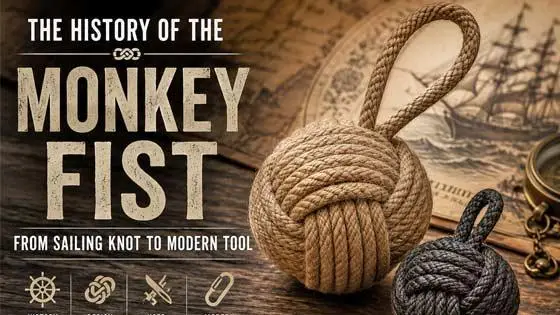
The monkey fist is one of those things that many people recognize but few actually know much about. Some people know it as a decorative knot, others recognize it from survival gear or keychains, and many have seen it connected to paracord or maritime equipment without realizing it has a surprisingly long history. What started as a practical knot used by sailors eventually evolved into something with a much broader range of uses, from boating and rescue work to utility gear, collecting, and everyday carry accessories.
At first glance, a monkey fist looks simple. It is a tightly wrapped knot that forms a round, weighted shape at the end of a rope or cord. Traditionally, sailors used monkey fists to make it easier to throw a rope from one ship to another or from dock to vessel. By adding weight to the end of a line, the knot made tossing ropes over long distances much more practical, especially in rough conditions where accuracy mattered.
Over time, monkey fists evolved far beyond their nautical roots. Modern versions are commonly made from paracord and may be attached to keychains, zipper pulls, outdoor gear, or survival equipment. Some people appreciate them for their practical uses, while others simply enjoy the craftsmanship and unique look of the knot itself.
In this guide, we will explore the history of the monkey fist, how it was originally used at sea, how the design evolved, and why people are still interested in this famous knot today.
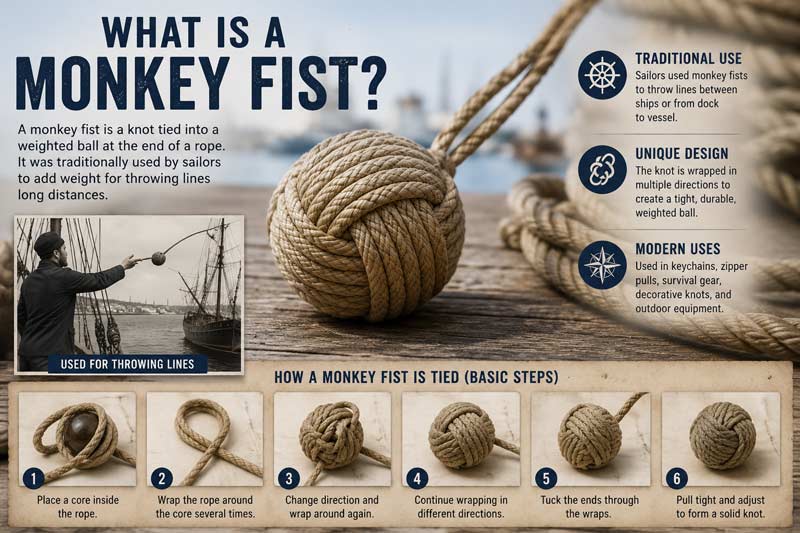
A monkey fist is a type of knot that is wrapped into a tightly woven ball at the end of a rope or cord. Traditionally, it was tied to add weight to the end of a line, making it easier to throw over longer distances. Sailors commonly used monkey fists aboard ships to help pass ropes between vessels or from dock to boat, especially when tossing a lightweight rope by hand would have been difficult.
What makes a monkey fist unique is its rounded shape and layered wrapping pattern. The knot is created by looping cord around itself several times in different directions until it forms a dense sphere. In traditional maritime settings, sailors sometimes placed a small weighted object inside the center, such as a stone or metal ball, to make the knot more effective for throwing. Modern monkey fists are often made from paracord and may use a marble, steel ball, or other core material depending on the intended purpose.
Today, monkey fists are used for much more than sailing. You will often find them attached to keychains, backpacks, zipper pulls, emergency gear, and survival kits. Some people appreciate them as practical utility knots, while others enjoy making them because of the craftsmanship involved. Decorative versions have also become popular in the paracord community because of their unique look and customizable colors.
Even though the design looks simple, the monkey fist remains one of the most recognizable and versatile knots in maritime history. Its combination of function, durability, and visual appeal is one reason it has remained popular for so many years.
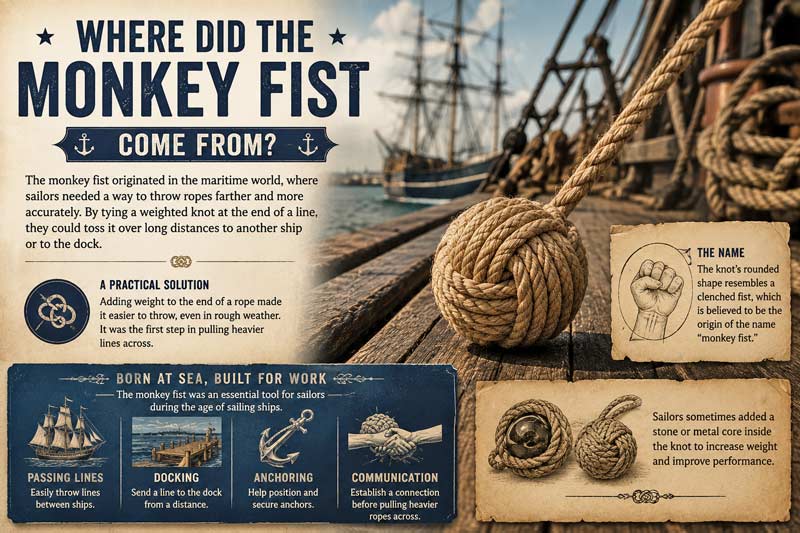
The monkey fist originated in the maritime world, where sailors needed a practical way to throw ropes over longer distances. On ships, passing lines between vessels or from dock to boat was an everyday task, but lightweight rope could be difficult to throw accurately, especially in rough weather or strong wind. To solve this problem, sailors developed the monkey fist knot by tying a dense, rounded knot at the end of a rope to add weight and improve throwing distance.
Most historians believe the monkey fist became especially common during the age of sailing ships, when crews regularly depended on ropes for docking, anchoring, and communication between vessels. By making a rope easier to toss, sailors could quickly establish a connection between ships before pulling heavier lines across. In many cases, the monkey fist acted as the first step in moving much larger ropes that were too heavy to throw by hand.
The name itself is believed to come from the knot's appearance. When tied tightly, the rounded shape resembles a small clenched fist, which likely inspired the nickname "monkey fist." Over time, sailors refined the design and sometimes added small weighted cores inside the knot, such as stones or metal balls, to make it even more effective for maritime work.
Even though ships and technology have changed dramatically over the years, the monkey fist remains one of the most recognizable nautical knots ever created. Its practical origin story is one reason people still find it fascinating today, even far beyond the world of sailing.
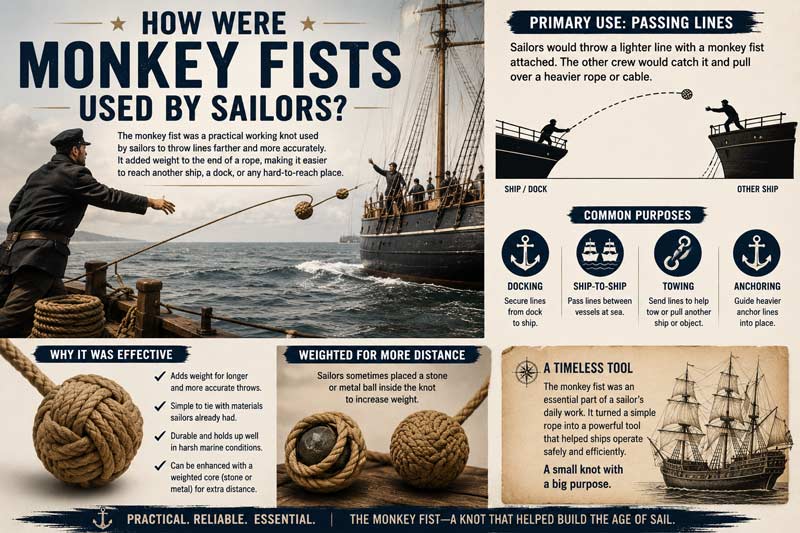
For sailors, the monkey fist was not decorative at all. It was a practical working knot designed to solve a very real problem: how to get a rope from one place to another quickly and accurately. Throwing a lightweight rope across open water can be surprisingly difficult, especially when ships are moving, winds are strong, or distances are longer than expected. By tying a monkey fist at the end of a line, sailors added weight that made the rope easier to throw and more likely to land where it was needed.
One of the most common uses involved passing a line between ships or from a dock to a vessel. A sailor would throw the lighter rope with the monkey fist attached, allowing the receiving crew to grab it and use it to pull over a much heavier rope or cable. This process made docking, towing, anchoring, and ship-to-ship communication much more efficient during the age of sailing ships.
Monkey fists were especially useful because they were simple, durable, and easy to create using rope that sailors already had on hand. Some versions included a weighted core, such as a stone or metal ball, to improve throwing distance and accuracy. Over time, the knot became one of the most recognizable maritime tools because of how useful it was in everyday ship work.
Even though modern ships use newer technology and equipment, the monkey fist remains an iconic symbol of maritime history. Sailors valued it because it turned an ordinary rope into a much more practical tool for getting work done at sea.
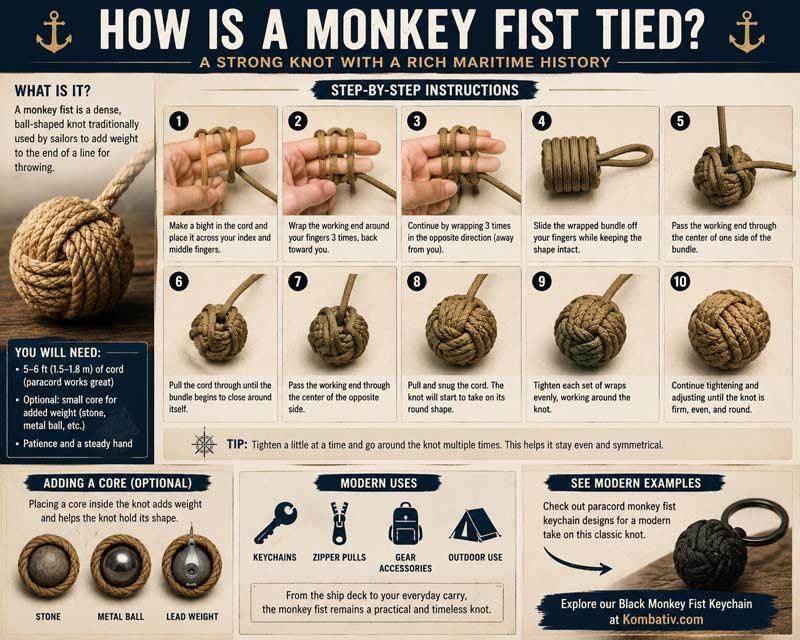
At first glance, a monkey fist knot can look surprisingly complicated, but the basic idea is fairly simple once you understand the pattern. The knot is created by wrapping cord around itself several times in different directions to form a tight, rounded ball. Most monkey fists start with a few loops wrapped around two fingers or another object to create the initial shape before additional wraps are added to build thickness and structure.
Traditionally, sailors often placed a small core inside the center of the knot to add weight and improve throwing performance. This could be something practical like a small stone or metal ball, depending on the intended use. Once the wrapping is complete, the cord is tightened carefully section by section until the knot becomes compact and evenly shaped. Getting the knot perfectly round often takes patience, since tightening one section can affect the shape of the others.
Modern monkey fist makers often use paracord because it is durable, flexible, and available in many colors. Some people enjoy tying monkey fists for practical outdoor uses, while others simply appreciate them as decorative knots or craft projects. Because the knot has become popular in the paracord community, there are now countless variations ranging from tiny zipper-pull versions to larger paracord monkey fist keychains.
If you are interested in seeing a modern example, paracord monkey fist keychain designs have become especially popular because they combine the classic knot with everyday carry convenience.
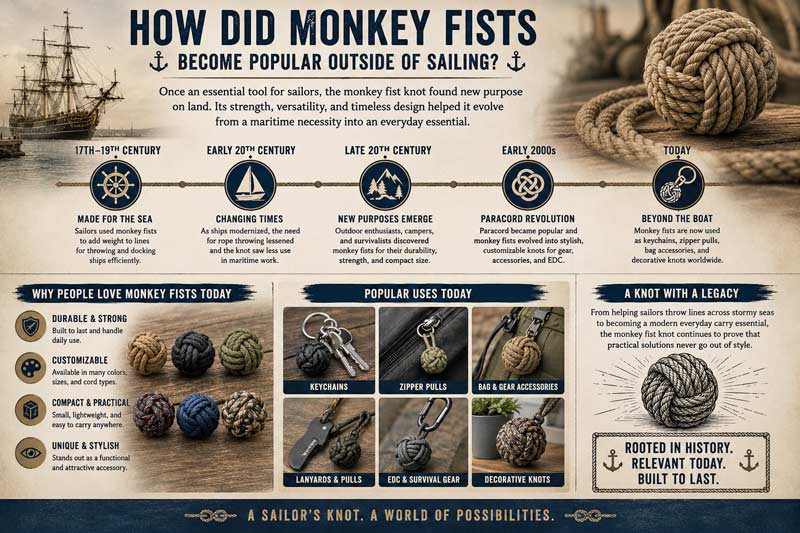
For a long time, monkey fists were mostly associated with ships, docks, and maritime work. As sailing technology changed and fewer people relied on traditional rope handling, the knot slowly began finding new life outside the nautical world. People started appreciating monkey fists not just for their practical function, but also for their durability, appearance, and versatility.
One reason for the shift was the rise of paracord and outdoor gear culture. Survival enthusiasts, campers, and everyday carry fans began using monkey fists as zipper pulls, gear attachments, bag accessories, and decorative knots because they were compact, durable, and easy to customize. The knot's unique round shape also made it stand out visually compared to simpler rope knots.
Over time, monkey fists became especially popular as keychain accessories. Paracord versions could be made in different colors, sizes, and styles, which helped them appeal to people looking for practical everyday carry items or something a little different for their gear setup. Modern black monkey fist keychain styles are one example of how a centuries-old maritime knot evolved into something many people now recognize outside the boating world.
Today, monkey fists sit at an interesting crossroads between maritime history, survival gear, craftsmanship, and everyday carry culture. What began as a sailor's practical solution for throwing ropes has turned into one of the most recognizable knots in the world.
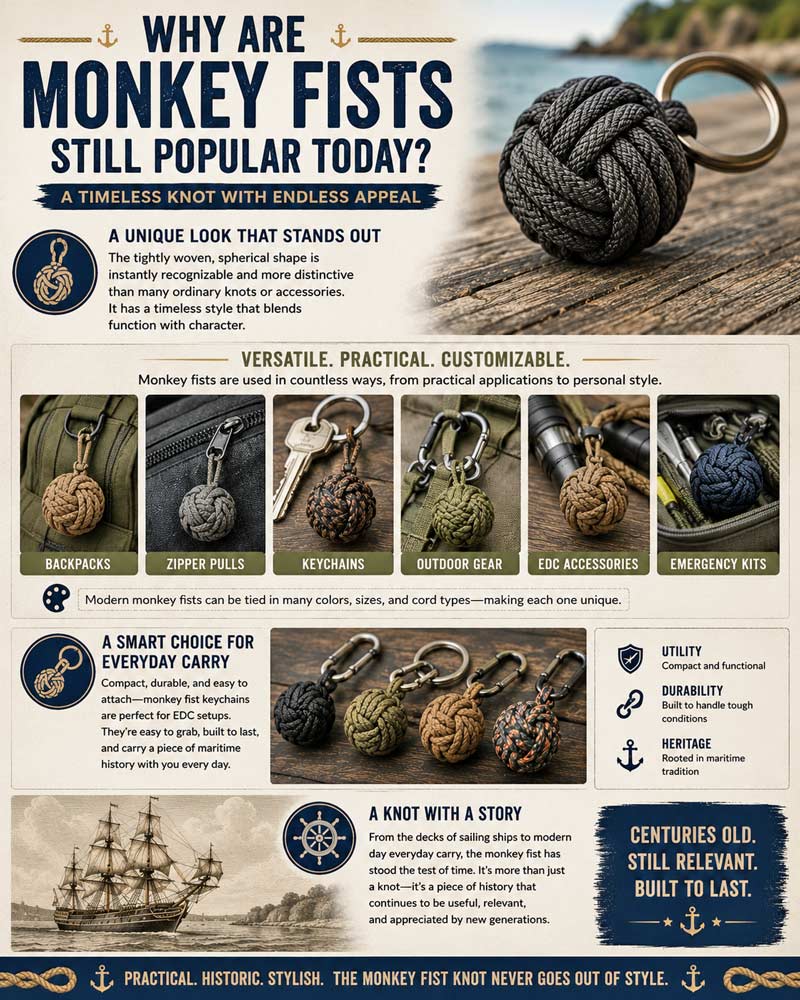
Even though most people are no longer using monkey fists to throw ropes between ships, the knot has stayed surprisingly popular for a wide variety of reasons. Part of the appeal comes from its unique look. The tightly woven round shape stands out immediately, making monkey fists feel more interesting and distinctive than many ordinary knots or accessories. For people who enjoy rope work, outdoor gear, or everyday carry items, the monkey fist has a timeless style that still feels practical.
Another reason for the knot's popularity is versatility. Modern monkey fists can be found attached to backpacks, zipper pulls, keychains, outdoor gear, and emergency kits. Some people simply like them as decorative accessories, while others appreciate how durable and compact they are. In the paracord world especially, monkey fists have become popular because they are customizable and can be tied in countless color combinations, sizes, and styles.
Monkey fists have also become common as part of everyday carry gear. Compact paracord knots attached to rings or clips are often used as keychain accessories because they are easy to carry and easy to grab. People interested in compact everyday carry keychain gear sometimes appreciate monkey fist designs because they combine utility, durability, and a connection to maritime history in one small item.
At the same time, many people are simply drawn to the story behind them. There is something interesting about a knot that started on sailing ships centuries ago and still manages to stay relevant today. Few nautical tools have made the jump from ship decks to modern everyday carry culture quite as successfully as the monkey fist.
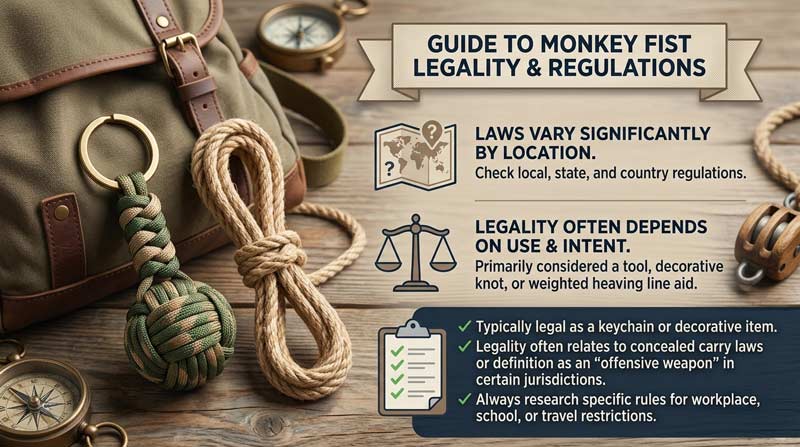
The legality of monkey fists can depend on how they are made, how they are used, and where someone lives. A traditional monkey fist knot made from rope or paracord is generally viewed as a simple knot or utility item. However, laws can become more complicated when a monkey fist includes a weighted core or is carried in a way that changes how it may be interpreted under local regulations.
Part of the confusion comes from the fact that monkey fists serve different purposes for different people. Some are purely decorative and used on keychains, backpacks, zipper pulls, or outdoor gear. Others are associated with boating, rope handling, or survival gear. In some places, a weighted monkey fist may be treated differently than a lightweight paracord accessory, especially depending on how local laws define impact tools or personal protection items.
Because laws vary widely by city, state, and country, it is always a good idea to check local regulations before assuming what is or is not allowed. Even if something is legal to own, rules around carrying or using it may be different depending on where you live.
For many people today, monkey fists are simply appreciated as durable accessories, practical rope knots, or compact additions to broader personal protection gear and everyday carry setups. Taking a few minutes to understand the laws in your area can help avoid confusion later on.
Few knots have managed to stay relevant for as long as the monkey fist. What began as a practical solution for sailors trying to throw ropes between ships eventually grew into something recognized far beyond the maritime world. Along the way, the monkey fist found new life in survival gear, outdoor equipment, paracord crafting, and everyday carry culture, all while keeping the same recognizable shape that made it useful centuries ago.
Part of what makes the monkey fist so interesting is how versatile it has become. Some people appreciate it as a functional knot with real nautical history, while others enjoy it as a craft project, decorative accessory, or practical addition to bags and gear. Modern paracord versions have helped introduce the knot to an entirely new audience, especially people interested in durable, compact everyday carry items.
For anyone curious about modern designs, exploring different paracord monkey fist keychains can be a fun way to see how the knot has evolved over time. Whether someone is interested in maritime history, survival gear, craftsmanship, or unique accessories, the monkey fist remains one of the few traditional knots that still feels surprisingly relevant today.
At the end of the day, the monkey fist has stood the test of time because it solved a real problem, adapted to changing needs, and developed a lasting identity all its own. That is not bad for a simple knot that started on the deck of a ship centuries ago.
The exact origin of the name is not completely certain, but most people believe the monkey fist got its name because of how the finished knot looks. When tied tightly, the rounded knot resembles a small clenched fist, which likely inspired sailors to call it a "monkey fist." Over time, the name stuck and became one of the most recognizable terms in maritime knot tying.
Another reason the name may have lasted so long is because sailors often gave knots colorful, memorable names that were easy to remember while working at sea. Since the monkey fist served an important practical purpose for throwing ropes between ships and docks, having a simple nickname likely made communication easier among crews.
Today, even people who know very little about sailing often recognize the name because the monkey fist has become popular far beyond the maritime world. Whether used in boating, paracord crafting, survival gear, or keychains, the unusual name is part of what makes the knot so memorable.
Traditionally, many monkey fists included a small weighted object hidden inside the center of the knot. Sailors often used materials like small stones, marbles, or metal balls to add weight, making the rope easier to throw between ships or from dock to vessel. The added weight helped improve distance and accuracy, which was especially useful in rough weather or when working across larger gaps.
Modern monkey fists can vary quite a bit depending on their intended use. Some paracord monkey fists still include a weighted core, while others use lightweight materials or no core at all. Decorative versions, zipper pulls, and smaller keychain designs are often made primarily for appearance or convenience rather than adding extra weight.
The material inside the knot can also affect the final size, shape, and firmness of the monkey fist. Some people prefer a tighter, denser knot, while others focus more on aesthetics or flexibility. Because there are so many variations today, no two monkey fists are necessarily built exactly the same.
Yes, monkey fists have become very popular as keychain accessories because they are compact, durable, and easy to customize. Small paracord monkey fists can be attached to keys, backpacks, zipper pulls, or bags, giving people something that is both practical and visually distinctive. Their rounded shape also makes them easy to grab, which is one reason many people enjoy using them as part of an everyday carry setup.
Another reason monkey fists work well for keychains is the variety of colors, sizes, and cord styles available. Some people prefer a simple, understated design, while others enjoy brightly colored paracord patterns that stand out. Since the knot itself is sturdy and resistant to wear, monkey fists tend to hold up well with everyday use.
Modern paracord monkey fist keychains are especially popular because they combine the knot's nautical history with a practical everyday accessory. For many people, they are simply a fun way to carry a little piece of maritime-inspired craftsmanship wherever they go.
The amount of time it takes to tie a monkey fist depends mostly on experience, knot size, and how detailed the design is. For someone learning for the first time, it might take anywhere from 15 to 30 minutes to get the wraps positioned correctly and tightened evenly. Since the knot is built layer by layer, beginners often need a little extra patience while learning how to keep everything balanced and round.
Once someone becomes familiar with the process, tying a monkey fist usually becomes much faster. Experienced paracord enthusiasts can often complete a basic monkey fist in just a few minutes, especially when working with smaller keychain versions or designs they have tied many times before.
The tightening process is usually what takes the longest. Even after the knot is wrapped, each loop has to be carefully adjusted and tightened section by section to create the smooth, rounded shape monkey fists are known for. Taking extra time during tightening often makes the biggest difference in how clean and polished the finished knot looks.
No, monkey fists do not always need a weighted core. Traditionally, sailors often added a small stone, marble, or metal ball inside the knot to help make a rope easier to throw over longer distances. The added weight improved accuracy and made the monkey fist more practical for maritime work, especially when passing lines between ships or docks.
Today, many monkey fists are made without any weighted center at all. Decorative knots, zipper pulls, and smaller keychain versions are often lightweight and tied entirely from paracord or rope. In these cases, the focus is usually more on appearance, convenience, or craftsmanship rather than adding extra weight.
Whether or not a weighted core is used often comes down to personal preference and intended purpose. Some people prefer the shape and firmness a core provides, while others like a softer, lighter monkey fist that feels more flexible. Since there are so many modern variations, there is no single "right" way to build one.
Yes, monkey fists have become fairly popular in survival, camping, and outdoor gear communities, especially since the rise of paracord accessories. Because paracord itself is lightweight, durable, and useful in emergency situations, many people enjoy incorporating monkey fist knots into backpacks, emergency kits, and everyday carry gear. The knot's compact shape and durability make it a natural fit for outdoor setups.
For some people, the appeal is mostly practical. Monkey fists can work well as zipper pulls, gear attachments, or grab points on bags and packs, making them easier to handle in outdoor environments. Others simply appreciate the craftsmanship and like adding a little maritime-inspired style to their gear without taking up much space.
Monkey fists are also popular because they are highly customizable. Outdoor enthusiasts can choose different paracord colors, sizes, and attachment styles depending on their setup. Whether used as a decorative knot, practical accessory, or part of a broader gear collection, monkey fists continue to appeal to people who enjoy durable, compact outdoor equipment.
Over time, monkey fists evolved far beyond their nautical roots. Modern versions are commonly made from paracord and may be attached to keychains, zipper pulls, outdoor gear, or survival equipment. Some people appreciate them for their practical uses, while others simply enjoy the craftsmanship and unique look of the knot itself.
In this guide, we will explore the history of the monkey fist, how it was originally used at sea, how the design evolved, and why people are still interested in this famous knot today.
What Is a Monkey Fist?
A monkey fist is a type of knot that is wrapped into a tightly woven ball at the end of a rope or cord. Traditionally, it was tied to add weight to the end of a line, making it easier to throw over longer distances. Sailors commonly used monkey fists aboard ships to help pass ropes between vessels or from dock to boat, especially when tossing a lightweight rope by hand would have been difficult.
What makes a monkey fist unique is its rounded shape and layered wrapping pattern. The knot is created by looping cord around itself several times in different directions until it forms a dense sphere. In traditional maritime settings, sailors sometimes placed a small weighted object inside the center, such as a stone or metal ball, to make the knot more effective for throwing. Modern monkey fists are often made from paracord and may use a marble, steel ball, or other core material depending on the intended purpose.
Today, monkey fists are used for much more than sailing. You will often find them attached to keychains, backpacks, zipper pulls, emergency gear, and survival kits. Some people appreciate them as practical utility knots, while others enjoy making them because of the craftsmanship involved. Decorative versions have also become popular in the paracord community because of their unique look and customizable colors.
Even though the design looks simple, the monkey fist remains one of the most recognizable and versatile knots in maritime history. Its combination of function, durability, and visual appeal is one reason it has remained popular for so many years.
Where Did the Monkey Fist Come From?
The monkey fist originated in the maritime world, where sailors needed a practical way to throw ropes over longer distances. On ships, passing lines between vessels or from dock to boat was an everyday task, but lightweight rope could be difficult to throw accurately, especially in rough weather or strong wind. To solve this problem, sailors developed the monkey fist knot by tying a dense, rounded knot at the end of a rope to add weight and improve throwing distance.
Most historians believe the monkey fist became especially common during the age of sailing ships, when crews regularly depended on ropes for docking, anchoring, and communication between vessels. By making a rope easier to toss, sailors could quickly establish a connection between ships before pulling heavier lines across. In many cases, the monkey fist acted as the first step in moving much larger ropes that were too heavy to throw by hand.
The name itself is believed to come from the knot's appearance. When tied tightly, the rounded shape resembles a small clenched fist, which likely inspired the nickname "monkey fist." Over time, sailors refined the design and sometimes added small weighted cores inside the knot, such as stones or metal balls, to make it even more effective for maritime work.
Even though ships and technology have changed dramatically over the years, the monkey fist remains one of the most recognizable nautical knots ever created. Its practical origin story is one reason people still find it fascinating today, even far beyond the world of sailing.
How Were Monkey Fists Used by Sailors?
For sailors, the monkey fist was not decorative at all. It was a practical working knot designed to solve a very real problem: how to get a rope from one place to another quickly and accurately. Throwing a lightweight rope across open water can be surprisingly difficult, especially when ships are moving, winds are strong, or distances are longer than expected. By tying a monkey fist at the end of a line, sailors added weight that made the rope easier to throw and more likely to land where it was needed.
One of the most common uses involved passing a line between ships or from a dock to a vessel. A sailor would throw the lighter rope with the monkey fist attached, allowing the receiving crew to grab it and use it to pull over a much heavier rope or cable. This process made docking, towing, anchoring, and ship-to-ship communication much more efficient during the age of sailing ships.
Monkey fists were especially useful because they were simple, durable, and easy to create using rope that sailors already had on hand. Some versions included a weighted core, such as a stone or metal ball, to improve throwing distance and accuracy. Over time, the knot became one of the most recognizable maritime tools because of how useful it was in everyday ship work.
Even though modern ships use newer technology and equipment, the monkey fist remains an iconic symbol of maritime history. Sailors valued it because it turned an ordinary rope into a much more practical tool for getting work done at sea.
How Is a Monkey Fist Tied?
At first glance, a monkey fist knot can look surprisingly complicated, but the basic idea is fairly simple once you understand the pattern. The knot is created by wrapping cord around itself several times in different directions to form a tight, rounded ball. Most monkey fists start with a few loops wrapped around two fingers or another object to create the initial shape before additional wraps are added to build thickness and structure.
Traditionally, sailors often placed a small core inside the center of the knot to add weight and improve throwing performance. This could be something practical like a small stone or metal ball, depending on the intended use. Once the wrapping is complete, the cord is tightened carefully section by section until the knot becomes compact and evenly shaped. Getting the knot perfectly round often takes patience, since tightening one section can affect the shape of the others.
Modern monkey fist makers often use paracord because it is durable, flexible, and available in many colors. Some people enjoy tying monkey fists for practical outdoor uses, while others simply appreciate them as decorative knots or craft projects. Because the knot has become popular in the paracord community, there are now countless variations ranging from tiny zipper-pull versions to larger paracord monkey fist keychains.
If you are interested in seeing a modern example, paracord monkey fist keychain designs have become especially popular because they combine the classic knot with everyday carry convenience.
How Did Monkey Fists Become Popular Outside of Sailing?
For a long time, monkey fists were mostly associated with ships, docks, and maritime work. As sailing technology changed and fewer people relied on traditional rope handling, the knot slowly began finding new life outside the nautical world. People started appreciating monkey fists not just for their practical function, but also for their durability, appearance, and versatility.
One reason for the shift was the rise of paracord and outdoor gear culture. Survival enthusiasts, campers, and everyday carry fans began using monkey fists as zipper pulls, gear attachments, bag accessories, and decorative knots because they were compact, durable, and easy to customize. The knot's unique round shape also made it stand out visually compared to simpler rope knots.
Over time, monkey fists became especially popular as keychain accessories. Paracord versions could be made in different colors, sizes, and styles, which helped them appeal to people looking for practical everyday carry items or something a little different for their gear setup. Modern black monkey fist keychain styles are one example of how a centuries-old maritime knot evolved into something many people now recognize outside the boating world.
Today, monkey fists sit at an interesting crossroads between maritime history, survival gear, craftsmanship, and everyday carry culture. What began as a sailor's practical solution for throwing ropes has turned into one of the most recognizable knots in the world.
Why Are Monkey Fists Still Popular Today?
Even though most people are no longer using monkey fists to throw ropes between ships, the knot has stayed surprisingly popular for a wide variety of reasons. Part of the appeal comes from its unique look. The tightly woven round shape stands out immediately, making monkey fists feel more interesting and distinctive than many ordinary knots or accessories. For people who enjoy rope work, outdoor gear, or everyday carry items, the monkey fist has a timeless style that still feels practical.
Another reason for the knot's popularity is versatility. Modern monkey fists can be found attached to backpacks, zipper pulls, keychains, outdoor gear, and emergency kits. Some people simply like them as decorative accessories, while others appreciate how durable and compact they are. In the paracord world especially, monkey fists have become popular because they are customizable and can be tied in countless color combinations, sizes, and styles.
Monkey fists have also become common as part of everyday carry gear. Compact paracord knots attached to rings or clips are often used as keychain accessories because they are easy to carry and easy to grab. People interested in compact everyday carry keychain gear sometimes appreciate monkey fist designs because they combine utility, durability, and a connection to maritime history in one small item.
At the same time, many people are simply drawn to the story behind them. There is something interesting about a knot that started on sailing ships centuries ago and still manages to stay relevant today. Few nautical tools have made the jump from ship decks to modern everyday carry culture quite as successfully as the monkey fist.
Are Monkey Fists Legal?
The legality of monkey fists can depend on how they are made, how they are used, and where someone lives. A traditional monkey fist knot made from rope or paracord is generally viewed as a simple knot or utility item. However, laws can become more complicated when a monkey fist includes a weighted core or is carried in a way that changes how it may be interpreted under local regulations.
Part of the confusion comes from the fact that monkey fists serve different purposes for different people. Some are purely decorative and used on keychains, backpacks, zipper pulls, or outdoor gear. Others are associated with boating, rope handling, or survival gear. In some places, a weighted monkey fist may be treated differently than a lightweight paracord accessory, especially depending on how local laws define impact tools or personal protection items.
Because laws vary widely by city, state, and country, it is always a good idea to check local regulations before assuming what is or is not allowed. Even if something is legal to own, rules around carrying or using it may be different depending on where you live.
For many people today, monkey fists are simply appreciated as durable accessories, practical rope knots, or compact additions to broader personal protection gear and everyday carry setups. Taking a few minutes to understand the laws in your area can help avoid confusion later on.
Why the Monkey Fist Has Stood the Test of Time
Few knots have managed to stay relevant for as long as the monkey fist. What began as a practical solution for sailors trying to throw ropes between ships eventually grew into something recognized far beyond the maritime world. Along the way, the monkey fist found new life in survival gear, outdoor equipment, paracord crafting, and everyday carry culture, all while keeping the same recognizable shape that made it useful centuries ago.
Part of what makes the monkey fist so interesting is how versatile it has become. Some people appreciate it as a functional knot with real nautical history, while others enjoy it as a craft project, decorative accessory, or practical addition to bags and gear. Modern paracord versions have helped introduce the knot to an entirely new audience, especially people interested in durable, compact everyday carry items.
For anyone curious about modern designs, exploring different paracord monkey fist keychains can be a fun way to see how the knot has evolved over time. Whether someone is interested in maritime history, survival gear, craftsmanship, or unique accessories, the monkey fist remains one of the few traditional knots that still feels surprisingly relevant today.
At the end of the day, the monkey fist has stood the test of time because it solved a real problem, adapted to changing needs, and developed a lasting identity all its own. That is not bad for a simple knot that started on the deck of a ship centuries ago.
Why Is It Called a Monkey Fist?
The exact origin of the name is not completely certain, but most people believe the monkey fist got its name because of how the finished knot looks. When tied tightly, the rounded knot resembles a small clenched fist, which likely inspired sailors to call it a "monkey fist." Over time, the name stuck and became one of the most recognizable terms in maritime knot tying.
Another reason the name may have lasted so long is because sailors often gave knots colorful, memorable names that were easy to remember while working at sea. Since the monkey fist served an important practical purpose for throwing ropes between ships and docks, having a simple nickname likely made communication easier among crews.
Today, even people who know very little about sailing often recognize the name because the monkey fist has become popular far beyond the maritime world. Whether used in boating, paracord crafting, survival gear, or keychains, the unusual name is part of what makes the knot so memorable.
What Is Inside a Monkey Fist Knot?
Traditionally, many monkey fists included a small weighted object hidden inside the center of the knot. Sailors often used materials like small stones, marbles, or metal balls to add weight, making the rope easier to throw between ships or from dock to vessel. The added weight helped improve distance and accuracy, which was especially useful in rough weather or when working across larger gaps.
Modern monkey fists can vary quite a bit depending on their intended use. Some paracord monkey fists still include a weighted core, while others use lightweight materials or no core at all. Decorative versions, zipper pulls, and smaller keychain designs are often made primarily for appearance or convenience rather than adding extra weight.
The material inside the knot can also affect the final size, shape, and firmness of the monkey fist. Some people prefer a tighter, denser knot, while others focus more on aesthetics or flexibility. Because there are so many variations today, no two monkey fists are necessarily built exactly the same.
Are Monkey Fists Good for Keychains?
Yes, monkey fists have become very popular as keychain accessories because they are compact, durable, and easy to customize. Small paracord monkey fists can be attached to keys, backpacks, zipper pulls, or bags, giving people something that is both practical and visually distinctive. Their rounded shape also makes them easy to grab, which is one reason many people enjoy using them as part of an everyday carry setup.
Another reason monkey fists work well for keychains is the variety of colors, sizes, and cord styles available. Some people prefer a simple, understated design, while others enjoy brightly colored paracord patterns that stand out. Since the knot itself is sturdy and resistant to wear, monkey fists tend to hold up well with everyday use.
Modern paracord monkey fist keychains are especially popular because they combine the knot's nautical history with a practical everyday accessory. For many people, they are simply a fun way to carry a little piece of maritime-inspired craftsmanship wherever they go.
How Long Does It Take to Tie a Monkey Fist?
The amount of time it takes to tie a monkey fist depends mostly on experience, knot size, and how detailed the design is. For someone learning for the first time, it might take anywhere from 15 to 30 minutes to get the wraps positioned correctly and tightened evenly. Since the knot is built layer by layer, beginners often need a little extra patience while learning how to keep everything balanced and round.
Once someone becomes familiar with the process, tying a monkey fist usually becomes much faster. Experienced paracord enthusiasts can often complete a basic monkey fist in just a few minutes, especially when working with smaller keychain versions or designs they have tied many times before.
The tightening process is usually what takes the longest. Even after the knot is wrapped, each loop has to be carefully adjusted and tightened section by section to create the smooth, rounded shape monkey fists are known for. Taking extra time during tightening often makes the biggest difference in how clean and polished the finished knot looks.
Do Monkey Fists Need a Weighted Core?
No, monkey fists do not always need a weighted core. Traditionally, sailors often added a small stone, marble, or metal ball inside the knot to help make a rope easier to throw over longer distances. The added weight improved accuracy and made the monkey fist more practical for maritime work, especially when passing lines between ships or docks.
Today, many monkey fists are made without any weighted center at all. Decorative knots, zipper pulls, and smaller keychain versions are often lightweight and tied entirely from paracord or rope. In these cases, the focus is usually more on appearance, convenience, or craftsmanship rather than adding extra weight.
Whether or not a weighted core is used often comes down to personal preference and intended purpose. Some people prefer the shape and firmness a core provides, while others like a softer, lighter monkey fist that feels more flexible. Since there are so many modern variations, there is no single "right" way to build one.
Are Monkey Fists Popular in Survival Gear?
Yes, monkey fists have become fairly popular in survival, camping, and outdoor gear communities, especially since the rise of paracord accessories. Because paracord itself is lightweight, durable, and useful in emergency situations, many people enjoy incorporating monkey fist knots into backpacks, emergency kits, and everyday carry gear. The knot's compact shape and durability make it a natural fit for outdoor setups.
For some people, the appeal is mostly practical. Monkey fists can work well as zipper pulls, gear attachments, or grab points on bags and packs, making them easier to handle in outdoor environments. Others simply appreciate the craftsmanship and like adding a little maritime-inspired style to their gear without taking up much space.
Monkey fists are also popular because they are highly customizable. Outdoor enthusiasts can choose different paracord colors, sizes, and attachment styles depending on their setup. Whether used as a decorative knot, practical accessory, or part of a broader gear collection, monkey fists continue to appeal to people who enjoy durable, compact outdoor equipment.
You May Also Be Interested In:
- The Real History of Nunchaku: From Farm Tool to Hollywood Icon
- What Is a Push Dagger? History, Design, and Modern Uses
- A Brief History of the Push Dagger: From Trench Warfare to Modern EDC
- The Real History of Escrima Sticks: From Battlefield Weapon to Modern Martial Art
- What Is a Kunai? From Japanese Tool to Ninja Weapon
- From Garden Tool to Combat Blade: The Evolution of the Kunai
- Modern Combat Khopesh and Other Deadly Weapons!
- A Practical Guide to Modern Self-Defense Weapons
- The Evolution of the Shuriken: From Samurai to Modern Martial Arts
- The Deadliest Throwing Knives for Modern Combat! Knife Testing and Review
Leave a Reply