




What Is the Best Weapon for Fighting in Tight Spaces?
August 21st, 2026
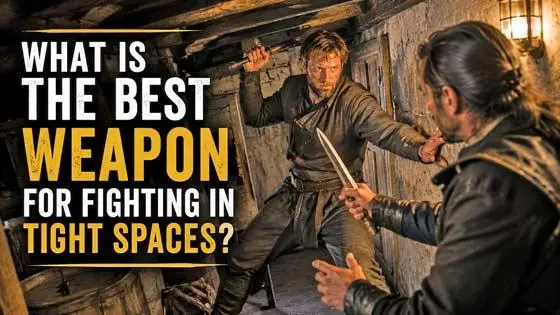
Some weapons seem almost unbeatable when there is room to move. A long spear can keep an opponent at a distance, a powerful axe can generate tremendous momentum, and a sword has enough reach to dominate the space around its wielder. Put those same weapons inside a narrow hallway, cramped ship, tiny room, or twisting staircase, however, and their greatest advantages can suddenly become serious limitations. Walls interrupt swings, ceilings restrict movement, furniture blocks footwork, and long weapons become increasingly difficult to reposition. Throughout history, fighters operating in confined spaces faced a completely different set of problems than soldiers on an open battlefield, and the weapons best suited to those environments were not always the ones you might expect. So if reach and raw power stop being the deciding factors, what actually makes a weapon effective when there is barely enough room to fight?
Tight Spaces Can Turn Reach Into a Liability
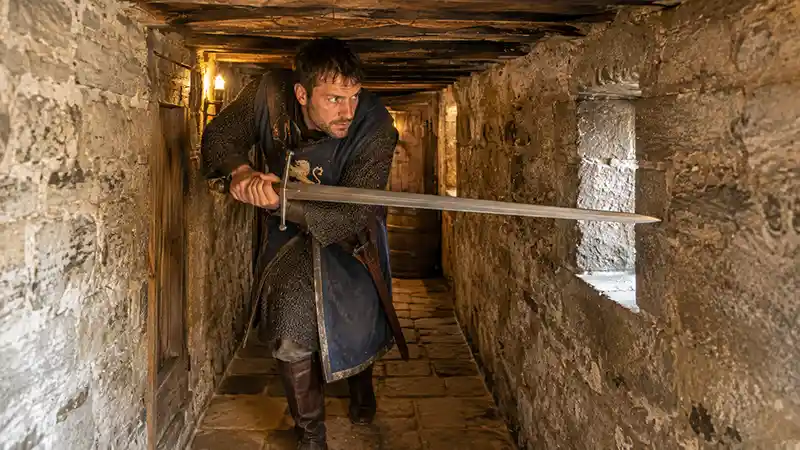
On an open battlefield, reach can be one of the greatest advantages a weapon can offer. A spear, polearm, or long sword allows its wielder to threaten an opponent before a shorter weapon can reach them. Move that same fight into a narrow corridor or cramped interior, however, and the geometry begins to change. The weapon still has its reach, but there may no longer be enough space to take advantage of it.
The problem is not simply that a long weapon might hit a wall. Length also affects how easily the weapon can be repositioned. Doorframes, low ceilings, furniture, support beams, staircases, and other obstacles can restrict the paths available to a long blade or shaft. Even turning around with a particularly long weapon can become awkward when the surrounding space is barely wider than the weapon itself.
That does not mean long weapons instantly become useless indoors. A long weapon capable of being directed forward can still exploit reach along a sufficiently open corridor. Historical swords also varied enormously in length, balance, and intended use, so simply dividing weapons into "long" and "short" misses much of the story. The important question is whether the surrounding environment allows the weapon to use the movements its design expects.
This creates one of the central paradoxes of fighting in confined spaces. The reach that keeps an opponent farther away in an open area can become increasingly difficult to manage as the environment closes in. Meanwhile, weapons that seem disadvantaged outdoors because of their short reach begin losing one of their biggest weaknesses.
So the best weapon for a tight space is not necessarily the smallest one. It is the weapon whose useful movements still fit inside the space available. That distinction is going to eliminate some surprisingly formidable weapons as we narrow down the contenders.
Thrusting Needs Far Less Room Than Swinging
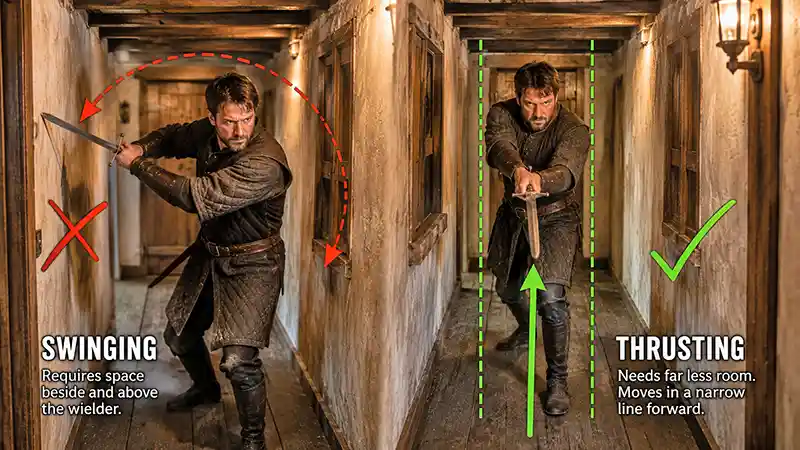
A weapon does not need to be short simply because the room is small. How the weapon moves can matter just as much as its overall length. Broad cuts and powerful swings require space beside and above the wielder, while a thrust can travel almost entirely along a narrow line directly in front of the body. In a hallway or doorway, that difference can completely change which weapons remain practical.
This is why a sword can still be formidable in confined surroundings even when there is not enough room for dramatic cuts. Many historical swords were capable of both cutting and thrusting, allowing the wielder to change how the weapon was used when the environment became restrictive. A narrow passage might eliminate much of the available swinging room without eliminating the weapon's ability to project its point forward.
The same principle helps explain why compact knives become especially relevant as the available space shrinks. A short blade requires relatively little clearance to reposition, and its usefulness does not depend on generating a huge arc through the air. The very lack of reach that disadvantages it in an open environment becomes less significant once both people are already extremely close together.
By contrast, weapons that depend heavily on large rotational movements can lose more of their normal effectiveness when walls close in. An axe may still be dangerous, for example, but a full chopping motion requires considerably more clearance than directing a point forward. Flexible weapons can face an even greater problem because part of their normal movement may require open space around the wielder.
This gives us our first major criterion for choosing the best weapon for tight spaces: it should remain useful without requiring a large swing radius. That does not tell us which weapon wins yet, but it immediately favors compact designs and weapons capable of working primarily along the narrow space directly in front of the user.
The Best Weapon Cannot Depend on Perfect Distance
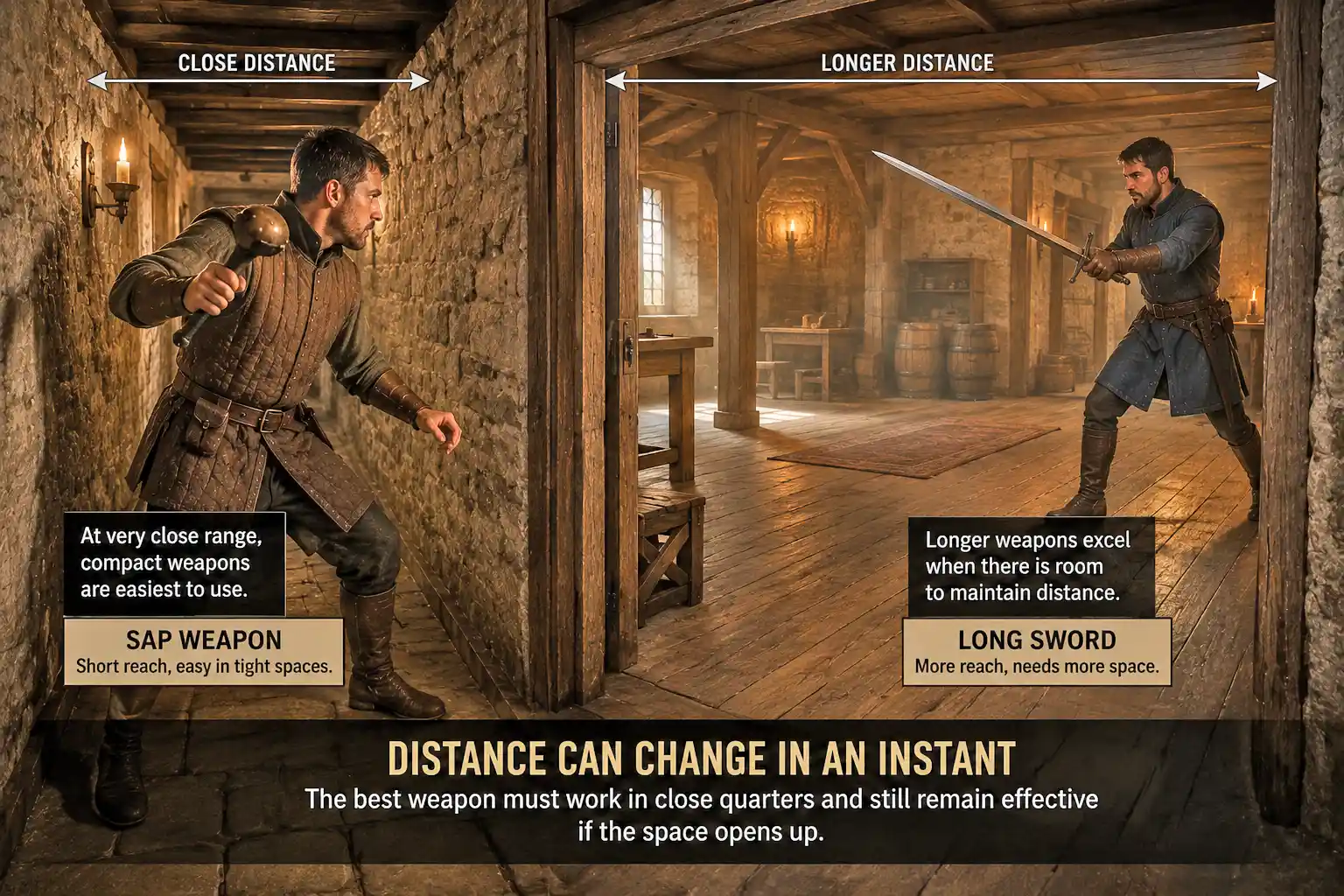
Reach still matters in a confined space, but there is another problem that becomes increasingly important as the available room disappears: distance can change almost instantly. A narrow hallway may begin with several feet separating two people, while a doorway, staircase, or cramped interior can force that separation to collapse almost immediately. A weapon that works beautifully at one range may become awkward once there is no longer enough room between the weapon and its target.
This creates a difficult tradeoff. Longer weapons generally benefit from keeping distance, while extremely short weapons sacrifice that advantage in exchange for maneuverability. In a confined environment, however, there may be very little control over which distance is available. Walls can prevent lateral movement, furniture can block retreat, and narrow passages can severely limit the ability to reposition.
Compact impact weapons illustrate the opposite end of that spectrum. Historical blackjacks and sap weapons, for example, packaged considerable mass into objects that occupied very little space. They lacked the reach of swords and longer clubs, but their compact dimensions meant that surrounding walls and low ceilings interfered with them far less.
That does not automatically make the shortest weapon the winner. If the space opens even slightly, additional reach becomes valuable again. A weapon optimized exclusively for extremely close range may surrender too much capability the moment there is enough room for something longer to operate effectively.
The strongest candidate, then, probably sits somewhere between the extremes. It needs enough reach to matter without becoming cumbersome when the distance suddenly collapses. In tight spaces, versatility across several distances may be more valuable than being exceptional at only one.
Doorways and Corners Create an Entirely Different Problem
A tight space is rarely just a smaller version of an open battlefield. Buildings are divided by doorways, corners, stairwells, columns, and narrow passages that constantly interrupt movement. A weapon may fit comfortably inside a room yet become awkward the instant its wielder has to pass through a doorway or turn into another corridor.
Length becomes particularly troublesome when direction changes. A long weapon projecting several feet in front of the body may work surprisingly well along a straight hallway, but rotating that weapon toward a threat approaching from another direction requires considerably more clearance. The surrounding architecture effectively limits the angles from which the weapon can be repositioned.
Compact weapons have an obvious advantage here. A short baton, for example, occupies relatively little space around its wielder compared with a sword or long-handled axe. That helps explain why modern batons can provide a useful example of the broader principle: reducing length sacrifices reach, but it also reduces the amount of surrounding space the object needs simply to be moved and redirected.
Corners create another interesting disadvantage for long weapons. The person carrying one may have plenty of usable space on one side of the corner and almost none on the other. A protruding blade or shaft can also reach the obstacle before the wielder has fully changed direction. Shorter objects remain much closer to the body, so changes in orientation require less clearance.
This gives us another criterion for our eventual winner. The ideal confined-space weapon cannot merely work while facing straight down an empty corridor. It needs to remain manageable when the environment forces sudden changes in direction. Once doorways, corners, and staircases enter the equation, compactness becomes much more valuable than it first appeared.
A Weapon That Stays Close to the Body Gains an Advantage
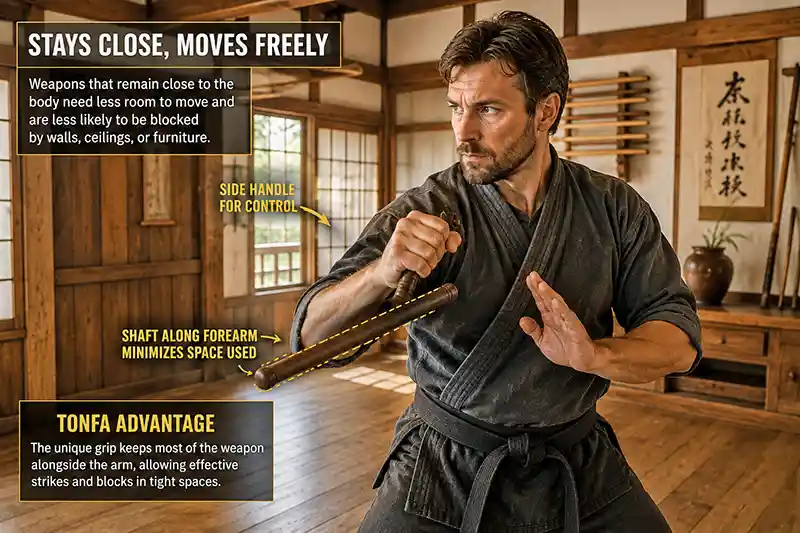
As the available space gets tighter, another characteristic starts becoming increasingly valuable: how far the weapon has to travel away from the body before it can be repositioned. A long blade or shaft naturally occupies a large amount of surrounding space. A compact weapon can remain much closer to its wielder, making walls, ceilings, furniture, and other obstacles less likely to interfere with its movement.
The tonfa is an interesting historical example because its unusual side handle allows most of the shaft to lie alongside the forearm. Rather than projecting its entire length outward like a conventional club, the weapon can be held in a comparatively compact configuration. That does not eliminate every disadvantage of fighting in a confined environment, but it demonstrates how grip orientation can change the amount of space a weapon occupies.
This is one reason tonfa deserve consideration even though they are not especially small. Their overall length tells only part of the story. When held along the forearm, much of that length remains close to the body, while the perpendicular handle provides a very different relationship between the hand and the striking surface than a straight stick of similar dimensions.
Other compact weapons solve the same spatial problem differently. Some reduce overall length, while others concentrate their mass around the hand. What they share is an ability to operate without constantly extending several feet into the surrounding environment. As rooms become smaller and obstacles become more numerous, that characteristic becomes increasingly important.
This gives us a useful distinction that raw measurements miss. The best weapon for a tight space may not simply be the shortest. It may be the one that occupies the least usable space while still providing meaningful reach and versatility. That puts some surprisingly unconventional designs back into contention.
Heavy Weapons Lose Something When the Swing Gets Shorter
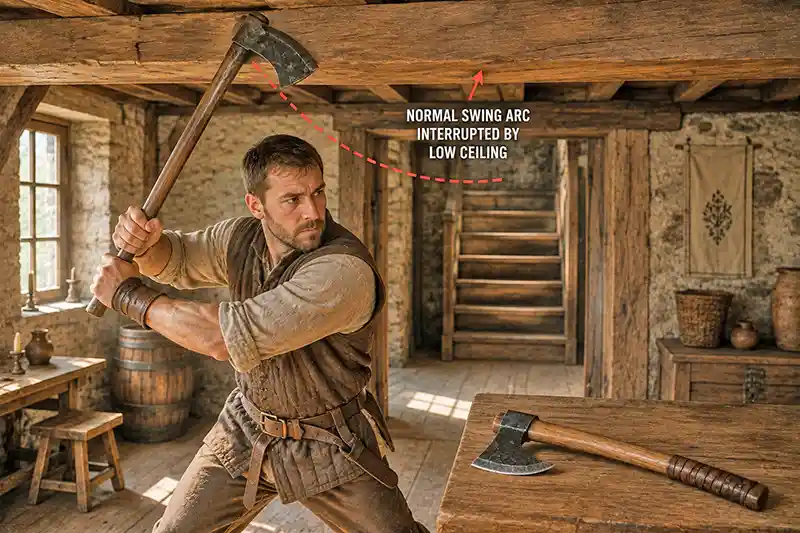
Some weapons depend heavily on momentum. An axe, mace, or heavy club can convert the mass of the weapon and the speed of its movement into a powerful impact. In open space, there may be plenty of room to accelerate that mass through a broad arc. Inside a cramped room, however, walls and obstacles can dramatically shorten the movement available.
This creates a disadvantage that is easy to overlook. A heavy weapon does not stop being heavy just because the room gets smaller. The wielder still has to accelerate it, control it, and redirect it, but may have considerably less space in which to take advantage of the momentum that justified the extra mass in the first place.
Consider axes and hatchets. Their concentrated head weight can make them formidable tools and weapons, but many axe designs benefit from having enough clearance for the head to travel through a meaningful arc. Reduce that arc far enough and some of the design's greatest strengths become harder to exploit. A compact hatchet suffers less from this problem than a long-handled axe, which shows once again that the category alone does not determine how well a weapon fits the environment.
Heavy weapons can also be demanding to recover and redirect after their movement has been interrupted. In an open area, there may be room for the weapon to complete its path. A wall, beam, piece of furniture, or other obstruction can stop that path unexpectedly, turning the surrounding architecture into another factor the weapon has to contend with.
This pushes our hypothetical winner farther away from the extremes. We want enough mass to make the weapon substantial, but not so much that it depends on a large movement to take advantage of that mass. In a tight space, controllability begins competing directly with raw power.
Knuckle Weapons Solve the Space Problem Almost Completely
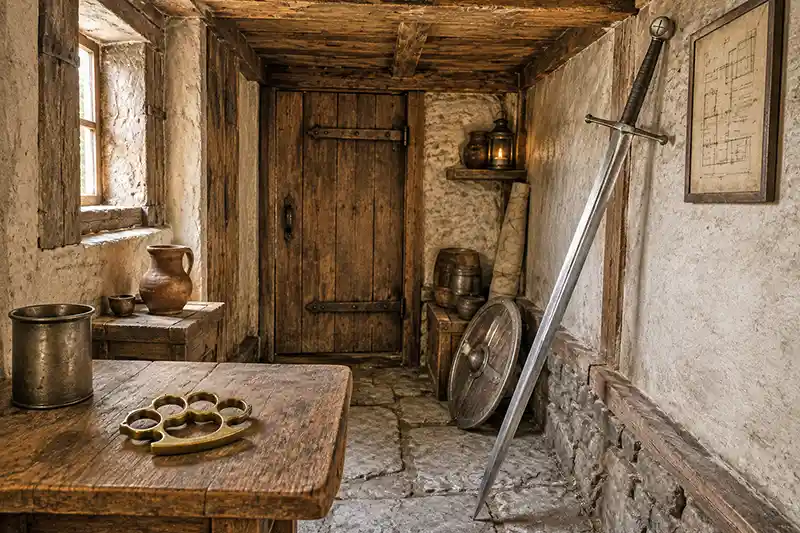
If the goal were simply to find the weapon requiring the least possible room to maneuver, knuckle weapons would immediately become serious contenders. They add almost no meaningful length beyond the hand itself. There is no long shaft to clear a doorway, no blade projecting several feet into a corridor, and no large weapon head that needs space to accelerate through a broad arc.
That extreme compactness is the defining advantage of knuckle dusters in our comparison. Because the weapon remains centered around the hand, walls and low ceilings impose relatively few additional spatial restrictions on the object itself. The user is essentially working within the same physical envelope required for ordinary hand movement.
But solving one problem completely can create another. A knuckle weapon provides virtually no additional reach. Against something even moderately longer, that becomes a major disadvantage whenever enough distance exists for the longer weapon to operate. Our hypothetical winner needs to function in tight quarters without surrendering every advantage the moment a narrow hallway opens into a larger room.
This exposes an important distinction between compactness and versatility. Knuckle weapons sit near one extreme of the spectrum. Long swords and axes occupy another. The best all-around design for confined environments may lie somewhere between them, offering more reach than the hand without requiring enough clearance to make walls and obstacles a constant problem.
So although knuckle weapons may come remarkably close to eliminating the space problem, they do it by sacrificing something we probably do not want to abandon entirely. The winner needs to be compact, but not so compact that its useful reach disappears with it.
Push Daggers Take Compactness in a Different Direction
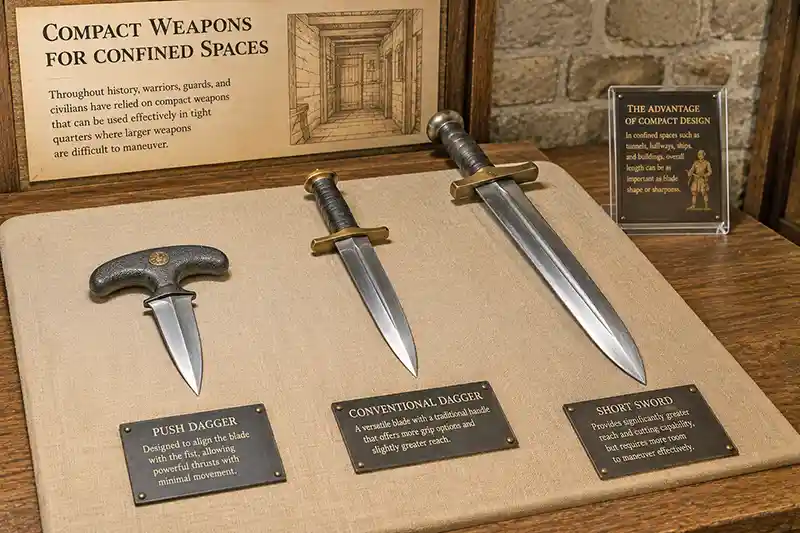
If knuckle weapons demonstrate how little space a weapon can occupy, the push dagger shows what happens when that same compact philosophy is applied to a blade. Its unusual T-shaped handle places the blade in line with the fist rather than extending from a conventional knife grip, creating an extremely short overall package.
That configuration immediately solves several problems created by confined surroundings. There is very little weapon extending behind the hand, almost no handle length to reposition, and no need for the broad movements associated with much larger weapons. The entire design remains concentrated around the hand and forearm.
This makes push daggers especially interesting in our comparison. They combine the extreme compactness of a knuckle weapon with some of the characteristics of a short blade. From a purely historical design perspective, that is a remarkably efficient use of space.
But once again, compactness comes at the expense of reach. A push dagger cannot threaten the same distance as a sword, baton, or even many conventional knives. In an environment so cramped that longer weapons cannot be maneuvered effectively, that disadvantage becomes less important. The moment additional space appears, however, the lack of reach becomes increasingly significant.
This is becoming a recurring pattern. The weapons that function most easily in extremely confined spaces tend to surrender reach, while the weapons with the greatest reach require more room to exploit it. The real challenge is finding the point where those two advantages overlap. And that suggests our eventual winner may be longer than a push dagger, but considerably shorter than a sword.
The Blackjack Was Almost Built for Cramped Environments
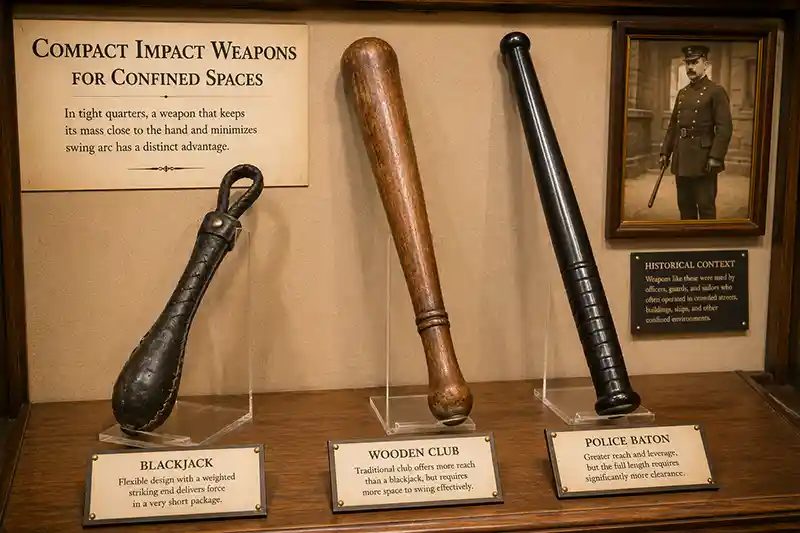
Few historical impact weapons demonstrate the advantages of compactness as clearly as the blackjack. Instead of relying on a long rigid shaft, the classic blackjack packed a weighted striking end into a remarkably short package, often using a flexible or semi-flexible body. The result was an impact weapon that occupied very little space compared with a conventional club.
That compact construction made the blackjack particularly interesting in places where a long weapon would have been inconvenient to carry or maneuver. Its history became closely associated with police officers, guards, sailors, and others who sometimes operated inside buildings, crowded streets, vehicles, or other environments where carrying a large club was impractical. The strange history of the blackjack is partly a story of how much striking capability could be squeezed into an unusually small object.
The flexible construction also changes the comparison with a rigid club. A long wooden stick needs clearance for the entire length of the weapon as it moves. A blackjack keeps nearly all of its mass close to the hand and concentrates additional weight near one end. Its small physical envelope means surrounding architecture interferes with it far less than it would with a sword, axe, or long baton.
Yet the same compromise appears again. The blackjack offers very little reach. Its compactness becomes increasingly valuable as the surroundings get tighter, but increasingly costly as the available distance grows. In a sufficiently open space, a longer weapon can exploit an advantage the blackjack simply cannot reproduce.
Still, the blackjack teaches us something important about our search for a winner. A weapon does not necessarily need a large swing to make use of concentrated mass. That gives compact impact weapons a stronger case than their modest dimensions might initially suggest, even if their limited reach may ultimately keep them from taking the top spot.
Expandable Batons Change the Size Equation
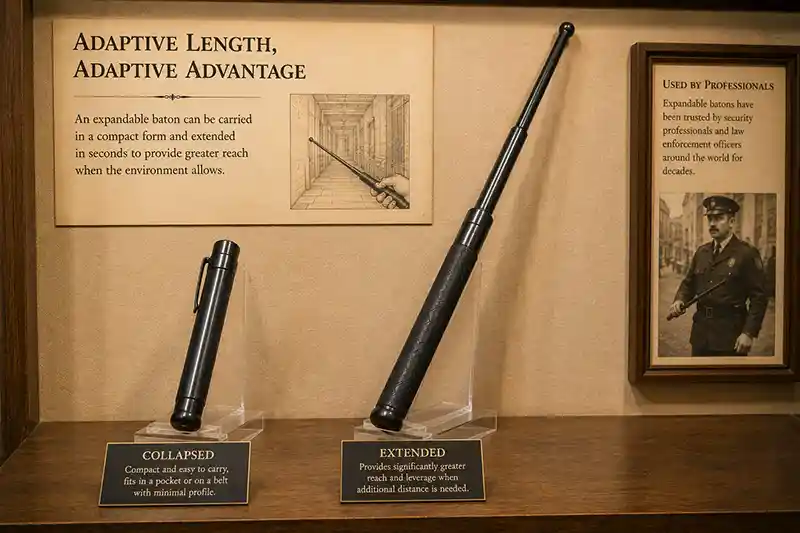
So far, we have treated weapon length as though it were fixed. An expandable baton complicates that comparison because it can exist in two very different configurations. Collapsed, it occupies relatively little space. Extended, it becomes a substantially longer rigid impact weapon. That ability to change length addresses one of the central compromises we have been encountering throughout this article.
The concept is especially interesting in a confined environment because the surrounding space may not remain consistent. A narrow passage can open into a larger room, and a cramped doorway can lead into a long corridor. A fixed-length weapon cannot physically change with those surroundings. An expandable design at least demonstrates how one weapon can combine compact storage with greater reach when extended.
That helps explain some of the appeal behind expandable batons used by security professionals. The design allows a relatively long rigid tool to be carried in a much smaller package. From a pure weapon-design perspective, that is an elegant solution to the conflict between portability and reach.
But extension does not magically eliminate the disadvantages of length. Once fully deployed, the baton still requires more clearance than a blackjack, push dagger, or knuckle weapon. The longer configuration can become increasingly awkward as walls, furniture, and other obstacles close in. Its advantage is not that it defeats the geometry of a confined space, but that its physical dimensions are not permanently locked into one configuration.
That makes the expandable baton one of our strongest contenders so far, but it also reveals something important about the question we are trying to answer. There may not be one ideal weapon length for every tight space. The best design may instead be one that preserves useful reach without becoming so long that the environment starts controlling the weapon.
Flexible Weapons Have a Surprising Problem Indoors
At first glance, a flexible weapon might seem perfect for a cramped environment. If the weapon can bend, surely it should be less restricted by walls than a rigid sword or staff. But flexibility does not necessarily reduce the amount of open space a weapon needs. In some cases, it can make the surrounding environment even more important.
Weapons built around chains, cords, or linked sections often depend on their moving components traveling through relatively large paths around the user. A rigid weapon has a predictable shape at every moment. A flexible weapon can change shape constantly, allowing parts of it to travel in directions that are much harder to keep clear of walls, furniture, beams, and other obstacles.
Even something as familiar as escrima sticks demonstrates the advantage of rigidity in this situation. A relatively short rigid stick has clearly defined dimensions, so the space it occupies is easy to understand. Add flexible sections or a long connecting chain and the effective movement envelope can become considerably larger and less predictable.
This is particularly important because a flexible weapon's moving end may depend on uninterrupted momentum. If a chain, cord, or linked section encounters an obstacle before completing its path, the surrounding architecture has interfered directly with one of the characteristics that makes the weapon distinctive in the first place.
So flexibility does not automatically solve the tight-space problem. In an open environment it can create unusual angles and movement patterns that rigid weapons cannot reproduce, but cramped surroundings can take away much of that freedom. When walls are only a few feet away, predictable geometry can become an advantage all by itself.
Trench Warfare Revealed What Tight Spaces Actually Favor
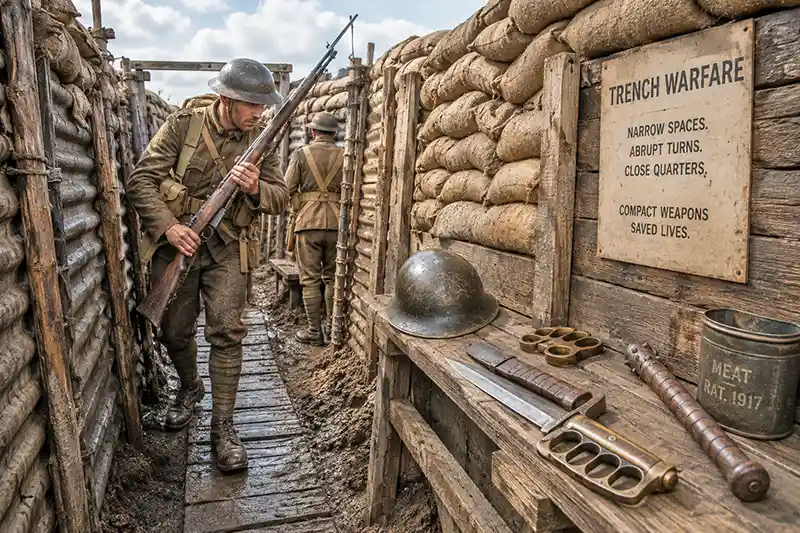
Few environments demonstrate the problem better than the trenches of World War I. Trenches were narrow, irregular, crowded, and filled with abrupt corners, dugouts, traverses, equipment, and other obstacles. Weapons that made perfect sense across an open battlefield could become remarkably cumbersome once fighting moved into those confined passages.
This helps explain the emergence and popularity of specialized close-quarters weapons during the war. Soldiers used everything from compact clubs and knives to improvised weapons, while certain purpose-built designs combined several close-range characteristics into a single package. The environment itself was influencing what soldiers considered useful.
The development of World War I trench knives provides a particularly striking example. Their relatively short overall dimensions made them far easier to maneuver than rifles with fixed bayonets or longer battlefield weapons when movement became severely restricted. Some designs even incorporated substantial guards or knuckle-style grips, reflecting just how specialized close-quarters equipment could become.
Trench warfare also reinforces a pattern we have seen throughout this comparison. The environment did not simply reward the shortest possible weapon. Soldiers still benefited from reach whenever enough space existed to use it. What changed was the value of carrying something that remained manageable when that space suddenly disappeared.
That historical evidence brings us closer to an answer. When combat moves from an open battlefield into an environment filled with walls, corners, and obstacles, compact weapons capable of functioning without broad movements become disproportionately useful. The trenches did not invent that principle, but they demonstrated it under some of the most extreme conditions imaginable.
Ships Were Another Nightmare for Long Weapons
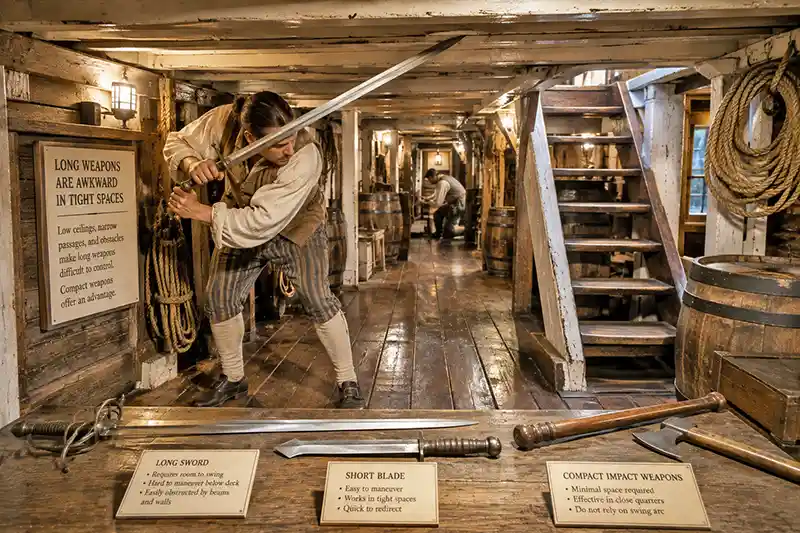
Trenches were not the first environment to punish oversized weapons. Wooden ships created their own maze of narrow passageways, low decks, ladders, cabins, rigging, bulkheads, and crowded working areas. A weapon that was perfectly manageable on an open deck could become much more awkward after moving below deck, where even standing upright could sometimes be difficult.
This is where the difference between theoretical reach and usable reach becomes especially important. A long blade might extend farther than a short one, but that advantage means little if beams, walls, or other parts of the ship prevent the weapon from being repositioned freely. Shorter blades and compact impact weapons demanded much less clearance from an already cluttered environment.
The same principle appears repeatedly in the history of weapons designed for close combat. Once fighting distances collapse, qualities that seem secondary on an open battlefield can become disproportionately important. Overall length, grip position, required movement, and the ability to redirect the weapon all begin competing with raw reach and power.
Ships also demonstrate why there probably cannot be one perfect answer for every confined environment. An open deck, narrow passage, steep ladder, and tiny cabin could all exist within a few yards of one another. A weapon optimized exclusively for the smallest cabin might be unnecessarily short on deck, while something ideal for the deck could become cumbersome below it.
That makes adaptability increasingly difficult to ignore. The best weapon for tight spaces needs enough reach to remain useful when the surroundings open up, but it cannot depend on having that open space available. The more environments we examine, the narrower that sweet spot becomes.
A Short Sword May Be the Sweet Spot
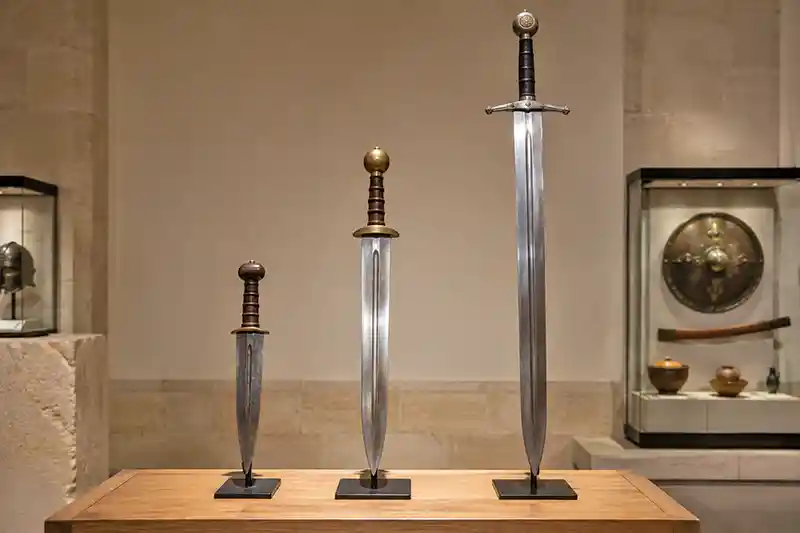
The pattern is becoming difficult to ignore. Extremely compact weapons maneuver beautifully in cramped surroundings but surrender almost all meaningful reach. Long swords and axes preserve reach and power but become increasingly dependent on having enough room to move. Somewhere between those extremes sits one of history's most persistent weapon designs: the relatively short sword.
A short sword preserves substantially more reach than a dagger, blackjack, or knuckle weapon without extending so far from the body that every doorway and ceiling beam becomes an immediate obstacle. More importantly, many short-bladed swords were capable of movements that did not depend entirely on broad sweeping cuts. Their comparatively compact dimensions made them adaptable to environments where a much longer blade could become cumbersome.
History produced many variations on this general idea. The Roman gladius is perhaps the most famous example, although it would be misleading to claim that it existed specifically because Romans expected to fight inside tiny rooms. Its design belonged to a larger military system involving formations, shields, armor, and particular battlefield conditions. Still, its compact dimensions demonstrate why a relatively short sword can occupy such an interesting middle ground.
Unlike the smallest weapons we have examined, a short sword does not sacrifice reach completely. Unlike much longer blades, it requires less surrounding clearance to reposition. And unlike heavily weighted impact weapons, its usefulness is not necessarily tied to generating a huge amount of momentum through a broad arc.
That combination makes the short sword our strongest contender so far. It does not completely dominate any single category, and that may be precisely why it performs so well across all of them. When the environment can change from a corridor to a doorway to a larger room within seconds, having fewer extreme weaknesses may matter more than possessing one overwhelming advantage.
Why a Short Blade Can Be More Versatile Than the Smallest Blade
If compactness were the only thing that mattered, the push dagger or another extremely short weapon would already have won. But our comparison keeps revealing the same problem: making a weapon smaller eventually produces diminishing returns. Once the weapon already fits comfortably inside the available space, shortening it further begins sacrificing reach without solving a problem that still needs to be solved.
This is where a conventional short blade becomes particularly interesting. It can remain compact enough to move through doorways, corridors, stairwells, and crowded interiors while preserving noticeably more reach than a weapon concentrated almost entirely around the hand. The additional blade length occupies some space, but not necessarily enough to create the severe maneuverability problems associated with much longer weapons.
Historical combat knives provide plenty of examples of this middle ground. Many of the forgotten combat knives of the Cold War were designed in an era when portability and close-range usefulness remained important considerations. They were not substitutes for swords, nor were they reduced to the smallest dimensions physically possible. Their proportions reflected a different compromise between portability, reach, and utility.
That compromise matters because "tight space" describes an enormous range of environments. A weapon might need to move through a doorway one moment and have several feet of clearance the next. Something optimized exclusively for the smallest imaginable space may be unnecessarily limited everywhere else.
The question therefore changes slightly. We are no longer asking which weapon can function in the least amount of space. We are asking which one loses the least capability as the available space changes. By that standard, the middle ground occupied by short swords and substantial combat knives becomes increasingly difficult to beat.
What About the Classic Fighting Knife?
The short sword has made a surprisingly strong case, but there is another contender sitting just below it in length: the substantial fighting knife. Compared with a sword, a fighting knife gives up reach, yet its shorter blade makes it exceptionally easy to carry and reposition in environments filled with walls, doorways, furniture, and other obstacles.
Historically, this was not merely a theoretical advantage. Fighting knives have appeared repeatedly as secondary weapons precisely because they remain usable when larger equipment becomes inconvenient. They can accompany a soldier without replacing the primary weapon, require very little storage space, and remain accessible in environments where carrying something sword-sized would be impractical.
The comparison becomes especially interesting when we look at weapons such as the trench knife. The history of the push dagger shows another path designers took toward the same general problem, reducing overall dimensions even further through an unconventional grip. But the conventional fighting knife retains something the push dagger largely sacrifices: additional reach without becoming dramatically larger.
That makes a substantial fixed-blade knife one of the most balanced contenders in our comparison. It is compact enough that the surrounding architecture rarely becomes the dominant problem, yet long enough to provide more useful reach than weapons centered almost entirely around the fist. Unlike a flexible weapon, its physical dimensions also remain completely predictable.
So are we ready to declare the fighting knife the winner? Not quite. The short sword still offers greater reach while remaining considerably more manageable than a full-sized sword, and compact batons occupy another interesting middle ground without relying on a blade at all. We are now down to weapons that make different compromises rather than weapons with obvious spatial disadvantages.
Could a Baton Actually Beat the Blades?
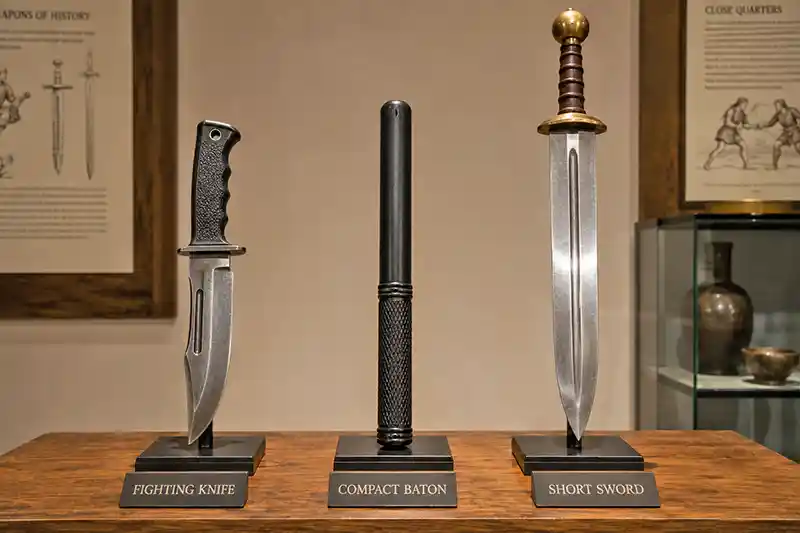
At this point, the short sword and substantial fighting knife look like obvious finalists. But a compact rigid baton deserves to remain in the conversation because it occupies much of the same useful middle ground. It offers noticeably more reach than a fist-centered weapon while remaining far shorter and easier to reposition than most swords, axes, or polearms.
The baton also has an unusually predictable physical footprint. Unlike a chain or other flexible weapon, every part of it remains exactly where its rigid construction suggests it will be. That matters when movement is constrained by walls, doorframes, furniture, or low ceilings. The wielder does not have to account for a trailing section moving independently through the surrounding space.
History provides countless variations on the basic short club, and modern baton designs continue the same fundamental concept. Even discussions of the fastest weapons in martial arts reveal how strongly speed and maneuverability can depend on factors beyond simple size. Weight distribution, length, grip, and the amount of movement required all influence how quickly an object can be controlled and redirected.
Where the baton loses ground is versatility of geometry. A short sword or substantial knife concentrates much of its useful length into a comparatively narrow profile, while a baton remains primarily an impact weapon. For our purposes, though, the important point is not which would cause greater injury. It is which design retains the most of its intended functionality as the environment becomes increasingly restrictive.
By that standard, the compact baton performs remarkably well. It has enough length to avoid the extreme reach disadvantage of knuckle weapons and push daggers, yet it remains short enough that ordinary indoor architecture interferes with it far less than with a long sword or axe. The finalists are converging on the same basic dimensions even though their designs are completely different.
So Which Weapon Actually Wins?
After eliminating the designs that depend heavily on reach, broad swings, large movement arcs, or extremely close distance, the answer lands somewhere in the middle. There is no weapon that becomes universally "best" simply because walls move closer together. But if we judge the designs by how little of their normal functionality is lost as space becomes restricted, a relatively short, rigid weapon emerges as the most adaptable overall design.
Among historical bladed weapons, that gives the short sword an especially strong case. It preserves meaningful reach without approaching the dimensions of a full-length sword or polearm. Its rigid construction makes its physical footprint predictable, and a blade capable of linear movement does not necessarily require the sweeping clearance associated with a large axe or other momentum-dependent weapon.
A substantial fighting knife arguably becomes the better fit when the environment grows extremely cramped. Push the scenario into a tiny cabin, narrow trench, packed passageway, or similarly restrictive enclosure and the knife's smaller dimensions become increasingly valuable. This helps explain why compact blades appear so frequently throughout the history of close-quarters fighting, including many of the most popular military knives of all time.
The compact baton deserves an honorable mention for essentially reaching the same conclusion through a completely different design. It occupies relatively little surrounding space, remains predictable because of its rigidity, and provides more reach than weapons concentrated directly around the hand. Expandable versions even demonstrate how designers have attempted to reconcile portability and reach within a single object.
So if we have to choose one winner for the broadest range of historical tight-space scenarios, the short sword probably takes it, with the fighting knife becoming increasingly compelling as the environment gets smaller. The important lesson is not that one specific weapon dominates indoors. It is that confined environments reward a particular combination of characteristics: moderate length, predictable geometry, maneuverability, and the ability to remain functional without enormous movements.
The walls do not necessarily make the smallest weapon the best. They simply change what "best" means.
The Real Winner Is the Weapon That Fits the Environment
It is tempting to end this question by declaring one weapon unquestionably superior, but history rarely works that neatly. A cramped ship's cabin, narrow castle staircase, World War I trench, underground passage, and crowded building may all qualify as tight spaces while presenting completely different physical limitations. The amount of usable reach can change dramatically from one environment to another.
What remains consistent is the advantage of adaptability. Long weapons can be extremely effective when a confined environment still provides a clear line of movement, but their size becomes a liability as corners, ceilings, and obstacles multiply. Extremely compact weapons solve the maneuverability problem almost completely, yet surrender reach whenever the surroundings open up. The designs that perform best across both situations tend to avoid either extreme.
That is why the short sword, substantial fighting knife, and compact baton kept surviving our comparisons. None offers maximum reach. None is the smallest possible weapon. Instead, each preserves enough reach to remain useful while occupying relatively little surrounding space. They represent different solutions to essentially the same design problem.
It also explains why the history of weapons is filled with compromises rather than one universally superior design. Soldiers, guards, sailors, and martial artists encountered different environments and different constraints, and the equipment that made sense in one setting could become awkward in another. Even something as simple as moving from an open courtyard into a narrow stairwell could completely alter which physical characteristics were advantageous.
So the short sword may be our overall winner, but the more interesting answer is why it wins. Tight spaces punish extremes. They reduce the value of excessive reach, expose weapons that require enormous movement, and reward designs that remain controllable when the surrounding architecture starts dictating where they can go.
In the end, the best weapon for fighting in tight spaces was never necessarily the shortest, heaviest, or most powerful. It was the one whose design still made sense after the room ran out.
Why Are Long Weapons Harder to Use in Tight Spaces?
Long weapons need room not only to reach outward, but also to change direction. Walls, ceilings, doorframes, furniture, and other obstacles can interfere with that movement, especially when a weapon depends on broad cuts or sweeping motions. A weapon that feels perfectly manageable outdoors can therefore become much more cumbersome inside a narrow passage or small room.
That does not mean every long weapon immediately becomes ineffective. A weapon that can be directed forward may still take advantage of its reach in a straight corridor with sufficient clearance. The problem becomes greater when the environment forces frequent turns, sudden changes in direction, or movement through doorways and around obstacles.
This is why confined environments tend to favor moderate dimensions rather than maximum reach. The extra length of a large weapon is only an advantage when there is enough usable space to exploit it.
Are Short Swords Better Than Long Swords in Confined Spaces?
Short swords can have an important advantage in confined environments because they require less surrounding clearance while still preserving considerably more reach than a dagger or fighting knife. This middle ground can make them easier to reposition around walls, doorways, low ceilings, and other obstacles without completely sacrificing the benefits of a longer blade.
That does not make a short sword universally superior. A longer sword can still exploit its additional reach when a corridor or room provides enough open space, while an extremely cramped environment may favor an even shorter blade. The surroundings ultimately determine how much weapon length can actually be used effectively.
This is why short swords emerged as such strong contenders in our comparison. They occupy a useful compromise between the maneuverability of compact weapons and the reach of larger battlefield weapons.
Are Knives Better Than Swords in Small Rooms?
Knives can become increasingly practical as the available space gets smaller because their short length requires very little clearance. Walls, ceilings, furniture, and doorframes are less likely to interfere with a compact blade, and the weapon can be repositioned without occupying as much of the surrounding room as a sword.
The tradeoff is reach. A sword retains a significant distance advantage whenever there is enough space for it to operate, which means a knife does not automatically become superior simply because the fight takes place indoors. A large room or straight hallway can still provide plenty of usable space for a sword.
As the environment becomes more restrictive, however, the balance gradually shifts toward the shorter weapon. This is why there is no exact point where knives suddenly become "better" than swords. It depends on how much usable space the particular environment actually provides.
Why Are Thrusting Weapons Better Suited to Narrow Spaces?
Thrusting movements require relatively little clearance because most of the weapon's motion can travel directly forward rather than sweeping through a large arc. In a narrow hallway, doorway, or similarly restricted environment, that can allow a weapon to remain functional even when walls prevent broad sideways movements.
This is one reason blade length alone does not determine whether a weapon is suitable for confined surroundings. A moderately long blade capable of being directed along its own length may require less usable space than a shorter weapon that depends heavily on wide swings to take advantage of its design.
The surrounding environment still matters, however. Corners, furniture, staircases, and extremely short distances can interfere even with weapons that do not require broad movements. Thrusting capability simply gives a weapon another way to remain useful when the available movement becomes increasingly restricted.
Are Batons Good for Confined Spaces?
From a purely historical and design perspective, compact batons have several characteristics that suit restricted environments. They provide more reach than fist-centered weapons while remaining considerably shorter than swords, staffs, and many other long weapons. Their rigid construction also gives them a predictable physical footprint when space is limited.
Overall length makes a major difference, however. A short baton requires relatively little clearance, while a substantially longer baton can encounter many of the same problems as other long weapons when walls, ceilings, and obstacles restrict movement. Expandable designs are particularly interesting because they demonstrate an attempt to combine compact storage with greater length when more space is available.
This places the compact baton in much the same middle ground as the short sword and substantial fighting knife. Rather than maximizing either reach or compactness, it represents a compromise between the two, which is one reason relatively short impact weapons have appeared in so many different historical forms.
Why Do Heavy Weapons Struggle in Tight Spaces?
Heavy weapons often depend on momentum to take advantage of their mass. Axes, maces, and large clubs can benefit from having enough room to accelerate through a substantial arc, but confined surroundings may dramatically reduce the space available for that movement.
The weight does not disappear when the swing gets shorter. A heavier weapon still requires effort to accelerate, stop, and redirect, while walls, ceilings, and other obstacles can interrupt its natural path. This can make maneuverability increasingly important as the environment becomes more restrictive.
That does not mean every heavy weapon is poorly suited to confined spaces. Overall length, balance, grip position, and the way the weapon was intended to move all matter. A compact hatchet and a long-handled axe, for example, present very different spatial requirements despite belonging to the same general family of weapons.
Are Flexible Weapons Good for Fighting in Tight Spaces?
Not necessarily. Flexible weapons may seem like an obvious choice because they can bend around obstacles, but many designs depend on having enough open space for a chain, cord, or linked section to move freely. In a cramped environment, walls, furniture, beams, and other obstacles can interfere with that movement.
A rigid weapon has a predictable physical footprint because its shape remains essentially constant. With a flexible weapon, different sections can travel along different paths as the weapon moves. That can make the surrounding environment particularly important even when the weapon itself is relatively compact while being carried.
This means flexibility and compactness should not be confused. Some flexible weapons are extremely portable, yet may still require considerable clearance to function as intended. In very restricted surroundings, a relatively short rigid weapon can actually be easier to accommodate than a flexible design that needs open space around it.
What Historical Weapons Were Designed for Fighting in Tight Spaces?
Many historical weapons were well suited to close and confined environments, although it would be misleading to claim that all of them were created exclusively for that purpose. Daggers, short swords, trench knives, compact clubs, and other relatively short weapons could remain manageable in places where longer battlefield weapons became increasingly cumbersome.
Different cultures arrived at different solutions because the environments and circumstances varied enormously. Soldiers in trenches faced different limitations from sailors below deck or fighters moving through buildings and fortifications. What many useful close-quarters weapons shared was relatively compact construction and less dependence on the large movements associated with longer weapons.
Were Trench Knives Designed for Confined Spaces?
The confined conditions of trench warfare were an important part of the environment in which specialized trench knives and other close-combat weapons became useful. World War I trenches could contain narrow passages, abrupt turns, dugouts, equipment, and other obstacles that made long rifles and bayonets more cumbersome when distances collapsed.
That does not mean every trench knife was designed according to one universal formula or solely because trenches were narrow. Different patterns appeared during the war, including improvised and purpose-built designs. Their relatively compact dimensions, however, made them far easier to accommodate in close quarters than many of the larger weapons carried on the battlefield.
Why Were Short Weapons Useful Aboard Ships?
Historical sailing ships could contain extremely restrictive interiors. Low overhead beams, narrow passageways, steep ladders, small cabins, rigging, equipment, and crowded decks all created obstacles that could interfere with long weapons.
Shorter weapons required less clearance to carry and reposition within those environments. This did not make long weapons useless aboard ships, particularly when there was sufficient room on an open deck. The advantage of compactness became much more apparent when movement shifted into the cramped spaces below deck.
Is a Dagger Better Than a Short Sword in a Tight Space?
It depends on how restrictive the space actually is. A dagger requires less clearance than a short sword and becomes increasingly easy to accommodate as the surroundings get smaller. The short sword, however, preserves considerably more reach while still being much more compact than many full-sized swords.
This creates the same tradeoff that appears throughout confined-space weapon design. In an extremely cramped enclosure, the dagger's smaller dimensions become more valuable. Give both weapons additional room, and the short sword has more opportunity to take advantage of its extra length. Neither is universally superior without considering the environment.
Does a Longer Weapon Always Give You an Advantage?
No. Additional reach can be an enormous advantage, but only when there is enough usable space to exploit it. A long weapon that can be freely repositioned may allow its wielder to operate from farther away, which is one reason reach has been so important throughout weapon history.
Confined environments can interfere with that advantage. Walls, ceilings, corners, furniture, and doorways can restrict movement and make excessive length increasingly cumbersome. The important distinction is therefore between theoretical reach and usable reach. A weapon cannot fully benefit from its length if the surrounding environment prevents that length from being effectively managed.
What Makes a Weapon Good for Confined Spaces?
From a historical design perspective, weapons suited to confined environments tend to share several useful characteristics. Moderate overall length reduces interference from walls and obstacles, rigid construction provides predictable geometry, and designs that do not depend entirely on broad movements retain more of their functionality when clearance becomes limited.
The best compromise also preserves some useful reach. Extremely compact weapons solve the maneuverability problem but sacrifice distance, while very long weapons maximize reach at the cost of requiring more space. That is why short swords, substantial fighting knives, and compact batons emerged as such strong contenders in our comparison.
Ultimately, there is no universal weapon for every confined environment. The most adaptable designs are those that lose the least of their intended functionality as the available space becomes smaller or suddenly opens up again.
You May Also Be Interested In:
- What Is a Fighting Cane? A Beginner's Guide to Martial Arts Canes
- What Is a Tonfa Weapon and How Was It Originally Used?
- What Is the Most Difficult Weapon to Defend Against?
- What Is a Billy Club Weapon and Is It Still Used Today
- Kubaton Weapon: What It Is and How It Works for Self Defense
- What Is the Best Self Defense Weapon for Everyday Carry?
- The Police Weapon Most People Forgot Ever Existed
- What Is a Kunai? From Japanese Tool to Ninja Weapon
- What Makes a Good Self Defense Weapon? Key Things to Consider
- 10 Weapon Myths Hollywood Got Completely Wrong
Leave a Reply