




What Is the Most Difficult Weapon to Defend Against?
August 21st, 2026
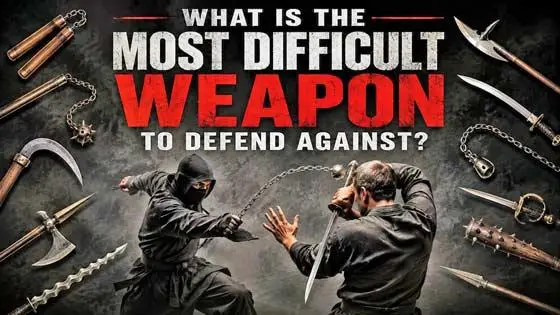
Some weapons are frightening because of their size, speed, or raw power. Others are dangerous for a completely different reason: they are extraordinarily difficult to read. A sword follows relatively predictable lines, but what happens when the weapon bends, changes direction in the middle of its movement, attacks from several angles, or reaches farther than it appears capable of reaching? Throughout history, weapon designers found ways to make defense increasingly complicated, from flexible chains and articulated staffs to deceptive blades and unusually long weapons. But if you had to judge them purely by the problems they create for someone trying to defend against them, which weapon would be the hardest of all to deal with?
The Hardest Weapon to Defend Against May Be the One You Cannot Predict
When people imagine a difficult weapon to defend against, size and power usually come to mind first. A massive axe looks terrifying, while a long sword creates an obvious reach problem. But neither characteristic necessarily makes a weapon unusually difficult to read. In fact, some of history's most intimidating weapons move in relatively predictable ways.
Predictability matters because defense begins before a weapon reaches its target. A rigid weapon has a fixed shape. Once it starts moving, its length, orientation, and general path provide information about where the weapon can go next. That does not make defending against it easy, but it gives the defender something extremely valuable: clues.
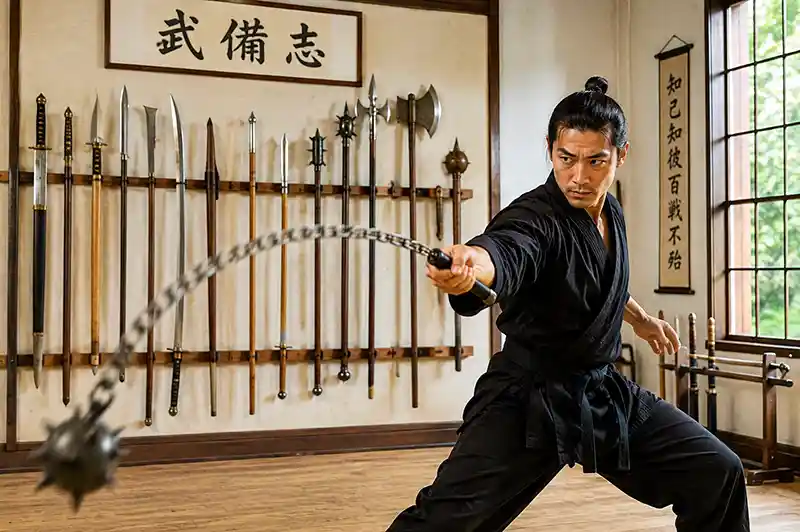
Flexible weapons begin to break those expectations. A chain can bend while moving, allowing different portions of the weapon to follow different paths. The striking end may continue traveling after another section changes direction, and the weapon's overall shape can transform dramatically during a single movement. That is one reason chained weapons immediately deserve a place among our strongest contenders.
This gives us the first criterion for deciding which weapon is truly the most difficult to defend against: unpredictability. Raw power matters, reach matters, and speed matters, but a weapon that makes its next movement difficult to interpret creates a fundamentally different defensive problem.
And once unpredictability becomes part of the equation, some very strange weapons suddenly become much more formidable than their size would suggest.
Flexible Weapons Can Change Direction After the Defender Commits
A rigid weapon usually gives the defender a relatively straightforward geometric problem. A sword blade, staff, or axe handle cannot suddenly bend around an obstacle. Its path can certainly change, but the entire weapon remains connected along a fixed line. Flexible weapons behave differently because momentum can continue traveling through the weapon even while its shape changes.
The nunchaku is a simple example. Two rigid sections connected by a cord or chain create movement that neither section could produce independently. Once one handle changes direction or slows, the other can continue moving around the connection point. That articulation introduces an additional variable the defender has to interpret.
This is part of what makes nunchaku so visually deceptive. The weapon's effective shape can change from almost straight to sharply angled in an instant. Someone watching the first handle does not necessarily have a perfect visual indication of where the second will be a fraction of a second later.
There is an important tradeoff, however. Unpredictability affects the person wielding the weapon too. Flexible weapons generally demand greater control than comparable rigid designs because their moving sections do not stop behaving independently simply because the user wants them to. The same characteristic that complicates defense can also complicate mastery.
Still, for our comparison, articulation earns the nunchaku an important advantage. A defense that successfully accounts for the first part of a weapon's movement may not necessarily account for what the connected section does next. That makes flexible weapons fundamentally different from most swords, staffs, axes, and other rigid contenders.
Reach Creates a Defensive Problem Before the Weapon Even Moves
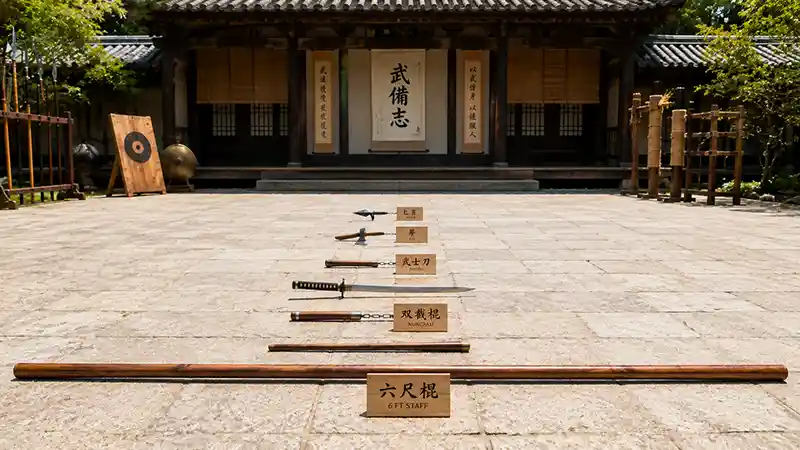
Unpredictability is only one way to make a weapon difficult to defend against. At the opposite end of the spectrum is something much simpler: reach. A long weapon can threaten an opponent while remaining outside the effective distance of a shorter one, forcing the defender to deal with the weapon before getting anywhere near the person controlling it.
The staff is one of the clearest examples. Its design could hardly be more straightforward, yet a long staff can control an enormous amount of space compared with a knife, short club, or other compact weapon. The defender is not merely dealing with the end of the weapon. They must account for a long rigid object capable of moving across a wide area.
This creates a completely different challenge from the nunchaku. A staff does not disguise its dimensions or suddenly change shape. The difficulty comes from having to cross the distance it controls. Even when the weapon's movement is relatively easy to understand, knowing what is happening and being able to do something about it are two very different problems.
Reach also magnifies relatively small movements. Because the far end of a long weapon sits at a considerable distance from the hands controlling it, a modest change in angle near the grip can produce much greater movement at the opposite end. A weapon does not need flexible joints to cover a surprising amount of space quickly.
That gives us our second major criterion: how much space can the weapon threaten while keeping its wielder farther away? Flexible weapons may win on unpredictability, but long rigid weapons answer with something equally troublesome: a defensive problem that begins before shorter weapons are even close enough to matter.
Speed Is Harder to Defend Against When the Weapon Is Light
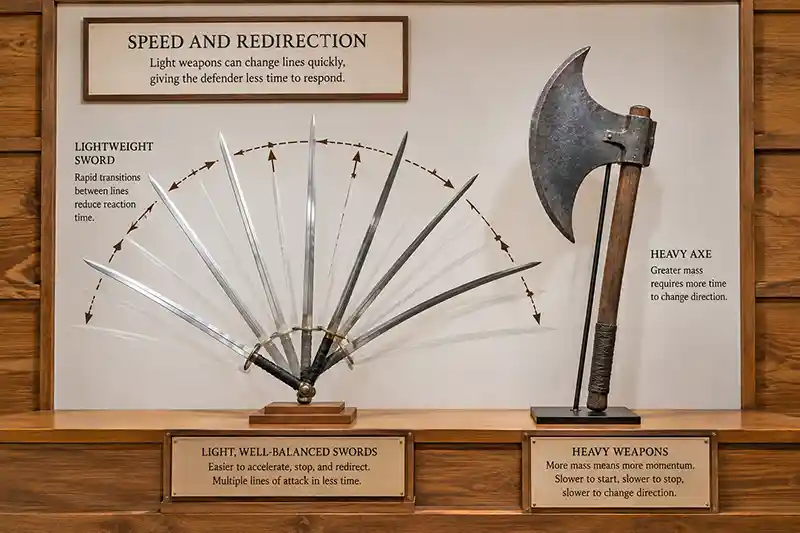
Reach creates distance, and flexibility creates uncertainty, but speed creates an entirely different problem: time. The faster a weapon can change position, the less time there is to recognize what is happening and respond. That sounds obvious, but weapon speed is not simply a matter of how quickly the person holding it can move.
Weight and balance have an enormous influence on how rapidly a weapon can be redirected. A massive axe may develop tremendous momentum, but changing its direction requires controlling that mass. A lighter sword or stick can often be accelerated, stopped, and redirected with much less effort. This means the weapon may threaten one line before rapidly transitioning somewhere else.
Swords provide a particularly interesting example because the category contains such enormous variation. Some are relatively light and agile, while others are substantially longer or heavier. Well-balanced swords demonstrate why judging a weapon by appearance alone can be misleading. A blade can possess meaningful reach without necessarily moving like a cumbersome piece of steel.
Speed becomes especially troublesome when combined with reach. A tiny weapon may move extremely quickly but still require its wielder to get very close. A longer weapon that can also be redirected rapidly creates a more complicated defensive problem because it combines reduced reaction time with a larger threatened area.
This gives us another criterion for our eventual winner: how quickly can the weapon shift from one potential line to another? The most difficult weapon to defend against may not be the one capable of producing the greatest force. It may be the one that gives the defender the least time to correctly interpret what is coming next.
Unusual Attack Angles Can Make Familiar Defenses Less Reliable
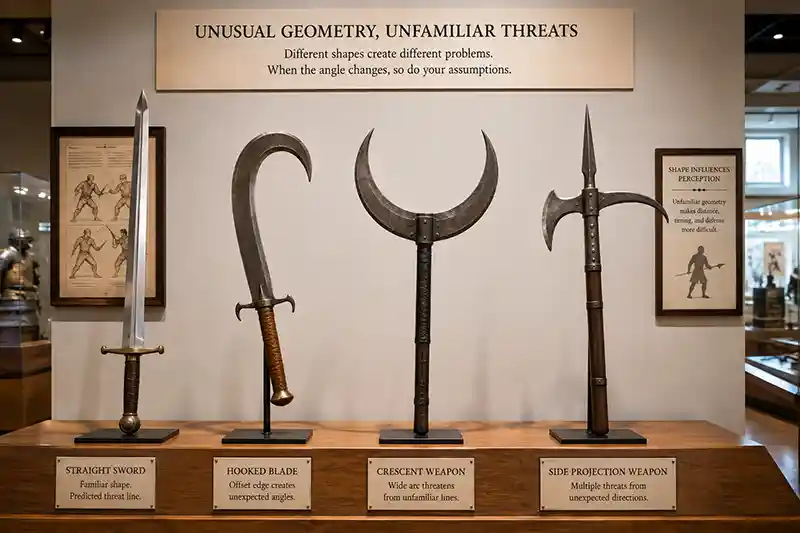
Some weapons become difficult to defend against not because they are faster or longer, but because their shape allows them to approach from directions that are less intuitive. Most simple weapons place their striking surface directly in line with the handle. Change that relationship, and suddenly the defender has to account for a weapon whose dangerous portion may not be exactly where the hands seem to indicate.
Hooked blades are an obvious example. A dramatically curved or projecting section changes the weapon's silhouette and creates geometry that differs from a conventional straight blade. Other historical designs incorporated side projections, multiple points, crescent-shaped heads, or combinations of striking surfaces that made the weapon considerably more complicated to visually interpret.
This is where the enormous category of exotic weapons becomes particularly interesting. Many unusual weapons look bizarre precisely because their designers abandoned the straightforward relationship between handle and striking surface found on simpler swords, clubs, and spears. Whether every unusual feature was genuinely advantageous is another question, but unconventional geometry could certainly force an opponent to account for unfamiliar shapes.
Familiarity matters more than it might seem. Someone who has repeatedly encountered straight swords understands their basic dimensions almost instinctively. Introduce a hooked blade, articulated section, offset point, or other unusual feature and some of those visual assumptions stop working. The weapon does not necessarily have to move faster. It can make the defender's existing expectations less useful.
That gives us another criterion for our eventual winner: unfamiliar geometry. The hardest weapon to defend against may be one that combines recognizable movement with a shape capable of producing something the defender did not expect.
Weapons That Threaten More Than One Distance Are Harder to Read
Most weapons have a distance at which their design makes immediate sense. A dagger is clearly a close-range weapon. A long staff announces its reach before anything happens. But some weapons complicate defense because their effective distance can change dramatically depending on how they are being used.
Flexible weapons are especially interesting here. A chain can be gathered close to the body one moment and extended across a much larger area the next. Articulated weapons can similarly transition between compact and extended configurations as their sections move relative to one another. The defender is therefore judging something more complicated than the fixed length of a rigid object.
This is one reason the history behind why nunchaku were actually invented is worth separating from the exaggerated abilities often attributed to them in popular culture. Whatever myths accumulated around the weapon, its articulated construction genuinely creates a different geometric problem from an ordinary rigid stick of comparable material and size.
Changing effective distance can also distort visual judgment. With a rigid sword, the location of the tip provides a fairly obvious indication of maximum physical reach. With a weapon containing flexible or articulated sections, its compact appearance at one instant may not communicate the full area those sections can occupy once they begin moving.
That does not make flexible weapons automatically superior. Their changing geometry demands control from the wielder as well, and the same complexity that makes them difficult to interpret can make them more difficult to use consistently. But from the defender's perspective, a weapon whose apparent dimensions keep changing adds another variable that must be judged correctly.
We now have several characteristics competing for the title: unpredictability, reach, speed, unusual geometry, and changing effective distance. The most difficult weapon to defend against may ultimately be the one that combines several of them rather than dominating only one.
Multiple Threatening Surfaces Make a Weapon Harder to Judge
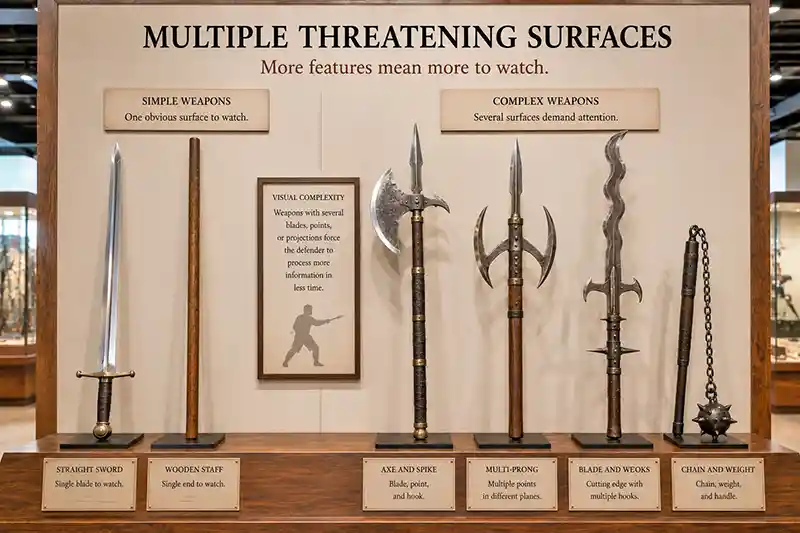
A simple weapon usually gives the defender one obvious feature to watch. A conventional sword has a blade. A club has a striking end. A spear has a point. More complicated weapons can force the eye to keep track of several potentially important surfaces at once, making the weapon's overall shape harder to interpret quickly.
Double-ended weapons provide an obvious example. When both ends of a staff or similar weapon are usable, attention cannot remain fixed exclusively on the end currently closest to the defender. The opposite end is still part of the weapon's geometry, and rotating the shaft can dramatically change which portion occupies the threatening side of the movement.
Weapons combining different features take this even further. Historical designs sometimes incorporated blades, hooks, spikes, weighted sections, or additional projections into a single object. Some were specialized tools adapted into weapons, while others appear almost deliberately complicated to modern eyes. The history of weird martial arts weapons that actually existed is filled with reminders that weapon design did not always follow the simplest possible formula.
This does not mean adding more blades or projections automatically produces a superior weapon. Additional complexity can increase weight, interfere with handling, or create disadvantages for the person carrying it. But from the narrow perspective of visual interpretation, a complicated silhouette gives the defender more information to process in less time.
That matters because defending against a weapon involves more than seeing movement. The defender must correctly identify which part of that movement represents the immediate problem. A weapon with several visually prominent ends, edges, or projections can make that judgment less obvious than it would be against a simple straight blade or stick.
As our contenders become stranger, a pattern is emerging. The hardest weapons to interpret are often not those with one overwhelming characteristic. They are the ones that force the defender to solve several different problems at the same time.
Heavy Weapons Can Be Difficult to Stop Once They Start Moving
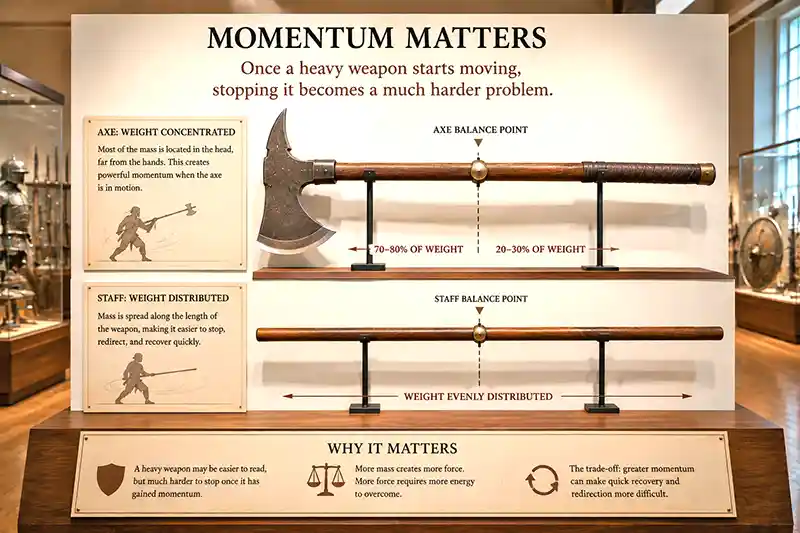
So far, lighter weapons have gained an advantage because they can change direction quickly. But greater mass creates a different defensive problem. Once a heavy weapon develops momentum, simply recognizing its path does not make that momentum disappear. The defender may understand exactly where the weapon is traveling and still face a substantial amount of moving mass.
Axes illustrate this particularly well. Much of an axe's weight is concentrated toward the head, placing significant mass away from the hands controlling it. This creates very different handling characteristics from a similarly sized weapon whose weight is distributed more evenly along its length.
That concentrated mass is one reason axes and hatchets deserve their own place in our comparison. They may not possess the unpredictable geometry of a chain weapon or the rapid redirection of a lighter blade, but they present a different question for the defender: what happens when the incoming weapon is relatively easy to read but much harder to arrest once it has gained momentum?
This exposes an important difference between avoiding a weapon and physically intercepting it. A weapon with substantial momentum can make direct opposition considerably less forgiving than its predictable path might suggest. In other words, knowing where something is going does not necessarily mean stopping it is simple.
The disadvantage belongs to the wielder as well. Greater momentum generally makes rapid recovery and redirection more demanding. If the weapon's movement does not achieve its intended result, its mass still has to be controlled. That gives lighter weapons an advantage in adaptability even while heavier weapons create a more imposing momentum problem.
So axes probably do not take the overall title. But they add another criterion we cannot ignore: how difficult is the weapon's movement to interrupt once it is already underway? The eventual winner may need more than unpredictability or speed. It may need enough momentum to make a correct defensive read only the beginning of the problem.
Throwing Weapons Create a Problem Most Melee Weapons Do Not
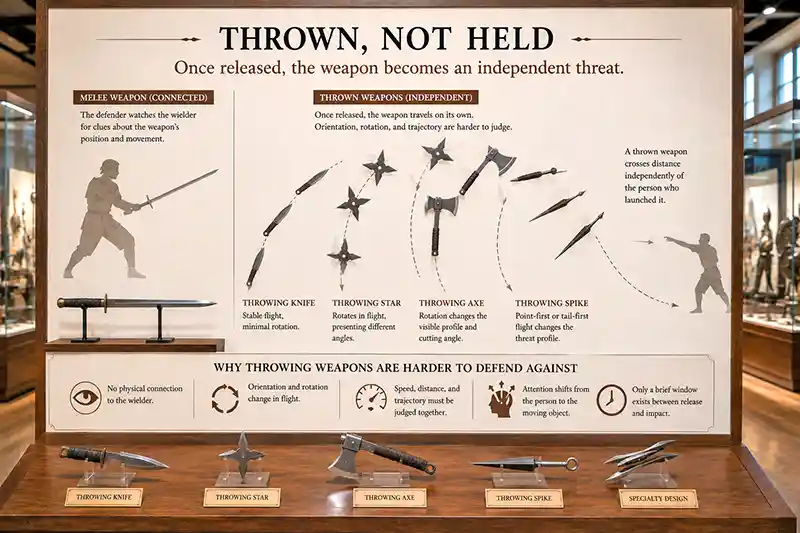
Nearly every weapon we have examined so far remains physically connected to the person controlling it. That gives the defender an important visual reference point. Watch the wielder's hands and body, and there are at least clues about where the weapon is positioned and how its movement may develop. A thrown weapon breaks that connection completely.
Once released, the weapon becomes an independent moving object. The defender is no longer watching only the person who launched it. Attention has to shift toward the object traveling through space, while the person who threw it remains separate from that movement. This creates a very different perceptual problem from facing a sword, staff, or axe.
The category of throwing weapons includes designs with dramatically different shapes and flight characteristics, from relatively straightforward throwing knives to stars, spikes, axes, and other specialized objects. Some rotate in flight, while others can travel with comparatively little visible rotation. That variation alone makes "throwing weapon" far too broad to describe one predictable defensive problem.
Rotation can make visual judgment even more complicated. A spinning object continually changes its orientation while traveling, meaning its silhouette can look different from one instant to the next. Unlike a sword held in someone's hand, there is no longer a fixed grip providing an obvious reference for which direction the weapon is facing.
Thrown weapons also demonstrate why distance alone does not determine defensive difficulty. A staff may control considerable space while remaining attached to its wielder. A thrown object can cross that space independently, forcing the defender to interpret its speed, trajectory, orientation, and changing distance simultaneously.
That makes throwing weapons unusual contenders, although they come with an obvious limitation: once the weapon leaves the hand, the wielder gives up direct control over it. That tradeoff probably keeps them from taking our overall title, but for the brief period between release and arrival, they create one of the most distinctive defensive problems in our comparison.
Hidden Weapons Add Surprise Before the Fight Even Begins

Not every difficult weapon gains its advantage from what happens after it starts moving. Some create a problem even earlier by making it difficult to recognize that a weapon is present at all. Historically, concealed weapons exploited an entirely different vulnerability: the defender may not know what they are dealing with until the weapon has already been revealed.
This is what makes the history of ingenious hidden weapons so fascinating. Blades were concealed inside canes, buckles, clothing, ordinary-looking objects, and other unexpected places. Their defining characteristic was not necessarily superior reach, speed, or power. It was the ability to disguise the nature of the threat.
That distinction matters for our comparison. Once a concealed blade is exposed, it may behave no differently from another blade of similar dimensions. Before that moment, however, the defender lacks one of the most important advantages available against an obvious weapon: advance information. There may be no visible blade length to judge, no obvious weapon posture to interpret, and no clear indication of what type of object is about to appear.
Concealment therefore represents a different kind of unpredictability from flexible weapons. A chain weapon can be difficult to read because its geometry changes during movement. A hidden weapon creates uncertainty because its geometry is unknown in the first place.
For our eventual winner, though, concealment probably cannot be the deciding factor. We are trying to determine which weapon is most difficult to defend against based primarily on the characteristics of the weapon itself, not whether someone successfully hides it beforehand. Surprise can make almost any weapon more difficult to deal with, but that does not necessarily make the underlying design harder to read once revealed.
Still, hidden weapons expose something important about defense: information matters. The less accurately someone can identify a weapon's dimensions, capabilities, and movement before having to react, the more difficult the problem becomes.
Weapons That Began as Tools Can Be Harder to Read
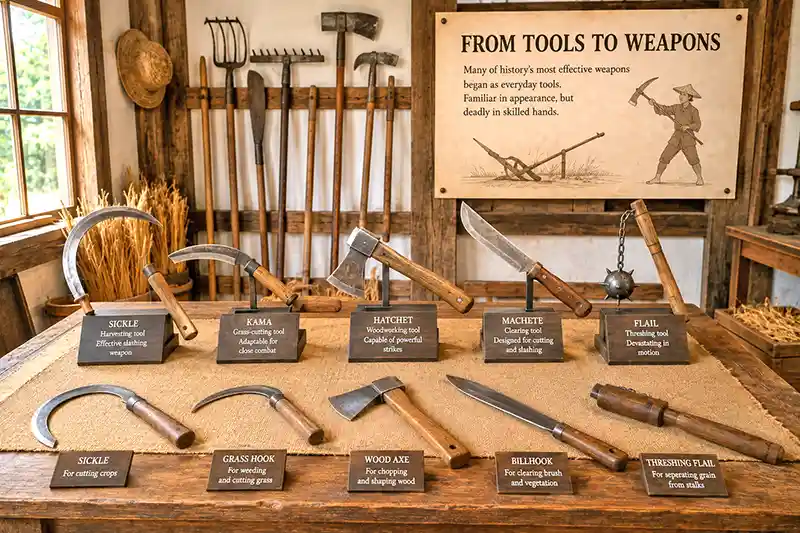
Some weapons create confusion for a reason that has nothing to do with concealment. Their shape comes from an entirely different purpose. When an object originally designed for farming, cutting vegetation, processing materials, or performing another everyday task becomes a weapon, its geometry may look very different from something designed exclusively for combat.
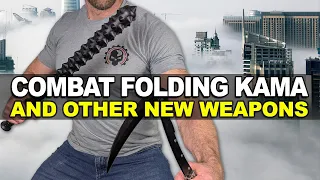
The kama is a good example. Its sharply curved blade projects at an angle from a relatively short handle, creating a silhouette completely unlike a conventional sword or dagger. Similar quirks appear in other tool-derived designs, where the location of the edge, balance of the object, or relationship between the handle and working surface reflects the job it originally performed.
The stories behind weapons that started as everyday tools show how surprisingly diverse these shapes could become. Sickles, axes, machete-like blades, flails, and numerous other objects crossed the boundary between practical implement and weapon at different points in history.
From the defender's perspective, unfamiliarity can matter. Someone accustomed to straight blades may find the visual geometry of a deeply curved sickle or offset cutting edge less intuitive. The weapon does not magically become superior because it originated as a tool, but its unusual proportions can make familiar assumptions about distance and orientation less reliable.
There is also an interesting contrast with the hidden weapons we just examined. A concealed weapon disguises what it is. A tool-derived weapon may be completely visible while still making its capabilities less immediately obvious. The uncertainty comes not from hiding the object, but from encountering a shape that does not conform to familiar weapon geometry.
This strengthens the case for unusual weapons in our comparison. The hardest design to defend against may be one that combines unfamiliar geometry with movement that is equally difficult to predict.
Some Weapons Were Designed to Overwhelm the Defense Itself
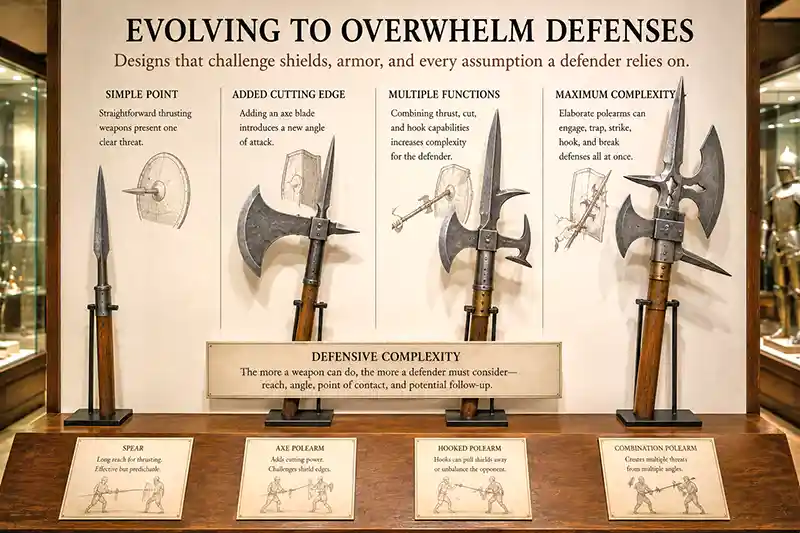
So far, we have mostly judged weapons by how difficult their movement is to interpret. But historical weapon design sometimes approached the problem differently. Instead of trying to avoid an opponent's defensive equipment, certain weapons were shaped to interact with shields, armor, or other protective barriers in ways that made those defenses less straightforward to rely upon.
Hooked and projecting weapon heads are particularly interesting examples. A conventional blade presents a relatively simple profile, while a weapon incorporating hooks, spikes, or multiple striking surfaces creates several possible points of contact. Polearms became especially elaborate in this regard, sometimes combining an axe-like blade, thrusting point, and rear projection into a single weapon.
This helps explain why some of the weapons rumored or recorded as being restricted from battlefields developed such intimidating reputations. Stories about supposedly "banned" weapons are often exaggerated, misinterpreted, or stripped of historical context, but they reveal how strongly people respond to designs that appear capable of defeating familiar forms of protection.
From our perspective, the important factor is defensive complexity. A straightforward weapon presents one obvious problem. A multifunctional weapon can force someone to account for several characteristics simultaneously. Reach might need to be considered alongside an unusual projection, while the weapon's orientation determines which part of its complicated head is relevant at that moment.
There is a downside, of course. Every additional feature adds material, and complicated weapon heads can increase weight or alter balance. More complexity does not automatically mean better performance. History is full of weapons whose intimidating appearance probably contributed as much to their modern reputation as their actual battlefield usefulness.
But this gives us another clue about our eventual winner. The most difficult weapon to defend against may be one that does not merely challenge a single defensive assumption, but forces several different judgments at once. And there is one family of weapons that combines that complexity with something we have already identified as particularly troublesome: flexible movement.
The Most Difficult Weapons Combine Several Problems at Once
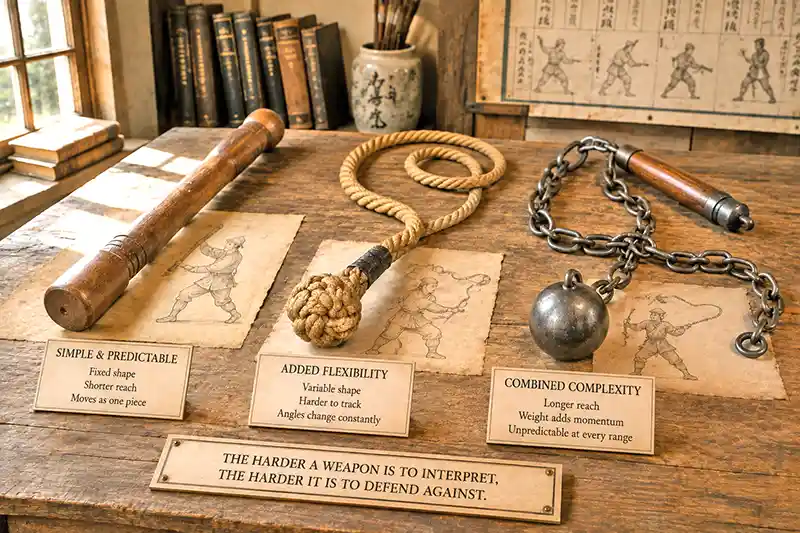
We now have enough contenders to see why choosing a winner based on a single characteristic does not work. A staff dominates in reach but remains geometrically predictable. A light sword can change direction rapidly but retains a fixed shape. An axe carries substantial momentum but becomes more demanding to redirect. Throwing weapons separate from their wielder entirely, yet surrender direct control the moment they are released.
The truly troublesome designs are the ones that begin stacking these characteristics together. Imagine a weapon that has significant reach but can also change shape. Add a weighted end capable of carrying momentum, then connect it with a flexible section whose position is constantly changing. Suddenly the defender is no longer solving one problem. Distance, timing, orientation, and trajectory are all changing together.
This is where flexible weighted weapons become especially interesting. The history of the monkey fist provides one example of how a compact weighted object attached to flexible material creates very different movement from an ordinary rigid club. Other historical chain-and-weight designs pushed the same basic concept much further, sometimes combining long flexible sections with substantial striking ends.
The important distinction is that the weight and the flexible section behave as parts of the same system. A rigid axe tells you exactly where its head is relative to its handle. With a chain-and-weight weapon, the striking end can occupy dramatically different positions relative to the hand controlling it. Momentum can continue carrying that weight even while the flexible connection changes orientation.
That combination begins checking nearly every box on our list. Variable geometry makes the weapon harder to visually interpret. Reach increases the area that must be considered. A weighted end adds momentum. And changing orientation makes its apparent dimensions less consistent from one moment to the next.
We are getting very close to our winner. But before declaring flexible weighted weapons the hardest to defend against, there is one particularly notorious historical design that deserves to be examined on its own.
The Kusarigama Combines Almost Every Defensive Problem We Have Found
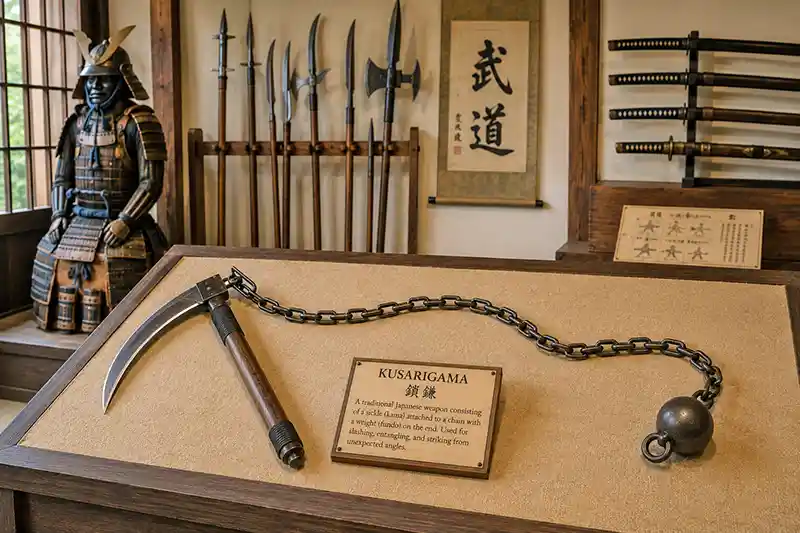
If we were looking for a historical weapon designed to make this comparison complicated, the kusarigama would be difficult to beat. Its basic construction combines two radically different weapon concepts: a rigid sickle and a flexible chain with a weighted end. Instead of forcing the defender to interpret one type of geometry, it presents several at the same time.
The kama portion is relatively compact, but its curved blade already creates a less familiar silhouette than a straight sword or staff. Attached to it is a chain capable of occupying a constantly changing path through space. At the opposite end, a weight adds another moving component whose position cannot be understood simply by looking at the orientation of the sickle.
This combination is what makes the kusarigama such a fascinating candidate. The weapon can appear compact while the chain is gathered, yet the flexible portion dramatically increases its overall movement envelope when extended. The rigid and flexible components also behave according to completely different geometry, forcing the eye to account for both simultaneously.
It is easy to see why weapons like this appear so frequently in discussions of brutal historical close-combat weapons. Their reputation can become exaggerated over time, particularly when modern entertainment turns unusual weapons into almost supernatural objects. But we do not need any mythology to understand why the kusarigama creates an unusual defensive puzzle. Its physical construction alone is complicated enough.
There is also an important weakness that prevents us from simply declaring it unbeatable. Complexity works both ways. A weapon with a rigid sickle, long flexible connection, and independently moving weight demands substantially more management from its user than a straightforward sword or staff. More variables for the defender can also mean more variables for the wielder.
Still, judged strictly by the criteria we established earlier, the kusarigama is an extraordinary contender. It combines changing geometry, variable effective distance, unfamiliar angles, multiple threatening components, and the momentum of a weighted flexible section in one weapon. Few historical designs stack so many of our defensive problems together.
And yet there is an even simpler flexible weapon that may challenge it for the top spot precisely because it accomplishes something similar with far fewer moving parts.
The Meteor Hammer May Be Even Harder to Read

The kusarigama earns its complexity by combining several different weapon types. The meteor hammer takes almost the opposite approach. Its basic construction is remarkably simple: one or more dense weights attached to a long flexible rope or chain. Yet that simplicity creates movement that can be extraordinarily difficult to interpret visually.
Unlike the kusarigama, there is no rigid sickle providing a constant reference point for the weapon's orientation. Much of the meteor hammer's effective shape is determined by the flexible line connecting the weight to the wielder. As that line bends, loops, extends, or changes direction, the location of the weighted end can change dramatically relative to the hands controlling it.
This gives the meteor hammer something many of our other contenders lack: extreme variability with relatively little structural complexity. A multifunctional polearm looks complicated because it is complicated. A meteor hammer can look almost primitive while producing an enormous variety of changing shapes during movement.
Its relationship with distance is equally unusual. A sword has a fixed maximum length that can be judged simply by looking at it. A meteor hammer can appear comparatively compact when much of its flexible length is gathered, then occupy a far larger area when extended. The defender has to interpret the weight, the flexible connection, and the changing radius of movement rather than relying on one rigid silhouette.
There is also momentum to consider. The weight concentrates mass at the end of a flexible connection, combining one of the axe's most troublesome characteristics with the changing geometry we identified in chain weapons. Yet the design avoids the additional rigid components that make the kusarigama more complicated for its wielder to manage.
That does not mean the meteor hammer is automatically superior. Flexible weapons demand considerable skill, and their unpredictability is not experienced exclusively by the person facing them. But if our question is specifically which historical weapon creates the most difficult movement to visually read and anticipate, the meteor hammer has suddenly become one of our strongest candidates.
The final question is whether pure unpredictability is enough to beat weapons that combine unpredictability with blades, multiple striking surfaces, or greater structural versatility.
Could a Simple Chain Weapon Be Harder to Defend Against Than the Kusarigama?
The meteor hammer raises an interesting possibility: perhaps adding more features does not always make a weapon harder to defend against. The kusarigama has a sickle, chain, and weight, but those additional components also provide information. The kama gives the eye a rigid reference point, and its orientation can reveal something about how the weapon is positioned.
A simpler chain-and-weight weapon removes much of that information. There may be little more than a handle or grip, a flexible length of chain, and a weight at the opposite end. Instead of tracking a recognizable blade attached to a flexible component, the defender is confronted with a moving mass whose position can change dramatically relative to the hand controlling it.
This is where simplicity becomes deceptive. A rigid club is simple because its behavior is easy to understand. A flexible weighted weapon can be mechanically simple while producing movement that is visually complicated. The weapon itself contains few parts, yet the number of shapes it can assume is enormous.
The contrast becomes even more interesting when compared with something like the blackjack. A blackjack can incorporate flexibility into a compact striking weapon, but its overall dimensions remain comparatively constrained. Lengthen that flexible connection dramatically and place more distance between the hand and weighted end, and the movement problem changes completely.
This helps explain why our search for the hardest weapon to defend against keeps returning to flexible designs. They violate one of the assumptions that makes rigid weapons easier to visually interpret: the position of the hand does not provide a fixed relationship to the position of the striking end.
The kusarigama may still be the more versatile and structurally complicated weapon. But if we narrow the question specifically to which design is hardest to visually track and predict, a comparatively simple chain-and-weight weapon may actually have the advantage.
That leaves us with a final comparison to make. We have identified the strongest candidates, and now we can rank them against the same criteria to see which weapon ultimately deserves the top spot.
Which Weapons Make the Final Cut?
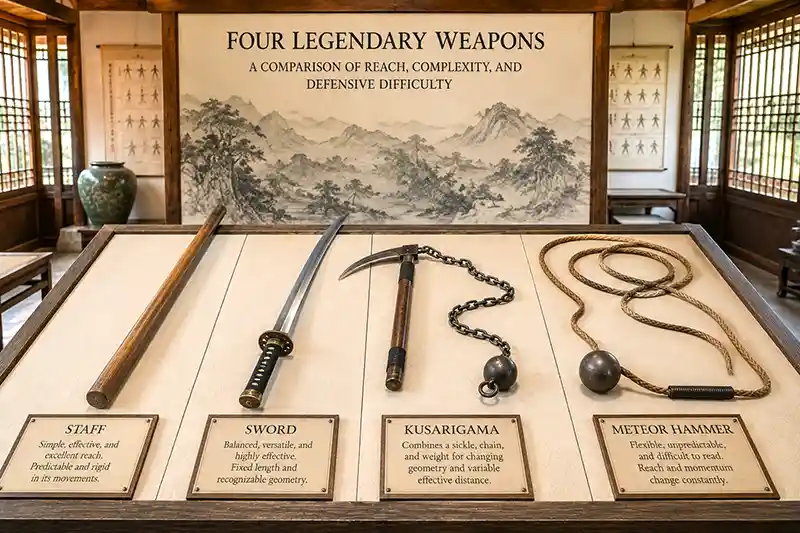
After comparing reach, speed, momentum, flexibility, changing geometry, unusual angles, concealment, and the number of different things a defender has to interpret at once, the field becomes much smaller. Plenty of historical weapons are formidable, but only a handful consistently create problems across several of those categories.
The staff remains one of the strongest contenders for pure reach. It can control substantial space while remaining comparatively quick and mechanically simple. Its weakness in this comparison is predictability. The weapon is rigid, its length is obvious, and its basic geometry never changes.
The sword offers perhaps the best overall balance. Depending on the design, it can combine useful reach with relatively fast redirection and a wide variety of movements. There is a reason swords became some of the most important weapons in history. But from the defender's perspective, a conventional sword still provides a fixed blade, fixed length, and recognizable relationship between the wielder's hands and the weapon itself.
The kusarigama is much more difficult to interpret. Its sickle, chain, and weighted end combine rigid and flexible components in a single weapon, producing changing geometry and dramatically different effective distances. It may be one of the strangest defensive puzzles in historical weapon design, but its complexity also creates substantial demands for the person controlling it.
Then there is the meteor hammer and related flexible weighted weapons. These sacrifice the obvious rigid reference points found on swords, staffs, and even the kusarigama. The weighted end can occupy dramatically different positions relative to the wielder while the flexible connection continuously changes shape. Reach, momentum, orientation, and apparent distance can all become part of the same visual problem.
That leaves us with an unusually close final ranking. If we were asking for the most versatile weapon, the answer could be completely different. If we were asking about reach, raw momentum, ease of control, or battlefield practicality, other weapons would rise immediately to the top.
But our question is narrower: which weapon is the most difficult to defend against? If we define that primarily by how difficult the weapon is to read, predict, and visually interpret once it begins moving, the strongest candidates are no longer swords or axes at all.
The final contest comes down to the kusarigama versus the meteor hammer.
The Meteor Hammer Takes the Title for Pure Unpredictability
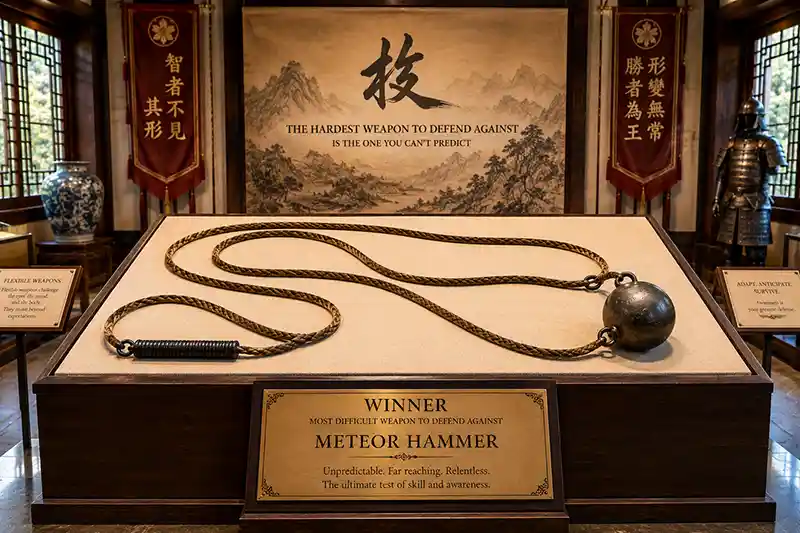
If we judge these weapons strictly by how difficult their movement is to read, the meteor hammer is our winner. It does not have the versatility of a sword, the straightforward reach of a staff, or the combination of rigid and flexible components found on the kusarigama. What it does have is an unusually troublesome combination of reach, changing geometry, concentrated weight, and constant variation in the position of its striking end.
The kusarigama comes extremely close. In some ways, it presents an even more complicated overall problem because the defender must account for the sickle as well as the chain and weight. But that rigid kama also provides something the meteor hammer largely eliminates: a stable visual reference. With the meteor hammer, almost the entire space between the wielder and the weight can continuously change shape.
That is what separates it from most of the weapons we examined. A sword can be fast, but its blade remains attached to the handle at a fixed angle. A staff can have tremendous reach, but its length never changes. An axe can develop substantial momentum, but the location of its head remains completely predictable relative to its handle. Even many unusual weapons retain some fixed geometry that the eye can use to understand what the weapon is doing.
The meteor hammer offers far fewer of those clues. Its weighted end can move through a large radius while the flexible connection bends into completely different configurations. The apparent distance between the weight and the wielder can change rapidly, and the weight carries momentum independently through those changing paths.
There is an enormous qualification to this conclusion. The weapon is also extraordinarily demanding for the person controlling it. The characteristics that make flexible weapons difficult to interpret do not somehow disappear for their users. A simpler rigid weapon may be dramatically more practical, controllable, and useful in many real historical circumstances.
So the meteor hammer is not necessarily the "best" weapon in our comparison. That was never really the question. If the contest is specifically about which historical weapon would be the most difficult to visually read and anticipate once it was already in motion, however, the meteor hammer makes the strongest case.
And that leads to the strangest conclusion of all: the hardest weapon to defend against may not be the one with the biggest blade, the greatest reach, or the most complicated construction. It may simply be the one that refuses to move the way your eyes expect a weapon to move.
Why the Most Unpredictable Weapon Is Not Necessarily the Best Weapon
Giving the meteor hammer our top spot creates an important distinction. Being difficult to defend against does not automatically make a weapon practical, versatile, or superior to everything else. In fact, some of the characteristics that helped the meteor hammer win our comparison also create serious disadvantages for the person using it.
A sword, staff, or compact striking weapon has relatively predictable geometry. That predictability helps an opponent understand its movement, but it also helps the wielder control it. The weapon remains where its user expects it to be, responds directly to changes in the hands, and does not contain a weighted end continuing along its own path through a flexible connection.
The meteor hammer sacrifices much of that simplicity. Its movement depends on momentum, timing, flexible length, and the constantly changing position of the weight. That creates the visual uncertainty that made it such a strong contender, but it also means substantially more variables have to be controlled by the person wielding it.
This is why weapon history repeatedly rewards relatively straightforward designs. Swords, spears, axes, staffs, and compact close-combat weapons survived for centuries not because they were the strangest things anyone could invent, but because they offered useful combinations of effectiveness, control, durability, portability, and versatility.
Our previous look at the best weapon for fighting in tight spaces demonstrated the same principle from another direction. Change the environment or the criteria, and the answer can change completely. A long flexible weapon that creates extraordinary unpredictability in open space could become far less appealing when walls, furniture, low ceilings, or other obstacles restrict its movement.
So the meteor hammer wins a very specific contest. It is our strongest candidate for the historical weapon whose movement would be hardest to visually interpret and anticipate. Ask which weapon was easiest to carry, simplest to learn, most useful on a battlefield, best in confined surroundings, or most versatile across different situations, and it might not even reach the final round.
That may be the most interesting lesson in the entire comparison: weapons do not become effective because they dominate every category. They become effective when their particular advantages match the circumstances in which they are used.
So What Is the Most Difficult Weapon to Defend Against?
After comparing everything from swords and staffs to axes, throwing weapons, nunchaku, the kusarigama, and flexible weighted weapons, our answer remains the meteor hammer. Not because it is the most powerful weapon in history, but because it combines several characteristics that make its movement unusually difficult to interpret.
Its flexible construction means there is no fixed relationship between the wielder's hands and the weighted end. Its effective distance can change as the flexible length moves, the weight carries its own momentum, and the weapon can assume dramatically different shapes from one moment to the next. Those characteristics remove many of the visual clues provided by conventional rigid weapons.
The kusarigama deserves an extremely close second place because it adds a sickle to many of the same problems. Nunchaku introduce articulation and changing geometry in a much more compact package. Long staffs create tremendous problems through reach alone, while swords demonstrate just how difficult a weapon can be without relying on mechanical complexity at all.
That variety is exactly why the broader world of bizarre weapons once carried for self-defense is so interesting. Historical weapon design produced countless different answers to the same basic problems, and the strangest-looking solution was not always the most effective one.
There can never be a completely objective winner because skill, environment, distance, familiarity, and countless other circumstances change the comparison. But judged specifically by unpredictability and the difficulty of visually reading the weapon's movement, the meteor hammer makes the strongest case.
And perhaps that is why it looks deceptively unimpressive when sitting still. Some weapons advertise exactly what makes them dangerous. The meteor hammer only reveals what makes it unusual once it starts moving.
Is the Meteor Hammer Really the Hardest Weapon to Defend Against?
There is no objective answer that applies to every situation, but the meteor hammer makes an unusually strong case. Its flexible construction, long effective reach, weighted end, and constantly changing geometry remove many of the visual clues that make rigid weapons easier to interpret.
That does not mean it would always be more effective than a sword, staff, axe, or other conventional weapon. Environment, distance, experience, and the skill of both people would completely change the comparison. Our ranking is specifically based on how difficult the weapon's movement can be to visually read and anticipate.
Under those criteria, the meteor hammer stands out because its striking end does not maintain a fixed position relative to the wielder's hands. The weapon can continuously change shape while the weight carries momentum through its movement, creating exactly the combination of variables that repeatedly caused problems throughout our comparison.
Why Are Flexible Weapons So Difficult to Predict?
Flexible weapons behave differently from rigid weapons because their shape can change continuously while they are moving. With a sword or staff, the position of one part of the weapon tells you a great deal about where the rest of it must be. A rope, cord, or chain removes that fixed relationship.
A weighted end can continue moving under its own momentum while the flexible section bends and changes orientation. This means the overall silhouette of the weapon can transform rapidly, making distance and direction more difficult to judge visually than they would be with a rigid object of fixed dimensions.
That unpredictability comes with a major tradeoff. The wielder also has to manage those additional variables, which is why flexible weapons can demand considerable control and familiarity. The same changing geometry that makes the weapon difficult for an opponent to interpret can also make it substantially more challenging to master.
Is the Kusarigama Harder to Defend Against Than the Meteor Hammer?
The kusarigama may actually present a more complicated overall weapon because it combines a rigid sickle with a flexible chain and weighted end. Someone encountering it has to account for components with completely different shapes and movement characteristics, giving the weapon an extraordinary amount of visual complexity.
The meteor hammer edges ahead in our comparison for a different reason: it provides fewer rigid visual references. With the kusarigama, the position of the kama still gives the eye something relatively stable to track. The meteor hammer consists primarily of a flexible connection and moving weight, allowing its overall geometry to change much more dramatically.
Which one is more difficult would ultimately depend on circumstances and the people involved. But when the criterion is specifically how difficult a weapon's movement is to visually interpret and anticipate, the meteor hammer's simplicity may paradoxically be what makes it the more unpredictable of the two.
Are Nunchaku Difficult to Defend Against?
Nunchaku can be difficult to visually interpret because the two rigid handles are connected by a flexible cord or chain. Unlike a solid stick, the weapon does not maintain one fixed shape as it moves. The angle between the handles can change rapidly, and momentum can continue carrying one section after the other changes direction.
That articulated construction gives nunchaku some of the unpredictability we identified in longer flexible weapons, but within a much more compact design. At the same time, their shorter overall dimensions mean they do not create the enormous changing movement envelope possible with something like a meteor hammer.
Nunchaku also demonstrate the recurring disadvantage of flexible weapons: complexity affects the wielder too. Their changing geometry demands greater control than a comparable rigid stick. So while nunchaku deserve a place among the more difficult weapons to visually read, their limited reach and demanding handling keep them below the meteor hammer and kusarigama in our overall comparison.
Are Swords Easier to Defend Against Than Flexible Weapons?
Swords are generally more predictable geometrically because the blade remains rigid and its position is fixed relative to the handle. Someone observing a sword can see its overall length, orientation, and the location of its point, providing visual information that a flexible weapon may not offer as consistently.
That does not mean swords are easy to defend against. Their combination of reach, relatively low weight, balance, and ability to change direction can make many sword designs exceptionally formidable. A skilled wielder can create considerable uncertainty without needing the weapon itself to bend or change shape.
The distinction is that a sword's unpredictability comes primarily from the movements of the person controlling it, while a flexible weapon adds another variable through the changing geometry of the weapon itself. For the specific criteria used in our comparison, that additional mechanical uncertainty is why weapons such as the meteor hammer and kusarigama ranked higher.
Does Reach Make a Weapon Harder to Defend Against?
Reach can make a weapon considerably more difficult to deal with because it increases the distance from which the weapon can present a threat. Long staffs, spears, polearms, and other extended weapons can control a much larger area than knives or compact impact weapons, giving the shorter weapon a significant distance disadvantage.
Reach alone, however, does not necessarily make a weapon unpredictable. A long rigid staff may control an enormous amount of space while still having a fixed length and easily recognizable geometry. Once its dimensions are understood, the basic relationship between the wielder's hands and both ends of the weapon remains consistent.
This is why reach becomes particularly interesting when combined with other characteristics. A flexible weapon capable of extending across a substantial distance can offer reach without maintaining the rigid geometry of a staff or spear. In our comparison, that combination of distance and changing geometry proved considerably more difficult to visually interpret than reach by itself.
Does Weapon Speed Matter More Than Power?
Not necessarily. Speed and power create different defensive problems, and neither automatically matters more in every situation. A fast, lightweight weapon can change position quickly and reduce the amount of time available to visually interpret its movement, while a heavier weapon may be easier to track but carry considerably more momentum once moving.
This is why some relatively light weapons performed so well in our comparison. Rapid redirection can make it difficult to anticipate where the weapon will be from one moment to the next. Add substantial reach or changing geometry, and speed becomes even more challenging because the defender has more information to process in less time.
Heavy weapons demonstrate the opposite tradeoff. An axe may not redirect as quickly as a lighter blade, but its concentrated mass creates momentum that remains important even when its path is relatively predictable. Ultimately, the hardest weapons to interpret tend to combine multiple characteristics rather than relying exclusively on either speed or power.
Does an Unusual Weapon Have an Advantage Simply Because It Is Unfamiliar?
Familiarity can make a significant difference in how quickly a weapon's movement is understood. Someone accustomed to seeing straight swords, staffs, or conventional knives already has expectations about their length, balance, and basic geometry. Encountering an unfamiliar weapon removes some of those assumptions and can make its capabilities less immediately obvious.
This is particularly relevant with weapons that have hooked blades, flexible sections, multiple striking surfaces, or unusual grip positions. Their appearance may make distance and orientation more difficult to judge at first simply because their geometry does not resemble more familiar weapons.
Unfamiliarity alone does not make a weapon inherently superior, however. Once its characteristics are understood, the novelty advantage can diminish considerably. The strongest contenders in our comparison were difficult to interpret for a deeper reason: their physical construction allowed their geometry or effective distance to change while they were moving.
So an exotic appearance can contribute to defensive uncertainty, but the most difficult weapons to read are not merely strange-looking. Their designs create movement that remains complicated even after you understand how the weapon works.
Are Throwing Weapons Harder to Defend Against Than Melee Weapons?
Throwing weapons create a fundamentally different problem because they stop being physically connected to the person who released them. With a sword, staff, or axe, the wielder remains part of the visual information surrounding the weapon. Once an object is thrown, its movement continues independently through space.
That can make trajectory, speed, distance, and orientation important simultaneously. Some thrown weapons also rotate during flight, causing their silhouettes to change continuously as they travel. In that sense, a thrown weapon can briefly become less visually predictable than a rigid weapon still being held.
The major tradeoff is control. Once a throwing weapon has been released, the person who threw it generally cannot redirect its path. Flexible melee weapons such as the meteor hammer remain connected to their wielder while still producing changing geometry and a moving weighted end.
For that reason, throwing weapons create a distinctive defensive challenge, but they do not take the top position in our comparison. Their independence makes them difficult to judge during flight, while their inability to remain continuously controlled after release limits the complexity they can sustain.
Does the Skill of the Wielder Matter More Than the Weapon?
In many real situations, skill may matter far more than the theoretical advantages of the weapon itself. A mechanically complicated weapon does not automatically become difficult to deal with simply because its design allows unusual movement. Someone must still be capable of controlling those characteristics consistently.
This is especially important with the flexible weapons that ranked so highly in our comparison. The meteor hammer, kusarigama, and nunchaku can produce changing geometry that rigid weapons cannot, but that same freedom of movement places greater demands on the person using them. Without sufficient control, unpredictability can become a disadvantage rather than an advantage.
A comparatively simple weapon can therefore become extraordinarily formidable in experienced hands. Staffs, swords, knives, and other conventional weapons survived across centuries partly because their effectiveness did not depend on mechanical complexity. Their simpler geometry allowed generations of martial traditions to develop sophisticated ways of using relatively straightforward designs.
This is also why our ranking should not be interpreted as a prediction of what would happen between two people. We are comparing the defensive problems created by different weapon designs, not attempting to remove the enormous influence of training, experience, environment, and circumstance. The meteor hammer wins our design comparison for unpredictability, but the person controlling any weapon remains one of the biggest variables of all.
What Is the Hardest Martial Arts Weapon to Defend Against?
Flexible weapons are among the strongest candidates because their shape can change continuously while they are moving. Weapons such as the meteor hammer, kusarigama, and nunchaku introduce variables that do not exist with a conventional rigid sword or staff.
Of those designs, the meteor hammer makes an especially strong case. Its long flexible connection allows the weighted end to occupy dramatically different positions relative to the wielder, while momentum and changing effective distance make its movement unusually difficult to visually interpret.
That does not make it universally superior to other martial arts weapons. Skill, familiarity, distance, and environment can completely change the comparison. But when judging purely by unpredictability and changing geometry, the meteor hammer is one of the most difficult designs to read.
What Makes the Meteor Hammer So Unpredictable?
The meteor hammer combines a flexible rope or chain with a concentrated weight at the end. Unlike a rigid weapon, there is no fixed geometric relationship between the wielder's hands and the striking end. The flexible connection can bend and change orientation while the weight continues moving under momentum.
This means the weapon's overall silhouette can change constantly. Its apparent reach can expand or contract depending on how much of the flexible length is extended, while the weighted end can travel through a large movement envelope without remaining aligned with the wielder's hands.
The same characteristics also make the meteor hammer demanding to control. Its unpredictability is not exclusively a problem for the person facing it. Managing a flexible connection and independently moving weight requires substantially different control than manipulating a rigid sword, staff, or club.
What Is the Most Unpredictable Weapon in History?
There is no objective historical winner, but the meteor hammer is an excellent candidate when unpredictability is defined by changing geometry and difficulty visually interpreting movement. Its flexible construction allows the weapon to assume dramatically different shapes while the weighted end carries momentum through those changing paths.
The kusarigama is another strong contender because it combines a sickle, flexible chain, and weight. Nunchaku create similar uncertainty on a smaller scale through their articulated construction. Other flexible and chain weapons can produce many of the same problems.
What separates the meteor hammer in our comparison is how few rigid visual references it provides. The design is mechanically simple, yet the relationship between the hand, flexible line, and weighted end can change continuously once the weapon begins moving.
Are Chain Weapons Harder to Defend Against Than Swords?
Chain weapons can be more difficult to visually interpret because their geometry is not fixed. With a conventional sword, the blade remains rigid and its position is directly related to the handle. A chain can bend, curve, and change orientation while different portions of the weapon continue moving.
Swords possess major advantages of their own. They can combine reach, speed, precise control, and relatively rapid redirection without introducing the handling difficulties of a long flexible connection. Their predictability of shape should not be confused with ineffectiveness.
The distinction comes down to what is being measured. If the question is purely which design creates more visual uncertainty, flexible chain weapons have an unusual advantage. If the question becomes versatility, control, historical battlefield importance, or practicality, the comparison could produce a completely different answer.
What Is the Hardest Weapon to Master?
There is no universally accepted hardest weapon to master, especially because different martial traditions define mastery differently. However, complex flexible weapons are obvious candidates because the wielder must manage momentum and changing geometry that do not exist to the same degree with rigid weapons.
The meteor hammer is a particularly good example. Its weighted end can continue moving while the flexible connection changes shape, meaning controlling the weapon requires understanding how momentum affects a component that is not rigidly attached to the hand. The kusarigama adds another layer by combining flexible components with a rigid sickle.
This creates one of the central paradoxes of our comparison. Some of the characteristics that can make a weapon unusually difficult to interpret can also make that weapon unusually difficult to control. Complexity does not provide an advantage for free.
Why Did Warriors Use Complicated Weapons Instead of Simple Ones?
Complicated weapons could provide specialized characteristics that simpler designs did not offer. Hooks, flexible sections, multiple striking surfaces, unusual blade shapes, and other features could reflect particular martial traditions, environments, available materials, or intended purposes.
But unusual weapons should not overshadow the historical importance of simpler designs. Spears, swords, axes, bows, clubs, and other comparatively straightforward weapons became widespread precisely because effective weapons also needed to be practical, controllable, durable, and suitable for the circumstances in which they were used.
Complexity therefore represented a tradeoff rather than an automatic improvement. An unusual feature could provide a specialized capability while simultaneously increasing weight, training requirements, manufacturing difficulty, or handling complexity. The strangest weapon was rarely the universal solution, which helps explain why relatively simple designs remained dominant throughout so much of military history.
You May Also Be Interested In:
- What Is a Tonfa Weapon and How Was It Originally Used?
- What Is the Best Weapon for Fighting in Tight Spaces?
- What Is the Best Self Defense Weapon for Everyday Carry?
- What Is a Billy Club Weapon and Is It Still Used Today
- Kubaton Weapon: What It Is and How It Works for Self Defense
- What Is a Kunai? From Japanese Tool to Ninja Weapon
- The Police Weapon Most People Forgot Ever Existed
- What Makes a Good Self Defense Weapon? Key Things to Consider
- 10 Weapon Myths Hollywood Got Completely Wrong
- What Is the Hardest Martial Arts Weapon to Master? We Ranked Them
Leave a Reply